

Small bathroom vanity organization in 2026 runs from a $17 over-door hook rack to a $145 rolling wire basket, and the single factor that decides which idea is yours is whether you own the wall or just the air in front of it.
Renters live with tension rods and adhesive hooks; anyone who can cut tile gains recessed medicine cabinets and anchored floating shelves.
The six-month rule applies either way: if you haven’t touched it since last season, the prettier container won’t save it.
1. Start by Pulling Everything Out
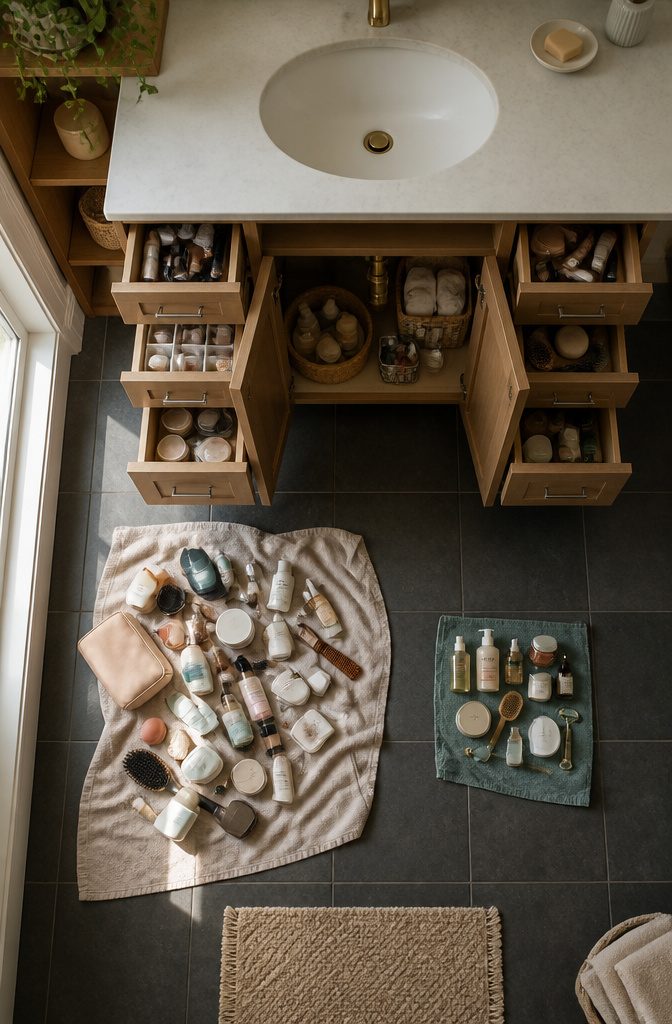
The first time I reorganized my bathroom vanity, I skipped this step entirely. I bought a set of matching acrylic bins, arranged everything neatly, and congratulated myself on a job well done.
Two weeks later the same clutter had migrated back across every surface, because I had organized around the clutter instead of removing it.
Every source that actually works starts the same way: pull everything out. Empty the drawers, the cabinet under the sink, the countertop backlog.
Spread it across a towel on the floor where you can see the full inventory in daylight.
Then sort into three piles. Keep what you use daily.
Toss anything expired, empty, or dried out. Donate unopened products that never matched your skin or your routine.
The six-month rule applies to anything you haven’t reached for since last season: if it sat through a full rotation of your life without getting picked up, it will not suddenly become essential once it has a prettier container.
This sorting step determines every decision after it.
The volume of what remains tells you whether you need one bin or four, whether shelf risers will help or just create more layers to dig through, and whether that back corner is dead space or exactly where the backup toilet paper belongs.
Skip it and you are not organizing. You are only rearranging.

Extended Arms: Door towel rack comes with 7.1 inches extended arms, you can hang your clothes easily without standing on tiptoe. Make sure there is a coin gap in the door for closing before ordering

Easy to Reach: The towel rack measures 15.7"L x 7.1"H x 1.8"D, Fits doors from 1-1/2" to 1-3/4" thick. Comes with 18 cm long hanging arms, you can hang your clothes easily by simply lifting your arms

STURDY DOOR HOOKS The door holder is made of alloy and carbon steel, durable and rust resistant and can hold up to 44 lbs. Great as coat hook, wreath door hanger, towel hook, hat hook, closet hook, cubicle hook, shower organizer, hat organizer, bathroom accessories and more.
2. Corral Daily Items on a Tray
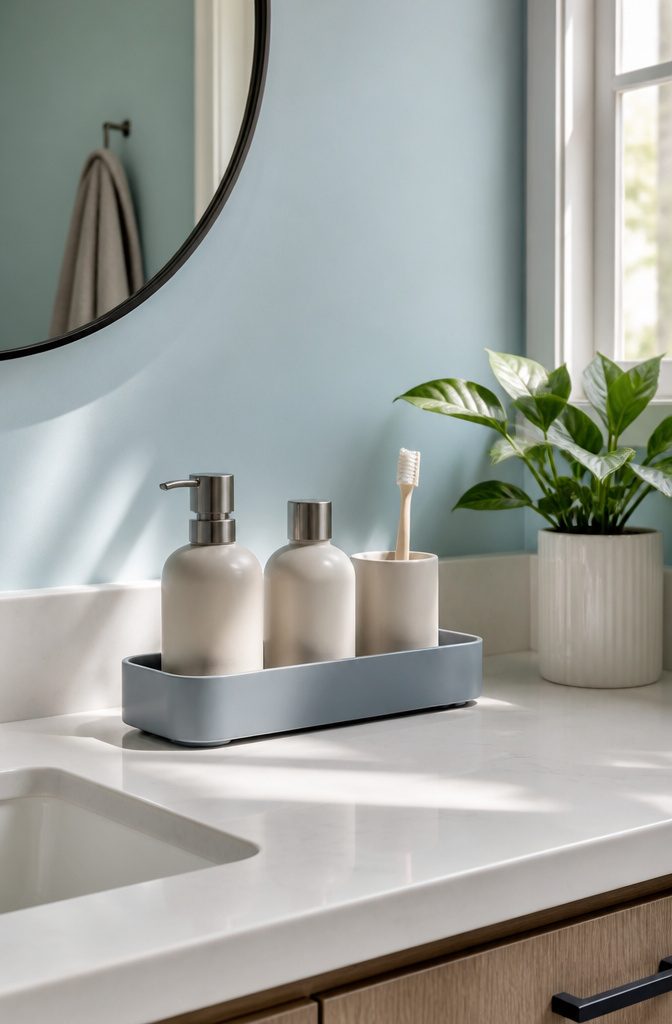
A tray on the bathroom counter keeps frequently used items grouped together, which prevents clutter while keeping soap, lotion, and toothbrushes within easy reach.
The mistake most of us make is buying a tray too large for the available counter space, then watching it swallow the surface it was meant to organize.
Sizing comes first. Measure the usable depth in front of your faucet, then subtract a couple inches for elbow room when you lean in.
The resulting length, not the tray you fell for online, is your hard limit.
Materials matter too: sealed wood, powder-coated metal, or resin survive humidity far better than raw bamboo or wicker, which can warp or mildew in a steamy bathroom.
What belongs here are the three or four products you touch every morning. Everything else, backup toothpaste, that serum you use twice a week, belongs in a drawer or cabinet.
In tiny bathrooms, your eyes and attention can become taxed quickly, so display only the items you use most often, and corral them together for a tidier look.
That last part is the practical takeaway: keep the tray minimal and the daily routine stays calm, not cluttered.

4-Section Separate Storage: 1 top bin and 2 transparent pull-out drawers sort prescriptions, vitamins and emergency care essentials. Store medical records in the top compartment

SMART STORAGE: Keep medicine cabinet clutter under control by neatly organising and storing items in this compact split container; Each box contains eight compartments that are sized to fit vitamins bottles, medication, aspirin, first aid conditions, bandage sauces, diabetic materials and more; These cans can be used in the fridge, which should keep them cool; Includes products, keep them organized and dust-free; Set of 2

Tailored for Bathroom Cabinet Storage Solutions: Each shelf includes adhesive patches for versatile installation on cabinet doors, interior panels, or directly free standing onto cabinet surfaces, optimizing every inch of bathroom cabinet space.
3. Install Floating Shelves Where Walls Are Bare
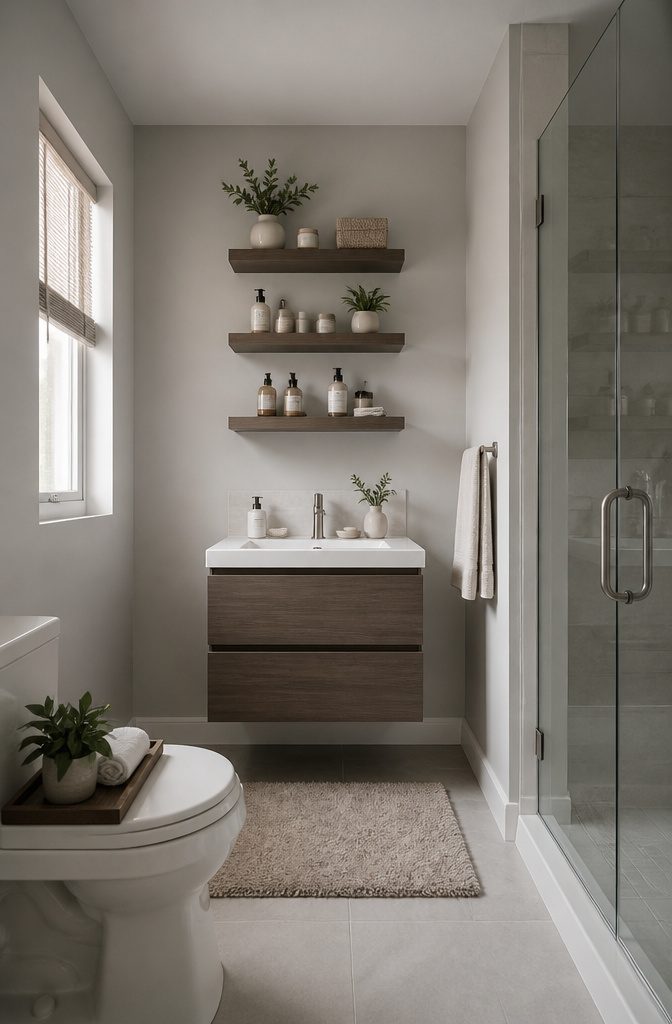
Bare wall space above or beside a small vanity is storage waiting to happen. 6–8 inch depth is the practical maximum for most small bathrooms; anything deeper and you are bumping shoulders or catching hips every morning.
I learned that the hard way after installing a ten-inch shelf that looked right in the aisle but fought me every time I reached for the faucet.
Weight ratings matter more in bathrooms than other rooms because bottles are heavy and humidity softens cheap particle board over time.
Check the bracket spec before you buy, then halve it in your head to account for damp air and the occasional leaning elbow.
The mistake that ruins floating shelves in small bathrooms has nothing to do with the shelf itself. It is mounting straight into drywall without anchors, watching the whole thing tilt slowly forward under its first load of conditioner bottles.
Toggle anchors or a stud hit are the only two honest options; everything else is borrowing trouble you will pay back when the shelf crashes at 6 a.m.

Strong and Durable Adhesive Shelf: Only for tile (non-cracked), glass, mirror, polished metal, stainless steel and acrylic. Do Not apply to grout lines. Not for use on painted/drywall, wood, wallpaper or any other rough/cracked surface. Please install carefully according to the instructions and pictures, if there is any problem during the first installation, you can re-install with a replacement adhesive
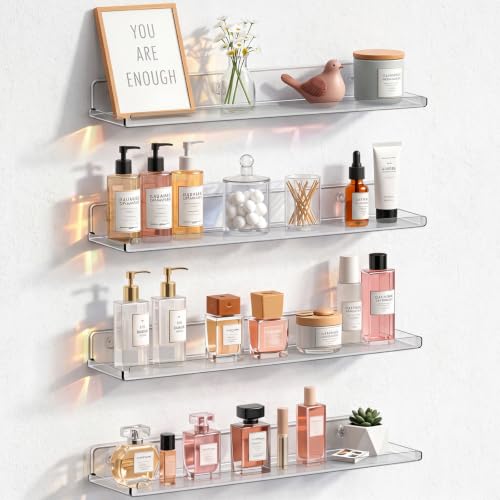
Sturdy & Stable: These floating wall shelves mount securely with expansion screws for a stable hold. Solid plastic material delivers lasting sturdiness, supporting up to 13 lb (6 kg) per shelf. All edges are well-finished for safety and front/side lips keep your essentials secure

Comprehensive Storage Solution: This 6-piece set includes small, medium, and large caddies with a soap dish and toothbrush holder to organize shower essentials. Keep your shampoos, soaps, razors, and more neatly stored in one place for easy access.
4. Use Over-the-Door Storage for Backup Supplies
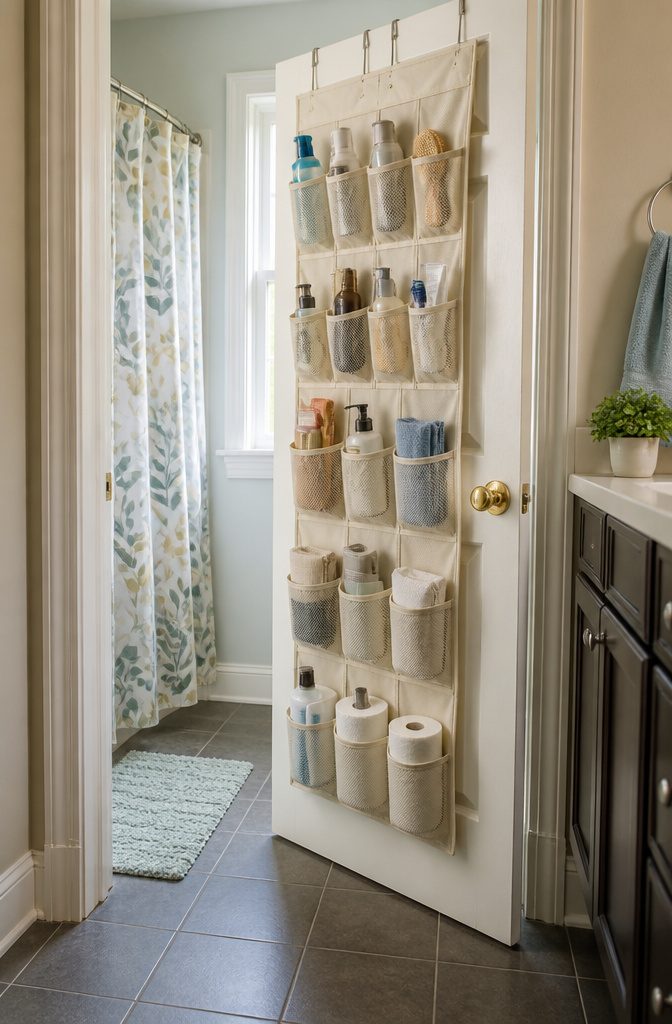
The back of a door is dead space until it isn’t, and most small bathrooms have two of them: the entry door and the cabinet door inside it.
Pocket organizers that hang over the top rail turn either surface into a grid of pouches for backup supplies, the stuff you reach for weekly rather than daily.
I keep backup skincare, spare toothbrushes, and my travel kit in one of these, which frees the vanity itself for the three things I touch every morning.
The difference matters because overloading the door organizer until it bangs against the frame or blocks the cabinet from closing is the mistake that kills the whole system.
A slim organizer with flat pockets holds more than you’d think; a bulky one with rigid shelves turns every open-and-close into a thud.
Hooks work the same way, hung lower for a hair dryer or flat iron, but only if the cord tucks inside the pocket rather than dangling into the door’s swing path.
The Oslo 5-Hook rack, with rounded rubberwood knobs and a padded steel frame, runs about $17 at The Container Store and sits on a standard 1⅜-inch door without hardware, which matters for renters.
The foam backing keeps it from chewing paint, and the smooth knobs have held up in steam without molding or staining.
Two ways to play this: reserve the door for overflow and keep daily items at the vanity, or split the difference with daily tools on the cabinet door and backup supplies on the entry door.
The split wins if you share the bathroom; the single-door setup works only if you live alone and can train yourself not to grab the wrong tier half-awake.

[Multi-Purpose Organizers] Small storage drawers help you to organize everywhere in your home. They can be used as organizers and storage for makeup, bathroom countertop, kitchen or laundry under sink, medicine cabinet, pantry, vanity. You can flexibly use our storage organizer for house organization and storage according to your needs.

【Perfect for Makeup Drawer Storage】Versatile 10pcs drawer organizer can be combined in 9*12 and 9*18 inch drawer in vanity, they are perfect for organizing cosmetics like lipstick, hair accessories, eye shadow, makeup brush, beauty products, jewelry and more, keep your vanity drawer well organized.
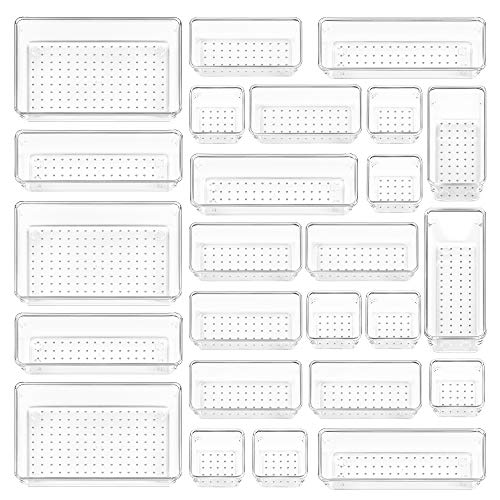
✔Make Everything Organized -- These clear versatile drawer dividers trays are perfect for any place in your home. Fit all kinds of drawers, such as vanity / bathroom / kitchen / office drawers/ craft room, ideal for organizing cosmetics, makeup tools, hair accessories, jewelry, pins, office supply, craft supplies, utensils, etc.
5. Divide Drawers With Adjustable Organizers
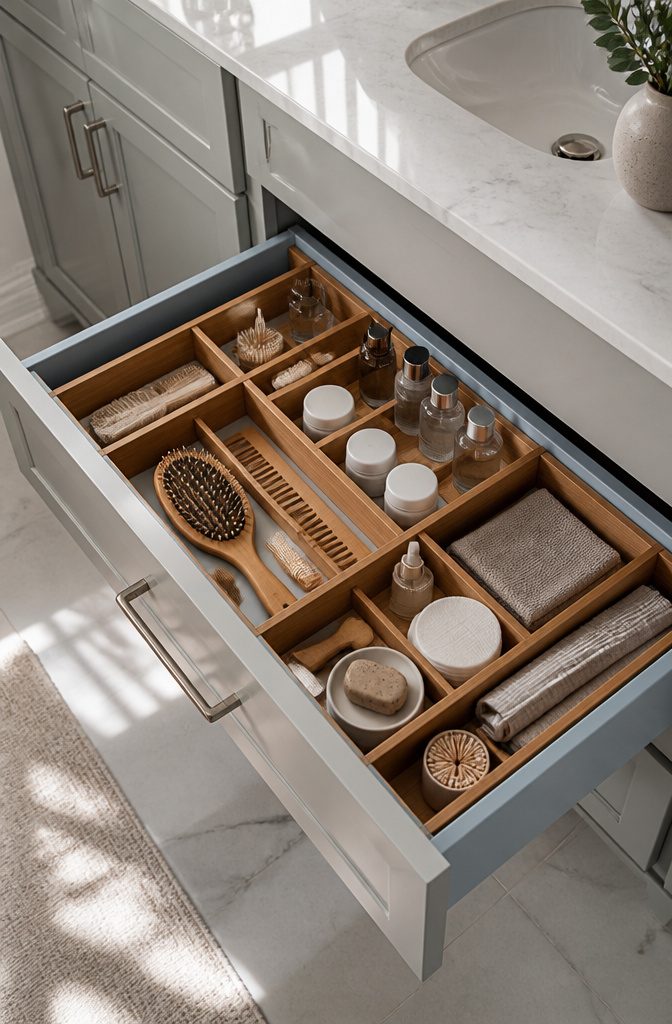
Drawers turn into black holes the second you stop giving every item a fixed address.
The consensus fix is adjustable bamboo dividers, and the ones that keep coming up are the SpaceAid Adjustable Bamboo Drawer Dividers with Inserts and Labels at $26.38.
Fixed bins force you to build your stuff around their dimensions; a spring-loaded bar lets you set the width to whatever you actually own, whether that is a 6-by-6-inch square of hair products or a narrow strip of bobby pins.
The mistake that wastes the purchase is measuring width first and ignoring depth. A divider that is an inch too tall will not close, and one that is too short floats around every time you slam the drawer.
Measure front to back before you order, then expand the bar until it bites the sides without bowing.

Sliding basket for easy access in limit space and stackable design. (Buy 2 sets and stack them together.)

MAXIMIZE CABINET SPACE: Smart stackable design allows you to stack two baskets vertically or use the sturdy top as a shelf to store other items. Perfect for under-sink, pantry, and cabinet organization.

Compact Space Solution: Four under sink bins (13.7"L x 5.4"W x 7.5"H) designed for tight spaces like sink cabinets or narrow shelves. Ideal for vertical storage of spray bottles, kitchen wraps, or bathroom essentials while keeping surfaces clutter-free.
6. Add a Rolling Cart for Flexible Storage
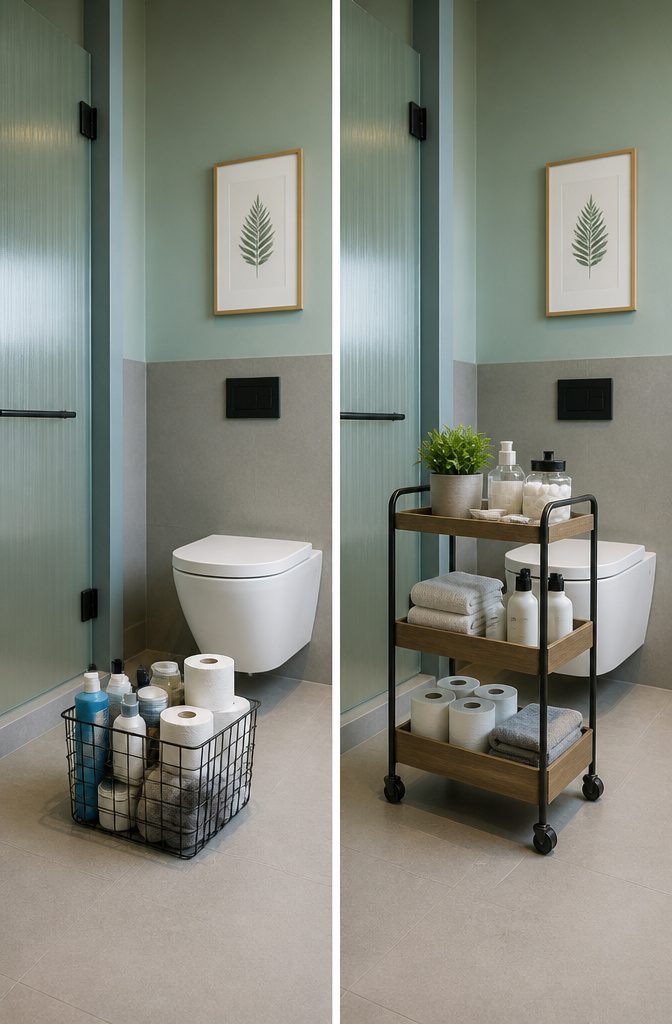
A rolling cart only earns its keep if the gap beside your toilet or vanity is wide enough to let it pass.
The IKEA Råskog Utility Cart, at $30, gives you three 11-by-15-inch epoxy-coated steel trays that drain water well enough for bath toys or damp towels, and the wheels lock so it stays put once you roll it in place.
Assembly runs about 15 minutes, which matters on a Saturday when you still have grout to scrub.
The Yamazaki Rolling Wire Basket, closer to $145, sits at roughly five inches deep and slips into spaces that look too narrow for storage; its powder-coated steel resists rust, though the wood-veneer top can discolor from shower splatter if you wedge it tub-side and forget to wipe it down.
Measure the gap first, then buy. I have watched friends eye the Råskog’s generous depth, only to find it blocks the toilet paper holder or sticks out past the vanity edge.
The Yamazaki’s slim profile solves that, but its wheels are not built for heavy loads and the price stings for something that mostly holds toilet paper and a spare hand-soap refill.
If your space is truly tight, face the open shelf against the wall: you see a clean plane, guests see a place to set a phone, and the clutter hides behind it.

Sturdy Door Hooks: The door rack is made of alloy and carbon steel, durability and rust resistance, strong enough to hold up to 45 lbs. Ideal as a coat hook, towel hook, hat hook, closet hook, cubicle hook and more

Premium Material & Durable: This towel hanger is made of manganese steel by laser cutting integrated molding, which is hard and durable, not easy to break, anti-rust and anti-corrosion. Very easy to care, wipe clean with damp cloth

Over door metal hook with plastic (rubber) coating, hook length 5.5", fits most interior doors thin (0.5") to thick (1 3/8") with fixed 1 3/8" opening (non-adjustable) - excludes wide front doors. Always measure your door thickness before purchase.
7. Stack Bins Under the Sink
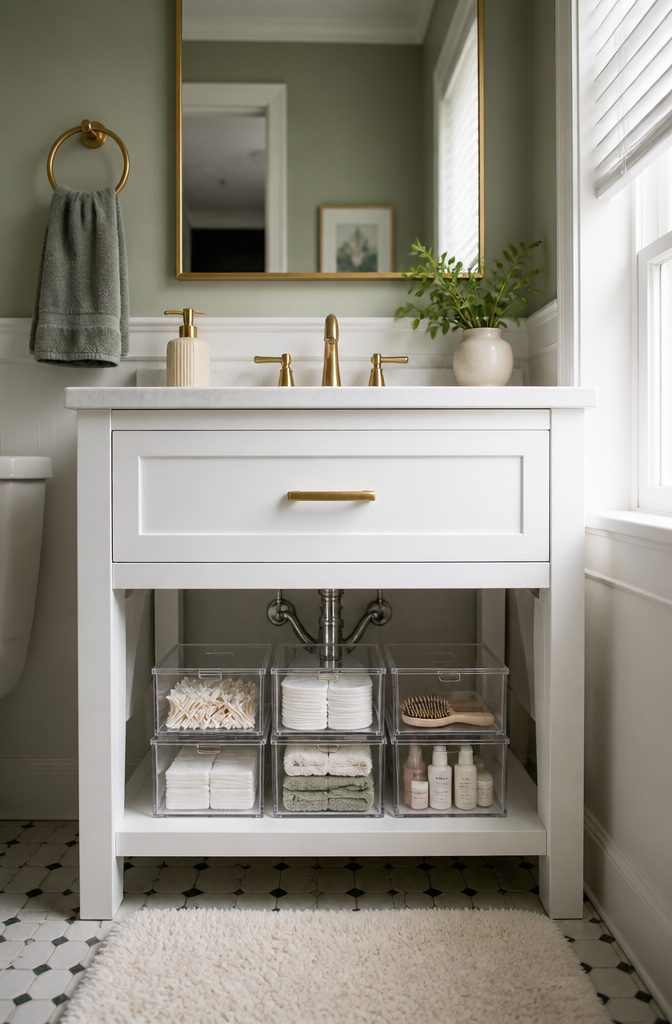
The space under most sinks is a tall empty box with one shelf, if you are lucky, and a tangle of drain pipes that kills half the footprint.
Measure the height from your cabinet floor to the underside of the shelf, then subtract two inches for the bin lip, or you will end up with a stack that wedges against the plumbing and refuses to slide out.
I learned this after buying a set of 12-inch drawers for an 11-inch cavity; the hardware store receipt was the only thing that fit.
A two-tier rack fixes the pipe problem by sidling in front of the drain and splitting the depth into slides.
The one that keeps surfacing in these searches runs $46.99, screws to the cabinet floor if you want stability, and stays put without hardware if you open one drawer at a time.
Plastic bins with sealed lids are the free alternative, but only if your shutoff valves sit high enough and your P-trap sits far enough back to leave a flat rectangle underneath.
Water-resistant storage matters here; hair products and spare makeup can take a splash, but a basket of cotton rounds turns to pulp.
Leave the toilet paper on a wall shelf or in the linen closet, not on the floor where a slow leak goes unnoticed.

Combo Pack: The lipstick case accommodates six lipsticks or slender creams such as lip balm and eyebrow pencils; the mask box effortlessly stores facial masks, stackable vertically, occupying minimal space.

FITS MEDICINE CABINET SHELVES - This iDesign Medicine Cabinet Organizer fits most standard medicine cabinets and features 6 divided compartments for vitamin and pill bottles, first-aid items, skincare, cosmetics, and more

Space Saving Design: Maximize your cabinet space with this versatile organizer that utilizes your cabinet space more efficiently, while the 2-tier clear shelves make it easy to see what you have
8. Hang a Tension Rod for Spray Bottles
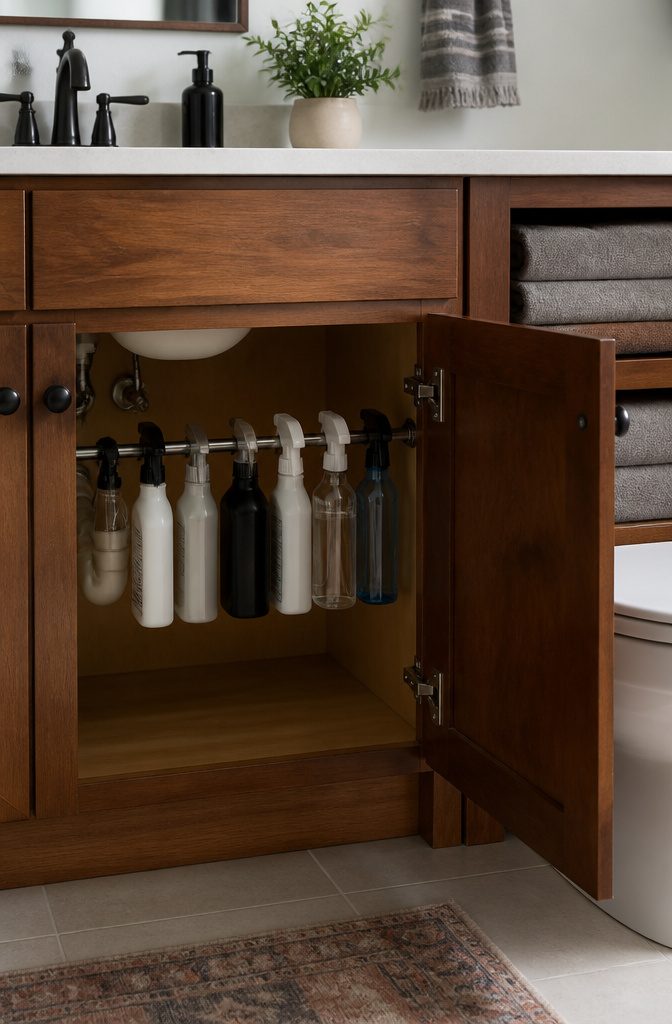
A tension rod wedged across the inside of the cabinet gives spray bottles a place to hang by their triggers, which frees the entire floor for taller items like toilet paper stacks or a small bin.
The trick is sizing it to the full interior width so the rubber or silicone tips press firmly against the sides without bowing the rod itself; a half inch short and it slips every time you reach for the glass cleaner.
I learned that the hard way after a month of finding my bottles in a puddle on the cabinet base.
The rubber tips matter more than the rod finish, since bare metal ends will chew through painted sides in a year of sliding.
Load only what the spring tension can actually hold; three full spray bottles is usually the limit in a standard vanity, and anything beyond that starts the slow weekly loosening that ends with the whole row on the floor again.
Wide compatibility: The internal width of the wall mount is 0.79 inches, and the maximum compatible phone size is 6.5 inches, which fits almost any phone on the market, including iPhone/Samsung/LG/Google Pixel/OnePlus/Motorola or remote control

[Versatility] This acrylic shelf is universally suitable for nearly every daily life places:bedroom,bathroom,toilet,kitchen,living room,RV,office.Good idea to set it at limited small space or at bedside,entryway wall,next to toilet,at side of locker etc. to hold or display phone,watch,cigarette,wallet,keys,reading glasses,little bluetooth speaker,wet wipes,tissues,toilet paper,little toys,toothbrush,toothpaste and more small items.Super multiple purpose!
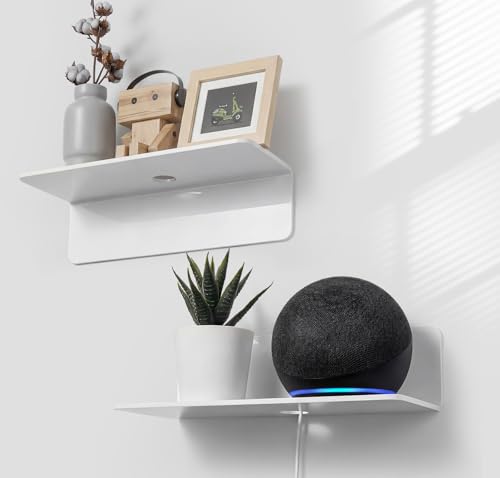
PROFESSIONAL QUALITY: The white floating shelves are made of high-quality acrylic with sturdy double-sided tape that is very reliable to hold up to 8 pounds.
9. Repurpose a Shower Caddy for Countertop Overflow
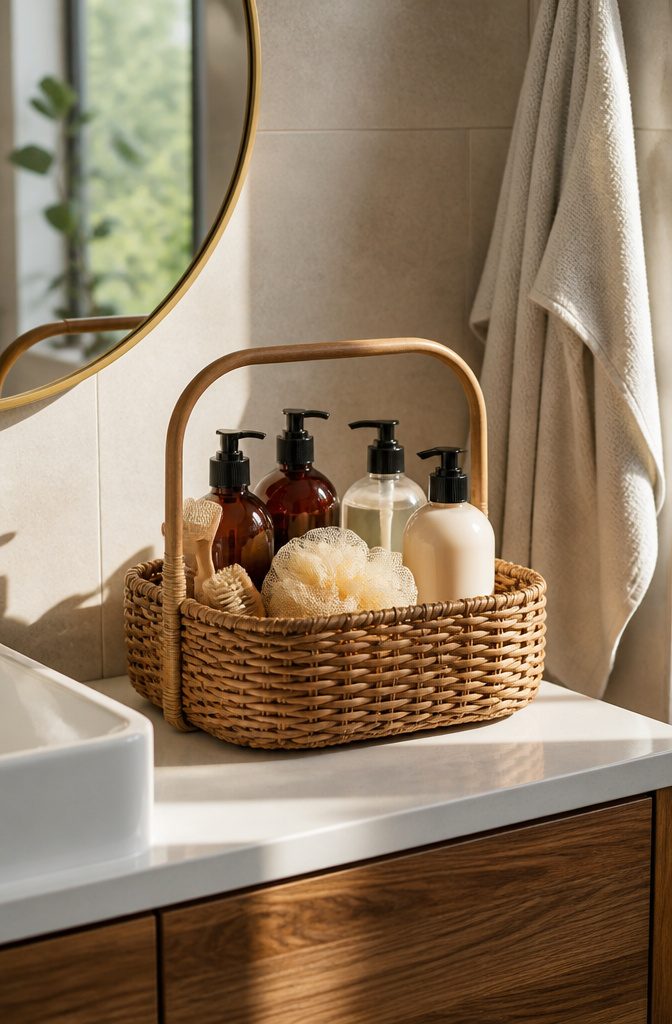
A shower caddy with a handle lands on the counter when the vanity drawer hits capacity and stays there until the project wraps up.
I like the kind with a rigid metal or plastic handle and open tiers, because you can lift the whole unit to the tub edge or the linen closet without unloading it first.
The suction-mounted caddies are built for wet tile and nothing else. Painted walls release them in a day, and tile with failing grout lets the suction cup seal to dust instead of stone.
I learned that the hard way in a rental where the caddy hit the tub at 2 a.m. and took a bottle of conditioner with it.
The handle version costs about the same, asks for zero installation, and moves where the morning demands it.

Premium Material:The drawer organizer is made of non-toxic plastic which may be safely used. The transparent design makes it easy to find what you need quickly

【LARGER SIZES】With 3 different sizes, our 6 pack clear drawer organizers could hold more gadgets, large and long enough to hold kitchen utensils, silverware, household tools and more. Includes: XL-12x6x2 inches(2pcs), L-9x6x2 inches(2pcs), M-6x3x2 inches(2pcs), Non-slip silicone pads(24pcs).

Stackable Storage Bins-- The top of the drawer has groove design ensures stacking. Use these stackable drawers to save space, which is also keep organized.
10. Recess a Medicine Cabinet for Hidden Depth
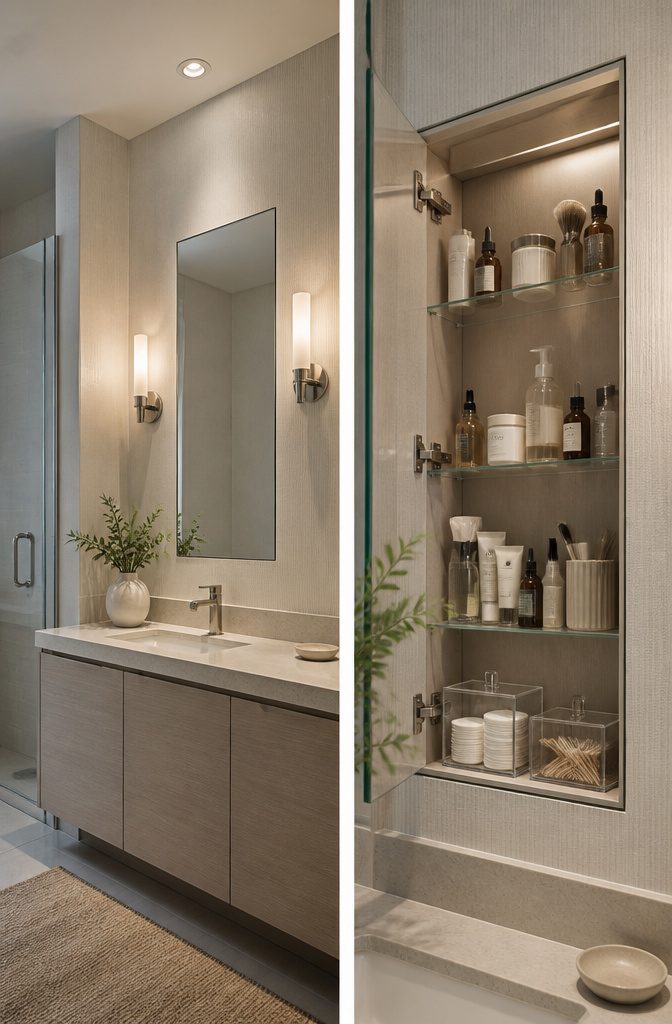
The mirror above your small bathroom vanity is probably doing nothing but reflecting. Swapping it for a recessed medicine cabinet buys you four or more inches of hidden depth where the wall cavity sits empty anyway.
Surface-mount cabinets hang like any mirror and work when you cannot cut into tile or a shared wall. Recessed versions sit flush with the wall plane, so the room reads the same size while the storage disappears.
I have seen the mistake of assuming all medicine cabinets are shallow. Some hold four inches of depth or more, enough for stacked skincare bottles, a toothbrush charger, or a spare razor stash.
The difference between a 2-inch ledge and a 4-inch box is the difference between a cramped tilt and actual organization.
Installation runs simpler than most renters guess, though a recessed unit needs a stud bay free of wiring. If you are mid-project and the wall is open, that is the moment to choose recessed.
If the bathroom is finished and you need storage this weekend, a flush-mount surface cabinet still beats a mirror with no back.

Smooth Sliding Basket: Features a spacious pull-out drawer with a handle opening and a wheel-guided rail system for effortless sliding and convenience
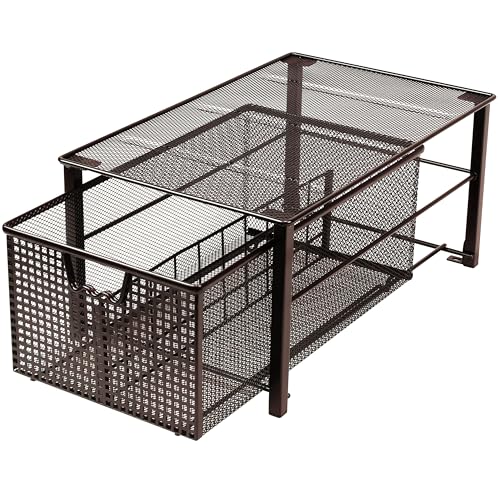
MAXIMIZE CABINET SPACE: Smart stackable design allows you to stack two baskets vertically or use the sturdy top as a shelf to store other items. Perfect for under-sink, pantry, and cabinet organization.

Sliding Drawer Organizer - With two sliding storage drawers, you can put even small or loose items in the drawers without fear of losing them to under sink chaos. It has a two-tier design that makes it super easy to organize and access, and offers plenty of space for your soaps, sponges, and dishwasher detergents
11. Maximize the Under-Sink Footprint
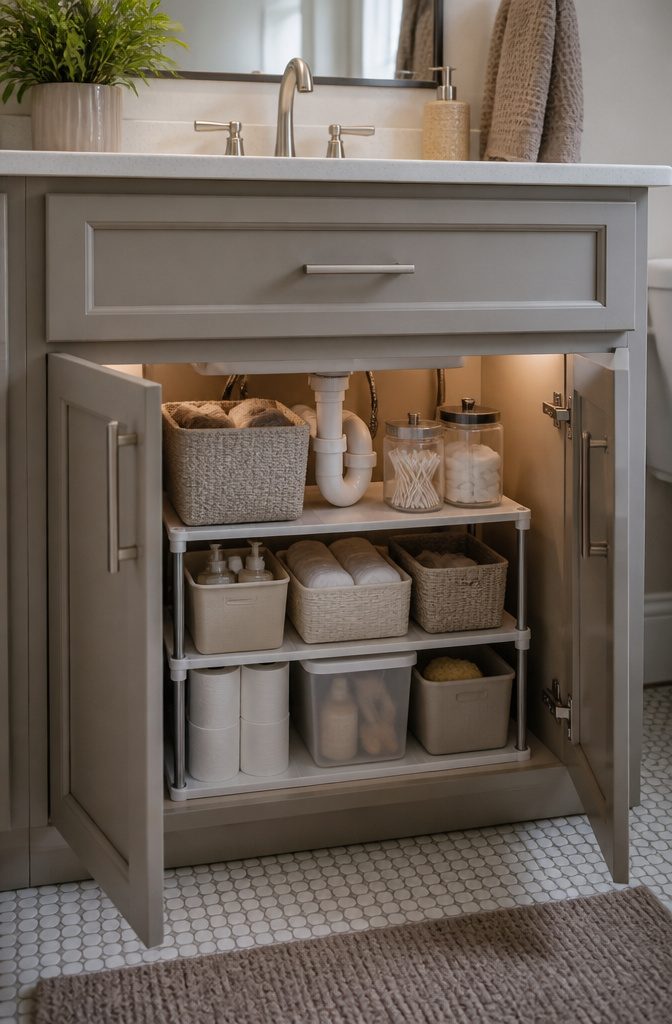
The cabinet under a small vanity usually looks like a cavern until you try to fit anything in it.
The P-trap and supply lines sit dead center, and a full-width rack, the kind that looks perfect in the store photo, will not slide past the plumbing.
I learned that the hard way with a wire shelf that arrived promising to double my space and instead blocked the shutoff valves entirely.
What works is tiered storage shallow enough to sit in front of the pipes rather than spanning across them. A two-tier organizer with pull-out drawers keeps the lower half usable without requiring clearance behind the trap.
Stackable plastic drawers with sealing lids protect contents from the drips that happen, and door-mounted organizers, repurposed shower caddies or adhesive hooks, grab the back of the cabinet door for brushes and small bottles.
Leave the center open. The shutoff valves need to be reachable in an emergency, and a leak will ruin anything stored directly underneath.
Water-resistant bins are non-negotiable here; paper products belong somewhere else entirely.
12. Stash Bulk Items in Decorative Baskets
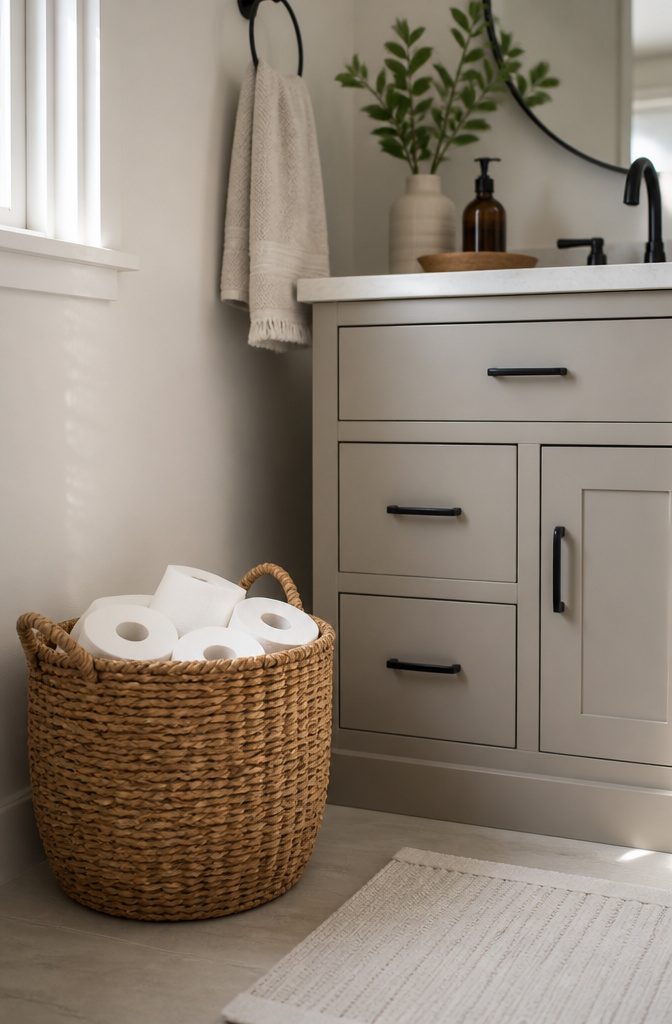
A basket stuffed with toilet paper rolls on the floor beside the vanity keeps backups from colonizing the medicine cabinet.
Open-weave seagrass or wire makes it easy to see when stock is running low; lidded rattan hides backup shampoo bottles from sightlines, which matters in a bathroom the size of a closet.
The trouble comes when a basket is sized for the shelf footprint but not the contents. A ten-inch square footprint sounds right until the rolls stack too high and the whole thing bulges like a grocery sack.
Handles on both sides are non-negotiable. A full basket of liquid soap refills and paper packs weighs more than it looks, and a handleless cylinder becomes a permanent installation once it settles.
I have watched someone try to drag a loaded felt bin by the rim, then leave it there for two years rather than empty it.
Floor baskets should clear the door swing by a few inches; shelf baskets need to slide out without dislodging what sits above. Measure the height first, then the width.
13. Lean a Towel Ladder Against the Wall
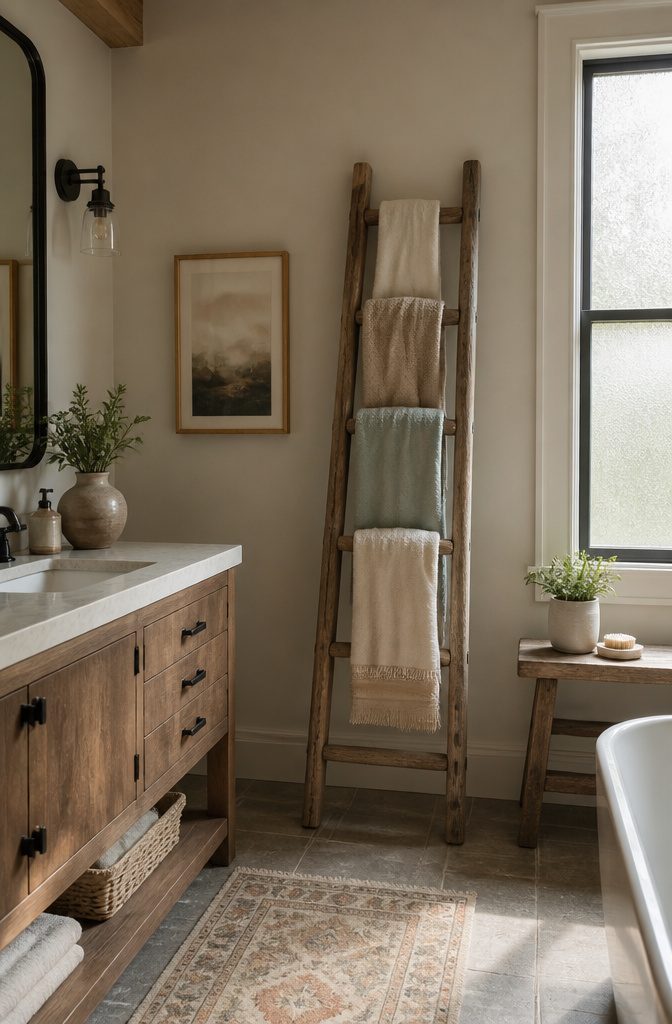
A freestanding towel ladder buys back wall space without a single hole drilled. Most run about a foot deep at the base and sit flat against drywall, which matters in a powder room where every inch of floor counts.
Rung spacing is where the decision gets interesting: tight gaps, roughly six to eight inches apart, grip hand towels without letting them bunch into a damp wad, but bath towels need more vertical room to breathe and dry.
I have seen ladders with mixed spacing, wider at the bottom for body towels and narrower up top, and that split approach works better than uniform spacing if you use both sizes daily.
The real mistake is placement for looks instead of movement. A ladder angling across the door swing or blocking the vanity drawer from sliding open turns into an obstacle you sidestep for six months before finally moving it.
Leave at least the door’s full arc of clearance plus the drawer’s extension length when you test the spot.
If the only wall that works is behind the entry door, the ladder becomes a towel rack for guests and a coat hook in practice, which is fine if you are honest about it before you buy.
14. Store Toilet Paper in Plain Sight
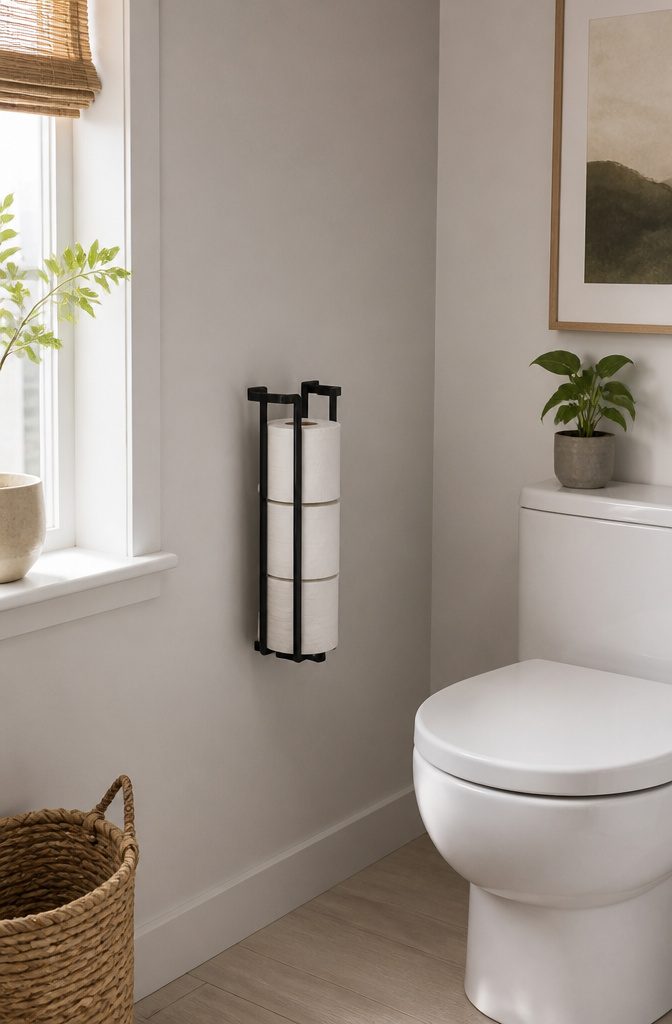
Extra toilet paper does not have to hide under the sink. A wall-mounted holder beside the toilet keeps rolls within arm’s reach and turns them into a vertical column that reads as intentional, not desperate.
I prefer the slim metal ones that hold three or four rolls; anything taller starts to feel like a pantry shelf in a space that is not one.
A narrow tower on the floor works when the wall is tiled and drilling is not an option.
Those slim CD racks from the nineties fit the gap between toilet and wall almost exactly, four to six rolls deep, with a footprint so small you forget it is there.
Woven baskets on the tank lid or the floor beside it soften the same function into something that looks like decor first, storage second.
The mistake that wastes all of this is placing the backup too far from the toilet to matter. If a guest has to cross the room to grab a roll, the storage has failed its only purpose.
Keep the display within easy reach from a seated position, or accept that you are storing decor, not toilet paper.
15. Mount a Pegboard for Flexible Hanging
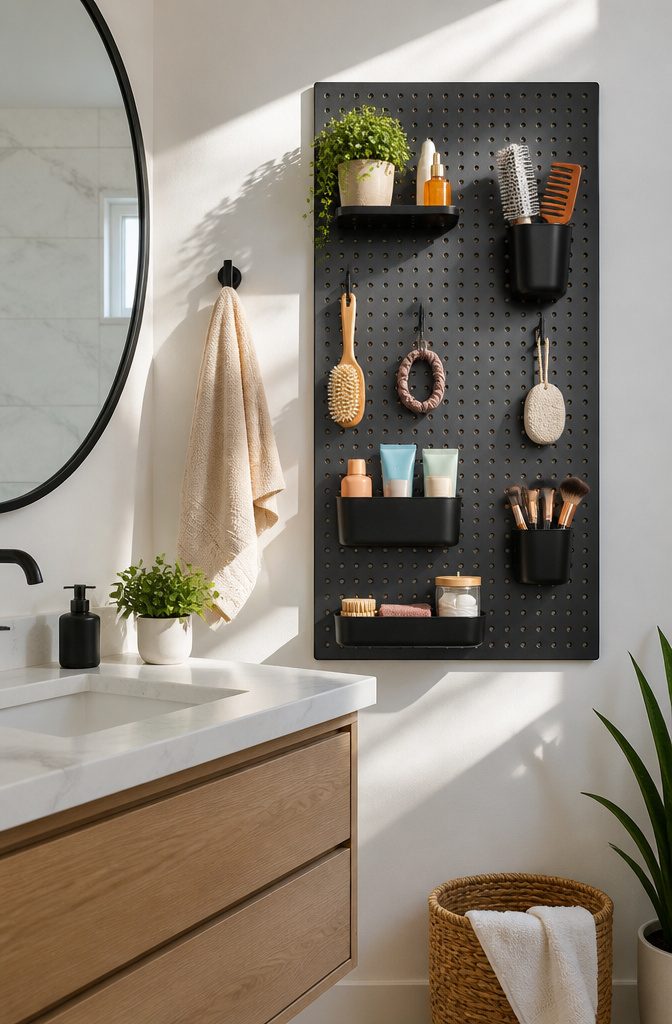
Standard pegboard swells in bathroom humidity, so the hardboard version from the hardware store will warp off the wall within a season.
For a bath that actually sees steam, a metal or moisture-resistant composite board holds its shape, and the powder-coated finish on most metal panels keeps rust at bay for years.
Inside a cabinet door, pegboard turns the dead zone behind your toiletries into a grid for hooks and small bins. The same system works on any wall section too narrow for shelves, like the six-inch strip beside a pedestal sink.
Match the hook to the load: a standard J-hook carries a dry brush or headband, while a locking peg hook rated for heavier items keeps a full hairdryer from dropping every time the door shuts.
The Singapore apartment that made this trick famous ran a full pegboard wall in 500 square feet, proving the system scales down as neatly as it scales up.
16. Keep a Catch-All Basket for Speed Cleaning
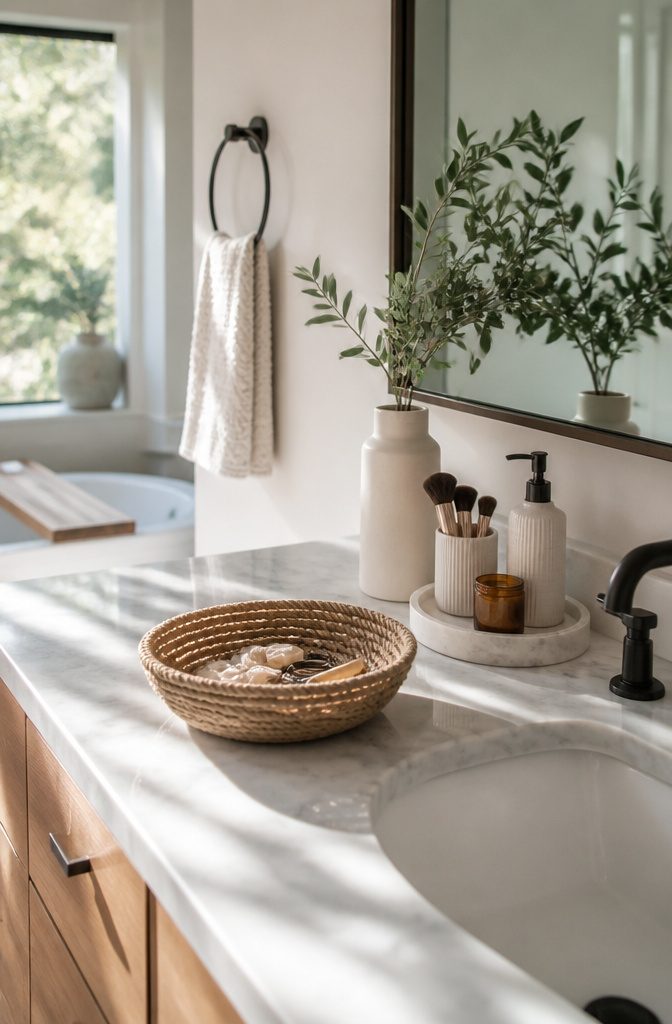
A catch-all basket on the vanity top gives the nightly sweep somewhere to land. Hair ties, contact cases, the random lip balm that migrates out of the drawer: one motion, basket full, counter clear.
The size matters more than the style. Too small and it overflows by Tuesday; too large and it becomes its own surface, another thing to work around.
Mine sits behind the faucet where the backsplash meets the counter, low enough that the mirror still clears it.
The real discipline is the weekly emptying, not the nightly sweeping. Saturday morning, the basket goes back to zero.
Everything either returns to its proper drawer or gets used up and thrown out. Skip two weekends and the catch-all stops being temporary storage.
It becomes the permanent home for everything, which defeats the point entirely. That basket is the most honest measure of whether your vanity organization is actually working.
17. Hang Wall-Mounted Baskets for Elevated Storage
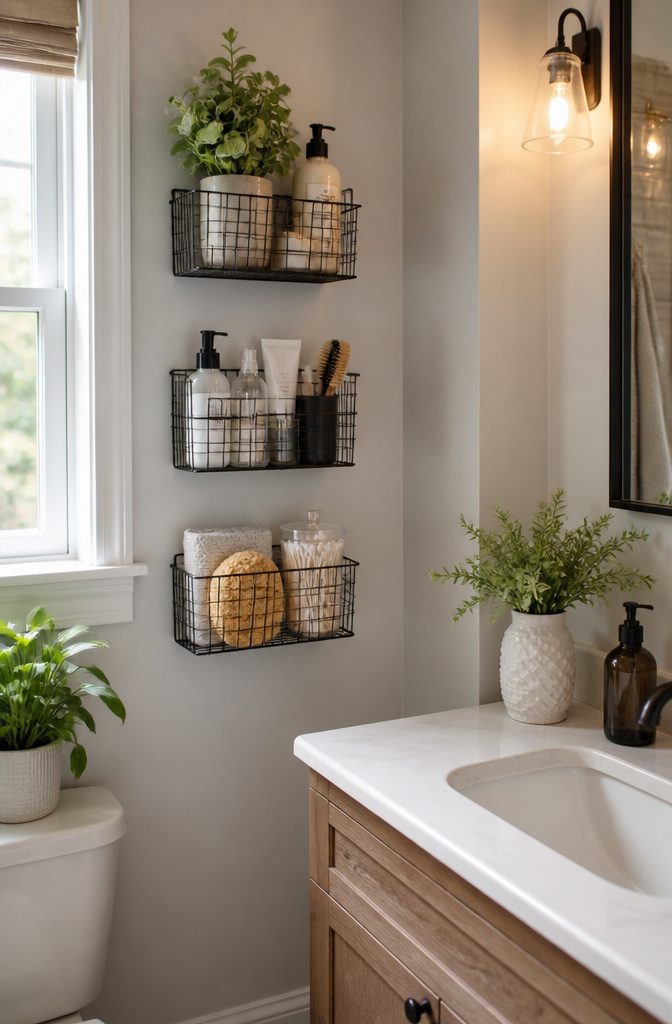
Wall-mounted baskets read as airy storage, but the hardware choice decides whether they stay up.
Tile backing demands a diamond-tipped bit and a sleeve anchor rated for the load; drywall alone needs a toggle bolt that grips the cavity, not a plastic anchor that pulls through the moment a full bottle lands inside.
I learned that second distinction the hard way in a rental where patching meant losing the deposit.
The basket depth matters as much as the mount. Shallow wire or seagrass versions look tidy until you load them with cylindrical bottles, shampoo or body wash, which roll and shift the center of gravity outward.
The basket tips. Everything spills.
A depth of at least four inches, with a flat base rather than a tapered one, keeps bottles upright and the mount from torqueing loose.
Weight limits printed on the hardware package assume a vertical pull, not the lever action of a front-loaded basket, so I treat the stated number as half its value.
18. Install Hooks for Towels and Robes
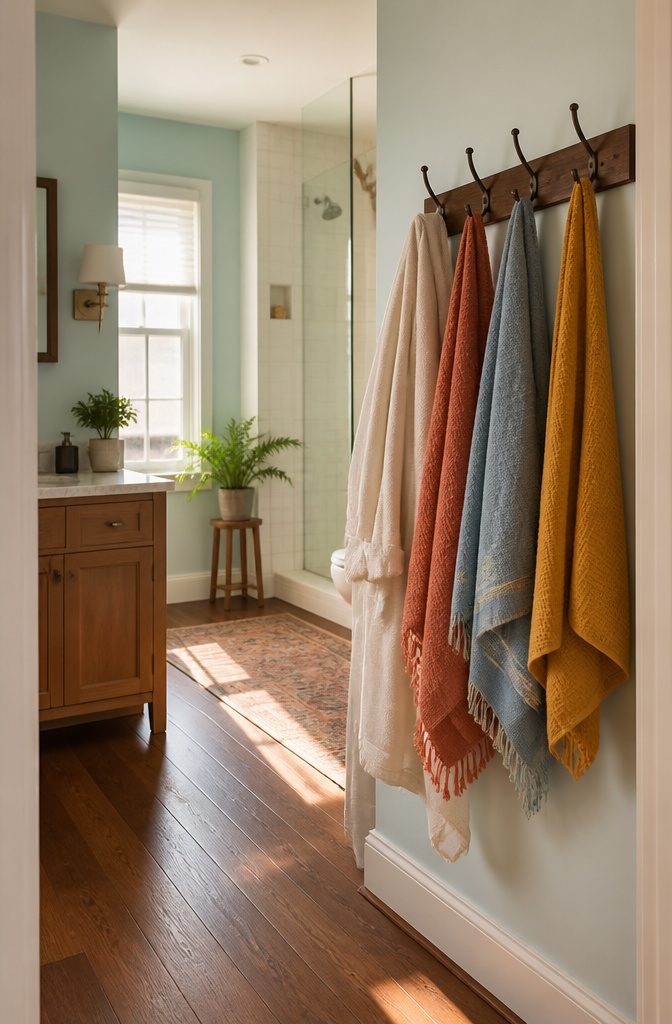
A towel bar on the back of a small bathroom door is a daily wrestling match.
Hooks win because they let a wet towel fall open and actually dry by morning, something I doubted until I saw it work in my own house.
The real gain is speed: a hook catches a towel in one motion, where a bar demands threading and straightening, so towels end up on the floor less often.
Placement matters more than the hardware itself. For adults, 48 inches from the floor keeps a bath towel off the vanity edge without dragging.
In a shared bath, two hooks spaced 8 to 10 inches apart stop the damp-towel handshake that happens with a single hook and two rushed users.
The mistake I see repeated is installing one decorative hook where a double or triple would serve the household. A single hook looks tidy in a photo and fails by Tuesday.
Pre-assembled hook racks save the measuring, or a simple trim piece mounted to the wall gives you a clean line to space your own.
For tight clearances, hooks that extend only about 2 inches from the wall keep the door swing free and work in the narrow gaps where a bar would collide with trim.
19. Spin Products on a Lazy Susan
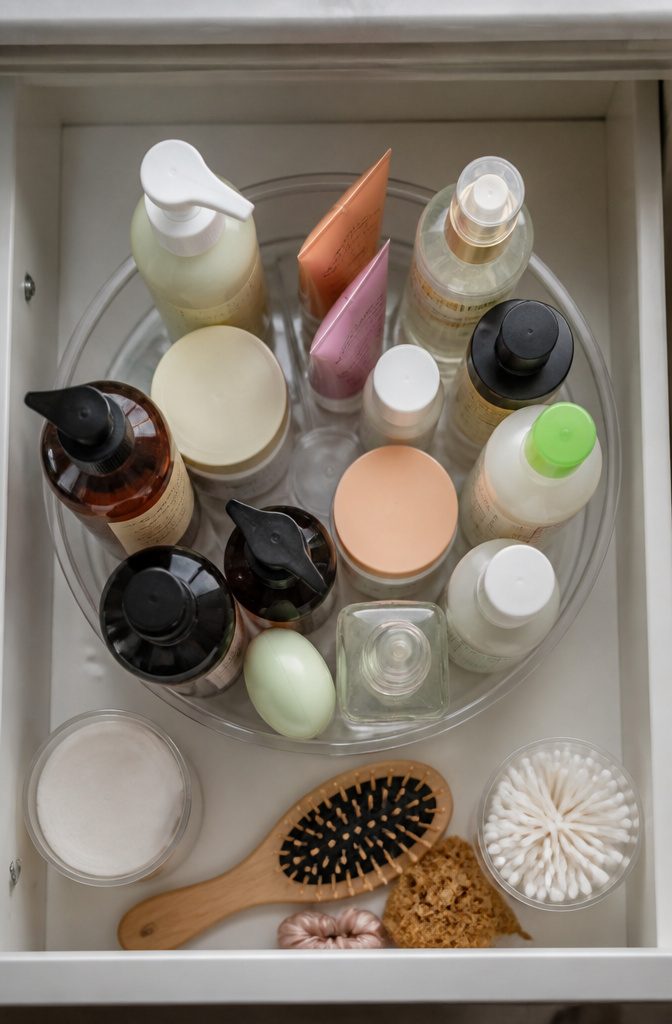
Deep cabinets under a small vanity swallow bottles whole. A Lazy Susan brings the back corner forward without rebuilding the shelf.
Diameter is where most buyers trip. In a vanity base under 24 inches, a 10-inch turntable leaves room to spin; a 12-inch often scrapes the plumbing and jams.
The lip matters just as much. A half-inch raised edge stops a serum bottle from tipping when the spin carries a little momentum.
I made the mistake of buying one that filled the cabinet floor almost to the walls. It looked efficient on the shelf at the store.
Installed, the rotation needed two inches of clear sweep it did not have, so it knocked against pipes and only turned forty degrees. That version lived under the kitchen sink instead, where the cavity is wider.
For the bathroom, I swapped down one size and gained full rotation. The lost surface area was nothing against reaching every item with a quarter turn.
20. Move Kitchen Organizers to the Bathroom
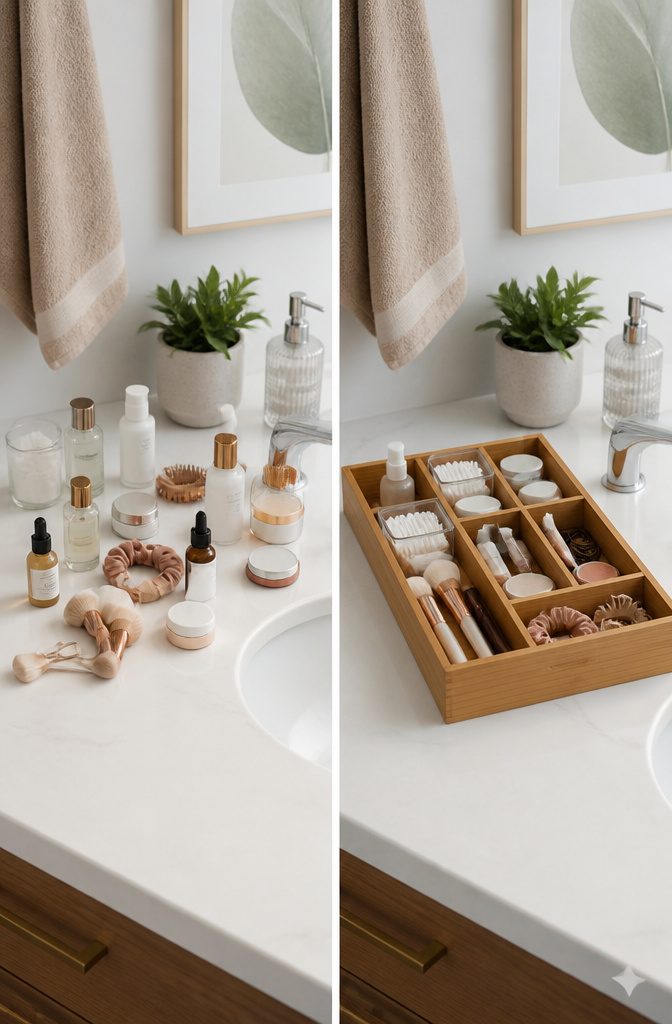
Kitchen organizers often transfer to a bathroom vanity better than you’d expect, but the fit is never guaranteed.
A silverware tray with its long, narrow slots lines up neatly with toothbrush tubes and floss picks, and the shallow 2-inch depth of something like the iDesign Linus organizers slips into most bathroom drawers without fighting the slide.
Spice racks work too, mounted on the wall beside the mirror for daily makeup or skincare, though the jars they were built for sit deeper than most serum bottles and can waste the back inch of space.
Cabinet door racks are where the measuring tape saves you.
Kitchen cabinets run deeper than bathroom vanities, and a rack that cradles a full-size olive oil bottle will jut past a smaller door or block the drawer behind it from closing.
I have made this mistake: the rack looked right in the store aisle, then needed new holes drilled an inch higher to clear the plumbing.
Measure the interior depth and the door swing before you buy, not after you’ve peeled the backing off the adhesive strips.
Suction-cup sponge holders from the kitchen aisle also adapt well to backsplash tile or mirror edges for the items that vanish into drawers and expire before you find them again.
Frequently Asked Questions
How can I maximize storage in a small bathroom?
Install floating shelves on bare walls and use over-the-door organizers for backup supplies to claim vertical space without eating floor area.
A rolling cart beside the toilet or vanity adds flexible storage if the gap is wide enough, while a tension rod inside the cabinet lets spray bottles hang and frees the floor for taller items.
Under the sink, tiered pull-out drawers sidestep plumbing and split the depth into usable slides.
What products are best for organizing bathroom drawers?
Spring-loaded bamboo dividers are the most practical choice because you can set the width to fit specific items rather than building around fixed bin dimensions.
The SpaceAid set with inserts and labels costs around $26 and handles everything from bulky hair-product squares to thin bobby-pin strips.
Measure front-to-back depth before buying; a divider that is too tall keeps the drawer from closing, and one too short drifts every time the drawer slams.