
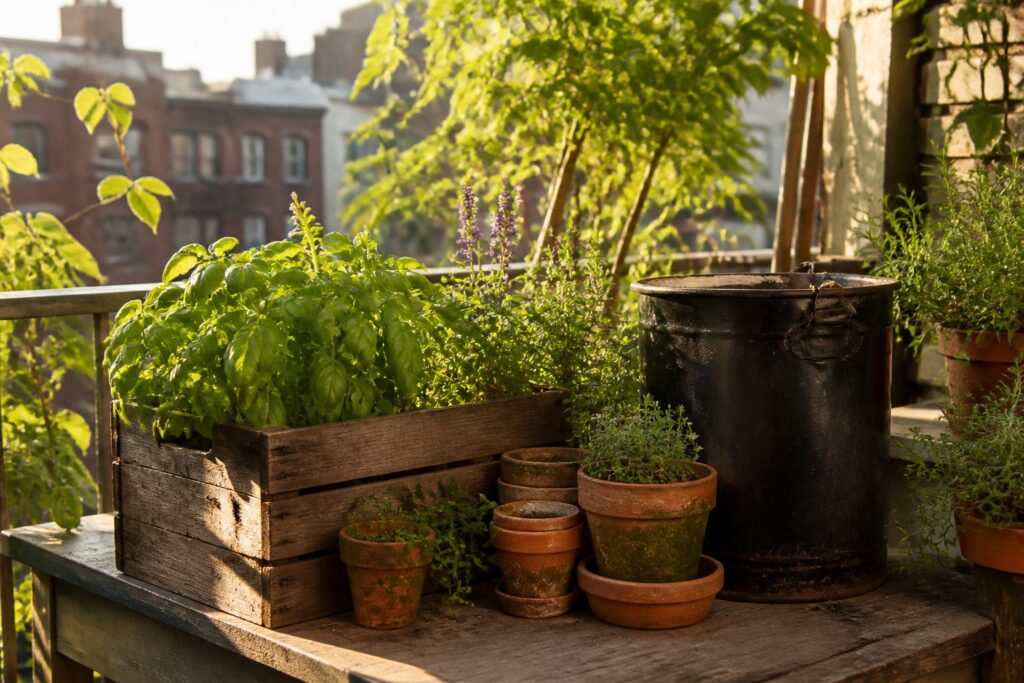
A small herb garden can live in six inches of soil or stretch across a wall, and the right choice depends on one thing: how many hours of direct sun your space actually gets.
Most herbs need 4 to 6 hours, but a balcony that looks bright at 9 a.m. can fall into shadow by noon once the neighbor’s tree fills out.
That measurement, not the size of your footprint, is what separates a thriving container of basil and thyme from a leggy disappointment.
1. Container Herb Gardens
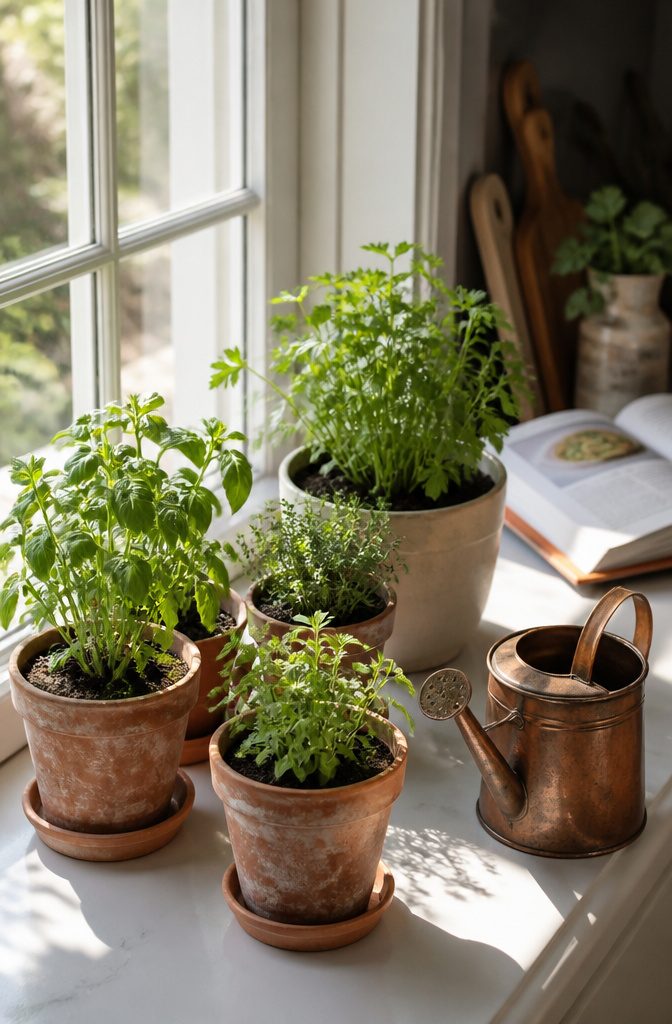
A container gives you the one thing a small space usually lacks: control.
Six inches of soil depth handles most herbs just fine, and that shallow profile fits on a windowsill, a balcony railing, or the one sunny corner of a patio.
Basil, thyme, oregano, and the rest of the mint family stay shallow-rooted and will grow happily in those six inches.
Parsley is the exception that proves the rule, along with cilantro and dill. Their taproots need a full 12 inches to reach down without curling back on themselves and stunting the plant.
Width matters too.
A foot across lets you group several herbs without crowding, and spacing plants 8–12 inches apart keeps air moving between leaves, which matters more for preventing mildew than most beginners realize. The real advantage of pots, though, is mobility.
You can roll or carry a container to follow the sun as the season shifts, and you can separate thirsty herbs like basil and parsley from drought-preferring rosemary and thyme instead of forcing them into the same bed.
Mint gets its own pot, always. In open ground it spreads fast enough to become a problem; in a container it stays where you put it.
2. Vertical Gardens
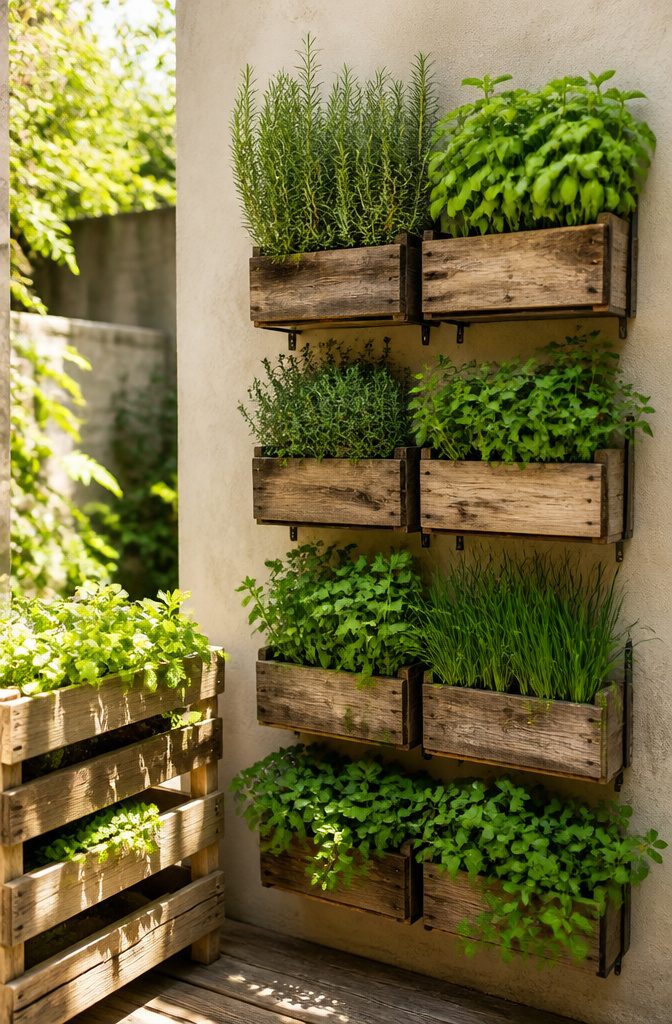
Growing herbs upward turns a narrow slice of wall or a tight corner into productive space that flat ground never could.
Wall-mounted planters, tiered stands, and pallet gardens each handle the job differently, and the choice between them comes down to how much sun your spot actually gets.
Most herbs need 4–6 hours of sunlight to produce worth harvesting. On a vertical setup, that requirement becomes the design problem: the top level hogs the light while lower tiers sit in shadow.
A three or four-tiered stand solves this by letting you sort herbs by appetite. Rosemary and basil, the sun-worshippers, ride the top where exposure is longest.
Parsley and mint tolerate less and stay productive on the lower shelves. Wall-mounted pocket planters or a repurposed wood pallet work the same way if you stage them so nothing sits fully behind something else.
Compact growers fit this vertical life better than sprawlers. Thyme, oregano, and chives stay small in shallow pockets of soil.
Basil and parsley also behave well enough if the planter depth holds their roots. I skip the idea of deep-rooted or heavy-stemmed herbs in a wall system; the weight and soil volume defeat the purpose of saving space.
PVC pipe gardens and fabric pocket systems get mentioned often, and they do squeeze herbs into a narrow footprint against a fence.
For a renter, though, a standalone tiered stand wins: it moves with you and needs no drilling into someone else’s siding.
3. Raised Bed Gardens
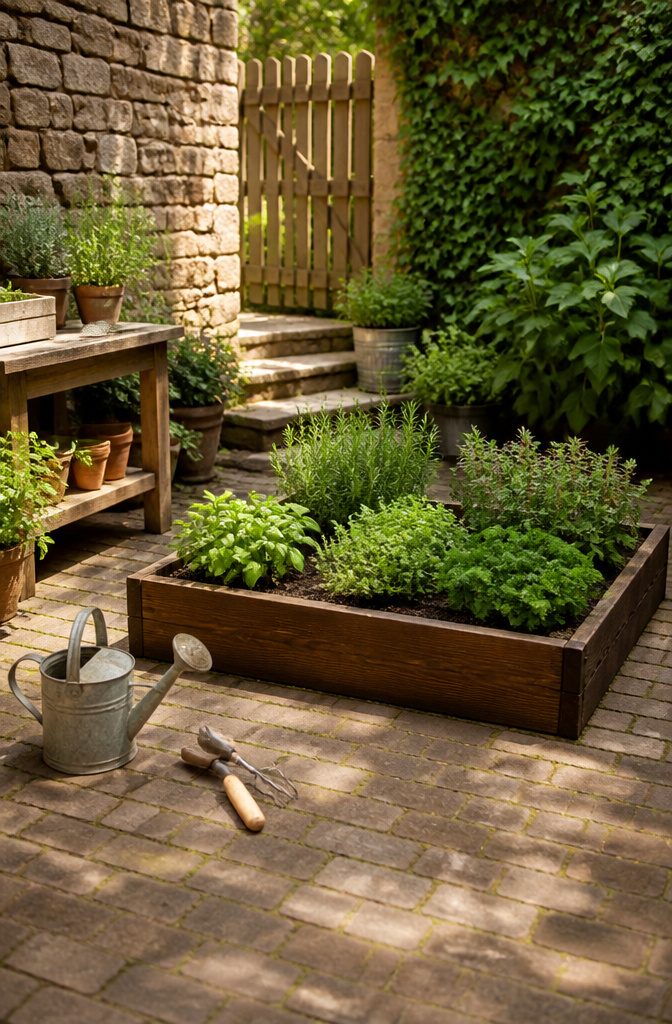
Raised beds give a small herb garden the structure that keeps it from sliding into weedy chaos. The walls corral the planting area, and the height makes every plant easier to reach without stepping on the soil.
A footprint of about 12 square feet is enough to separate herbs by their watering needs, which matters more than most people realize: rosemary and thyme want dry feet, while basil and parsley drink deeper.
Putting them in different beds ends the compromise that kills half your crop.
The soil mix is where the work pays off. Equal parts topsoil, compost, and coarse sand, the kind sold as paver sand in the construction aisle, gives Mediterranean herbs the drainage they evolved for.
The result is light soil with enough organic matter to feed the plants and enough grit to let water pass through fast.
That drainage is not automatic, though. A raised bed without exit holes or with a false bottom that traps water will still rot roots.
The walls lift the planting zone, but gravity still needs somewhere to send the excess. Build in a way out, or you have built a bathtub.
4. Herb Spiral Gardens
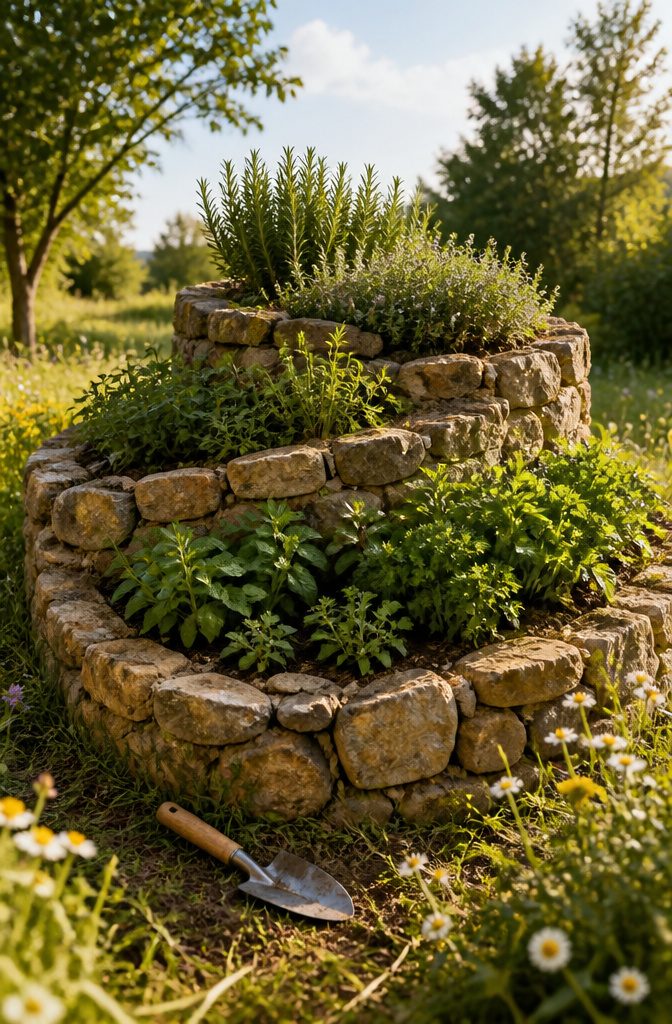
A herb spiral builds a whole garden into about six feet of ground by stacking stone or brick into a rising coil.
The top dries out fastest and catches the most sun, while the bottom stays damper and shaded where the water settles. That slope creates microclimates without any moving parts.
Plant rosemary and thyme at the peak; both are Mediterranean herbs that want full sun and sharp drainage.
Parsley and mint belong at the base, where the soil holds more moisture and the taller wall blocks some afternoon light. One spiral handles herbs that would otherwise need separate beds or containers.
For a weekend build, dry-stack fieldstone or reclaimed brick without mortar. The wall holds itself if you angle each course slightly inward, and you can adjust height as you go.
A three-foot rise over two full turns is enough to feel the difference between top and bottom, though even two feet still separates the wet-loving from the drought-tolerant.
What you give up is access: harvesting from the center means reaching over the wall, so keep the spiral no wider than you can comfortably lean across.
Mine would stop at about four feet across, which still gives twelve to fifteen linear feet of planting edge in a footprint most patios can spare.
5. Herb Pathways
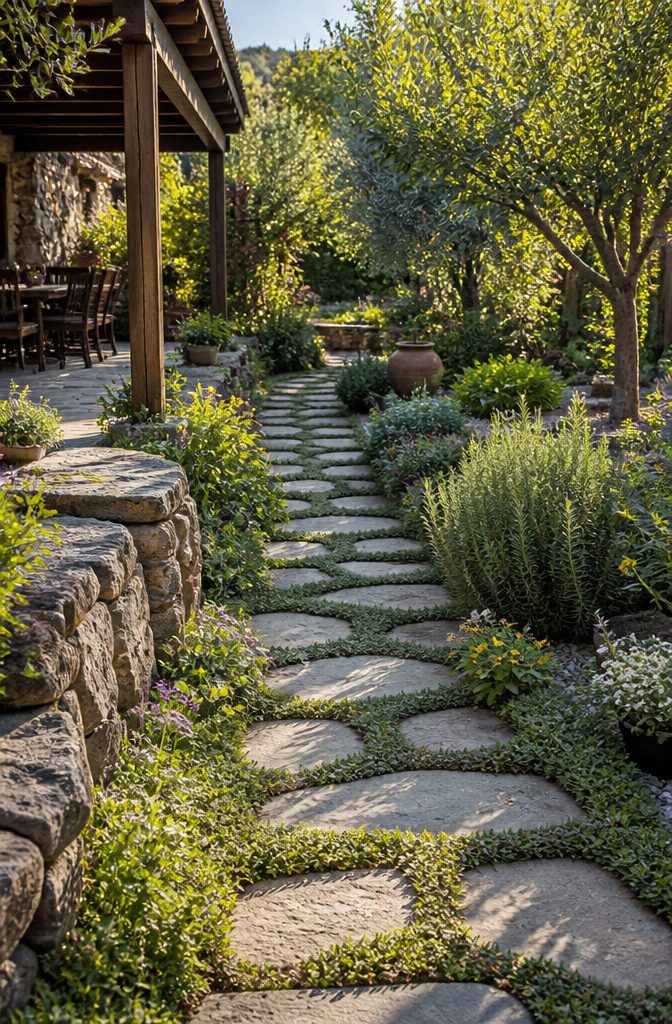
The space between pavers is mostly wasted ground unless you plant something that tolerates the odd footfall.
Thyme works here because it stays low, spreads to fill gaps, and releases its scent when crushed. Hardy herbs like this yield from ground that would otherwise sit bare.
A path lined with rosemary, lemon balm, or mint gives you something more: fragrance as you brush past.
The practical side is that you harvest without making a separate trip. Snip a few leaves on your way to the grill or back door.
Two ways to play this. One is the crack-and-crevice planting between stones, which demands tough ground cover and occasional stepping tolerance.
The other is a soft border alongside the path, where taller herbs can arch without risk. The border wins if you want aromatic herbs you brush against while walking, since no one needs to watch their step.
The stepping-stone method is better for squeezing yield from tight quarters, though you may need to block guests from wandering off the stones. I’ve seen mint recover from a misplaced boot; rosemary, less so.
Scent here is not decoration. It is the design element that makes a functional path feel like a garden.
6. Themed Herb Gardens
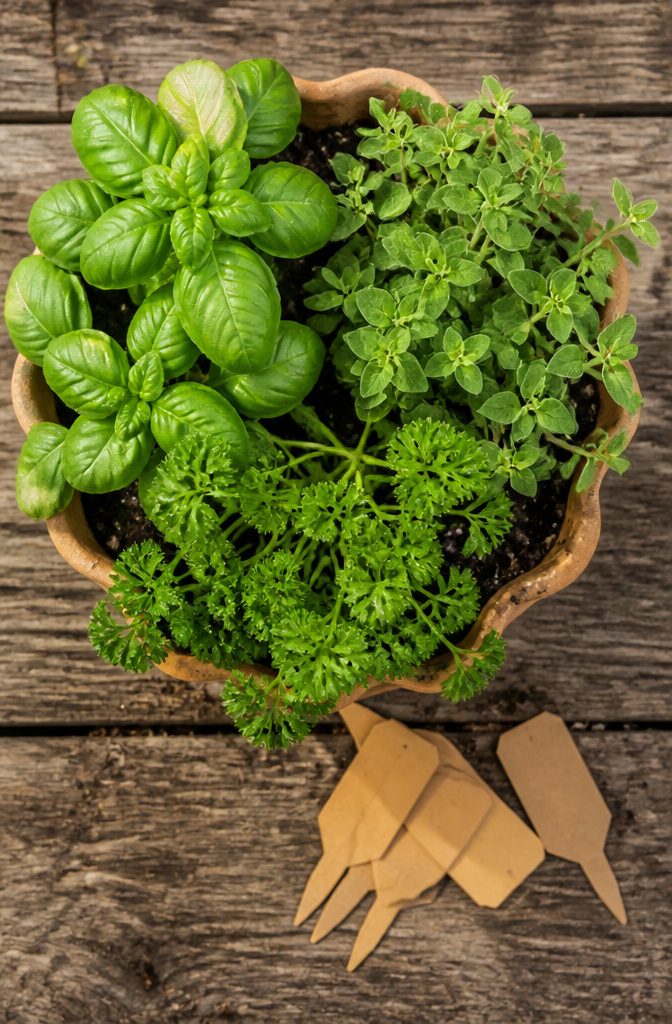
A culinary theme like Italian herbs is the most practical starting point for a first small garden. Basil, oregano, and parsley all want about six hours of sun and regular moisture, so one watering routine covers the whole pot.
Compare that to mixing rosemary, which prefers to dry out between waterings, with basil that wilts if you wait that long. The theme does the planning for you.
Tea gardens follow the same logic. Chamomile, lemon balm, and peppermint share a tolerance for partial sun and steady water.
Lemon balm spreads like the mint it is, so I would keep it contained even in a grouped planter. The flowers are a side benefit, though I grow these for the harvest, not the display.
Fragrance gardens are the third option, and the least practical if you actually cook.
Lavender and rosemary want drier soil and more sun than a tea group would tolerate, so the theme still works, but it narrows where you can place the pot. For renters moving the planter to catch light, that matters.
I would start Italian every time. You will use what you grow, and the care is forgiving enough that a missed watering does not cost you the whole crop.
7. Hanging Planters
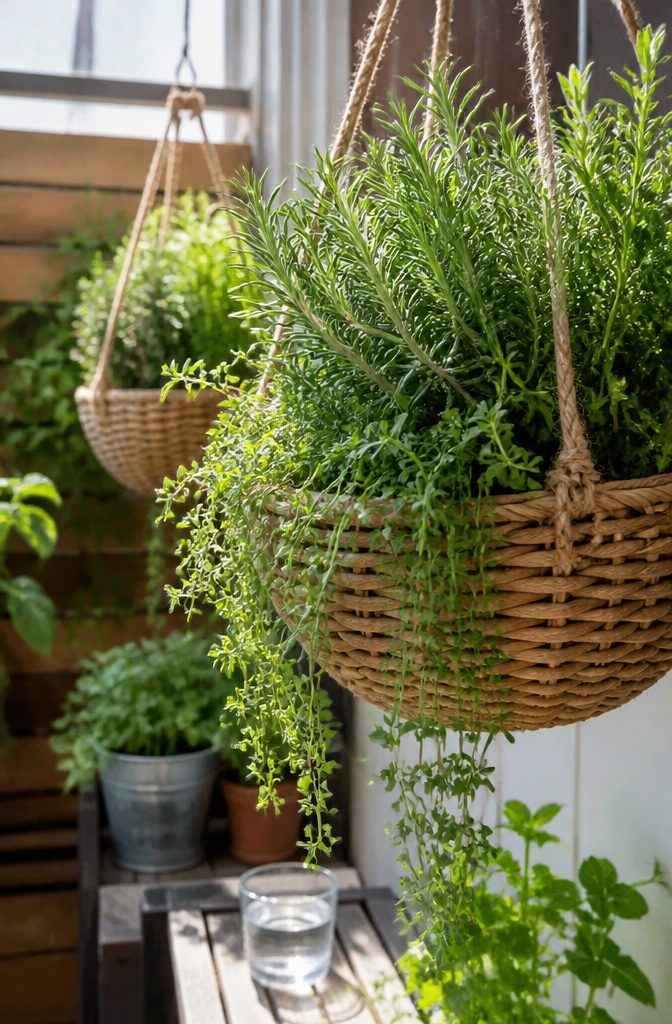
Ceiling hooks and rail-mounted planters turn the vertical space above eye level into usable growing area, which is exactly where a small herb garden ideas search pays off for renters with balconies or compact patios.
Wet soil is heavy, and a waterlogged basket can pull a weak hook straight out of drywall or soft wood.
Mount into a joist, a solid beam, or a masonry anchor, not just the surface finish, or plan on finding your thyme in pieces on the floor.
Creeping thyme and trailing rosemary are the clear winners here, softening the edge of a basket and spilling downward in a way upright growers never manage.
Thyme in particular forms a dense, fragrant mat that eventually covers the whole container. Keep mint in a hanging basket too, but for different reasons: its roots stay contained instead of invading every neighboring pot.
Basil, parsley, and upright rosemary want light from above and will lean and stretch if you suspend them, so save those for a tiered stand or the top shelf of a wall system.
The trade-off is water. Air circulates on all sides of a hanging basket, so the soil dries faster than ground-level pots.
On hot, windy days, you are watering daily. Plan for that before you mount the hook.
8. Upcycled Containers
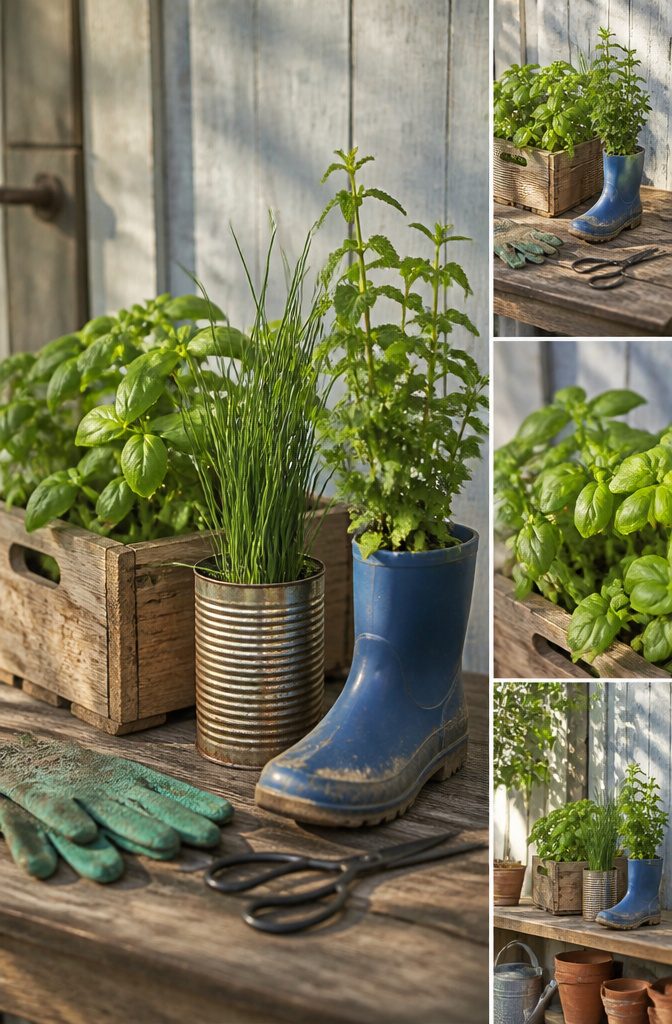
A tin can with its label soaked off, a wooden crate from a winery liquidation, an old wheelbarrow with a rusted bed, a dresser missing its top drawer: these make the best small herb garden ideas for anyone watching the budget.
The cost is usually the gas to go pick the thing up, and the look of mismatched containers in a single color family reads intentional rather than haphazard.
The non-negotiable step is drainage. Herbs die fast when their roots sit in water, so drill holes every 3 to 4 inches across the bottom of whatever you repurpose.
A masonry bit handles ceramic; a standard twist bit works for metal and wood. Skip this and you are planting in a bathtub.
Food safety matters with certain materials. Galvanized metal can leach zinc; old pressure-treated wood may contain chemicals you do not want near basil you will eat raw.
Lining questionable containers with a food-grade plastic barrier is the workaround, or stick to items you can verify clean: plain steel cans, unfinished cedar crates, cast iron with no enamel mystery.
9. Herb Garden Edging
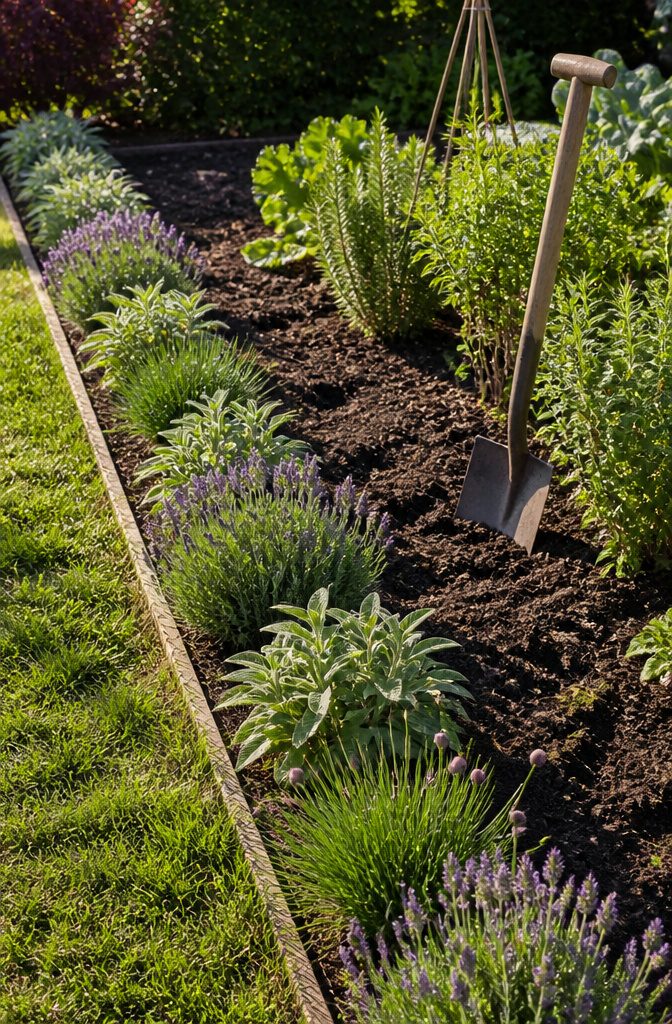
Low-growing herbs make the cleanest living edge for an existing bed, and the ones worth planting are the ones you will actually cut from.
Lavender stays tight enough to trace a line, chives fill in soft and grassy, and dwarf sage holds a low mound that reads as structure.
Each of these tolerates the occasional brush of a knee or foot, which matters because edging sits where people lean to weed or step back to assess.
The dual purpose is what justifies the space. A border defines the bed visually and gives you something to harvest without walking into the planting.
Drought-tolerant choices like lavender and thyme also handle the drier soil at a bed’s edge, where the main planting gets first claim on water.
The trade-off is patience.
A living edge fills in over a season or two, not a weekend, and until then it looks sparse. Stone or paver edging reads finished immediately, but it gives nothing back to the kitchen.
For renters especially, herbs as edging travel with you if you started them in transplantable plugs rather than direct seeding. That portability tips the choice for anyone who knows they will move within a few years.
10. Indoor Herb Gardens
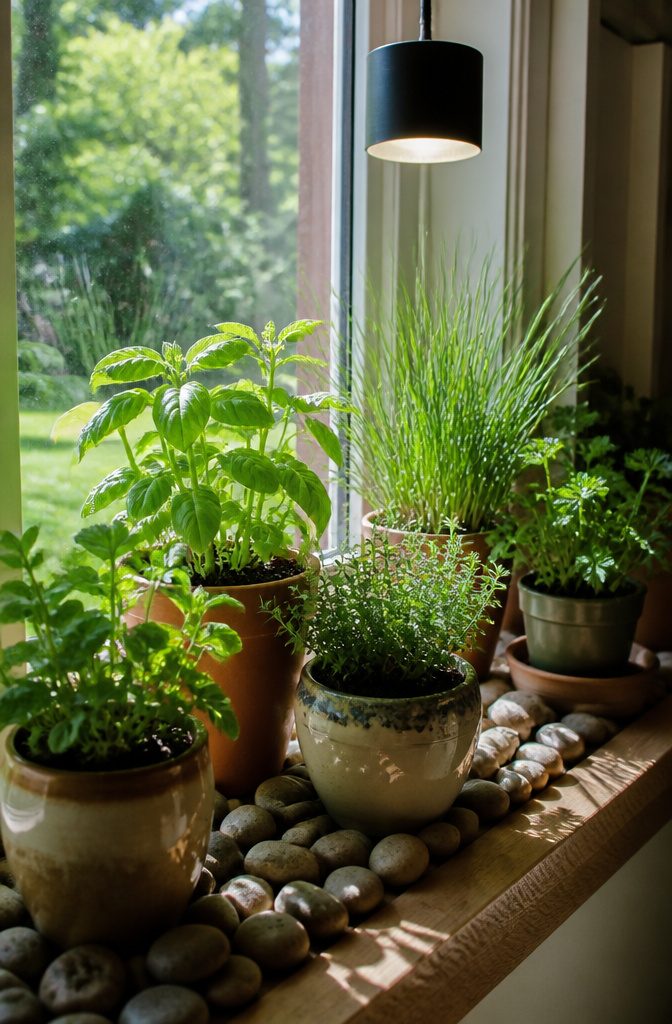
A south-facing windowsill is the closest most renters get to a year-round garden, and 4 to 6 hours of direct sun is the threshold that decides whether it works.
My own kitchen faces east, so I rely on a grow light hung a few inches above the pots to keep basil from stretching into pale, flavorless strings.
The light is non-negotiable for anyone without that southern exposure; herbs grown in dim corners do not recover from the mistake.
Indoor air is the quieter problem. Heating systems drop humidity to levels that crisp parsley edges and slow every leaf’s growth.
A saucer of pebbles and water under the pot helps, though I have had better luck simply grouping plants so their shared transpiration buffers the dry air.
Temperature swings near a window, cold at night and hot by afternoon, stress Mediterranean herbs more than the forgiving ones.
Basil, chives, parsley, and mint are the herbs that tolerate this artificial life.
Basil wants warmth and frequent pinching of any flower bud; chives manage on less light than the rest and rebound within days of cutting. Parsley starts slower but harvests for months once established.
Mint belongs in its own pot regardless, since it will overrun any shared container. The rest of the classic kitchen roster, rosemary and thyme and the other woody perennials, stay outdoors in my experience.
They demand drier soil and stronger sun than a windowsill reliably gives, and replacing a dried-out lavender plant every February is not a ritual worth repeating.
Best Herbs for Small Spaces
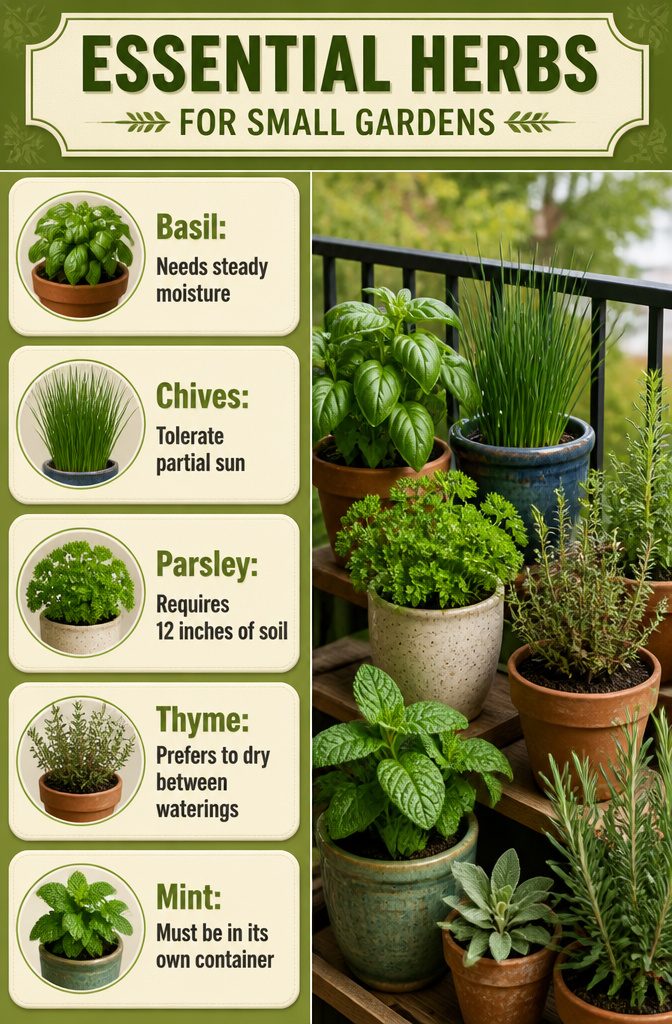
Not every herb earns its spot in a cramped kitchen or a balcony rail. I look for plants that stay manageable, grow back after cutting, and actually get used before they bolt.
- Basil wants steady moisture and at least six hours of sun. I keep it near parsley because they drink on the same schedule.
- Chives stand almost upright in narrow pots and tolerate partial sun better than most herbs.
- Parsley handles lower light than the Mediterranean crew and needs a foot of soil depth to root properly.
- Thyme is perennial in most regions and prefers to dry between waterings. Shallow roots let it live in a six-inch pot.
- Mint belongs in its own container, period. Left in open soil it will choke everything around it. Six inches of depth is enough.
- Cilantro and dill each want twelve inches of soil and cooler conditions. Treat them as annuals.
- Marjoram, oregano, rosemary, sage, and tarragon all share shallow root systems and six-inch pot viability. Group the Mediterranean ones together and water them less.
- The full list covers the range most cooks actually reach for: bright annuals like basil and cilantro, hardy perennials like thyme and sage, and aggressive spreaders you have to fence in.
Soil and Drainage
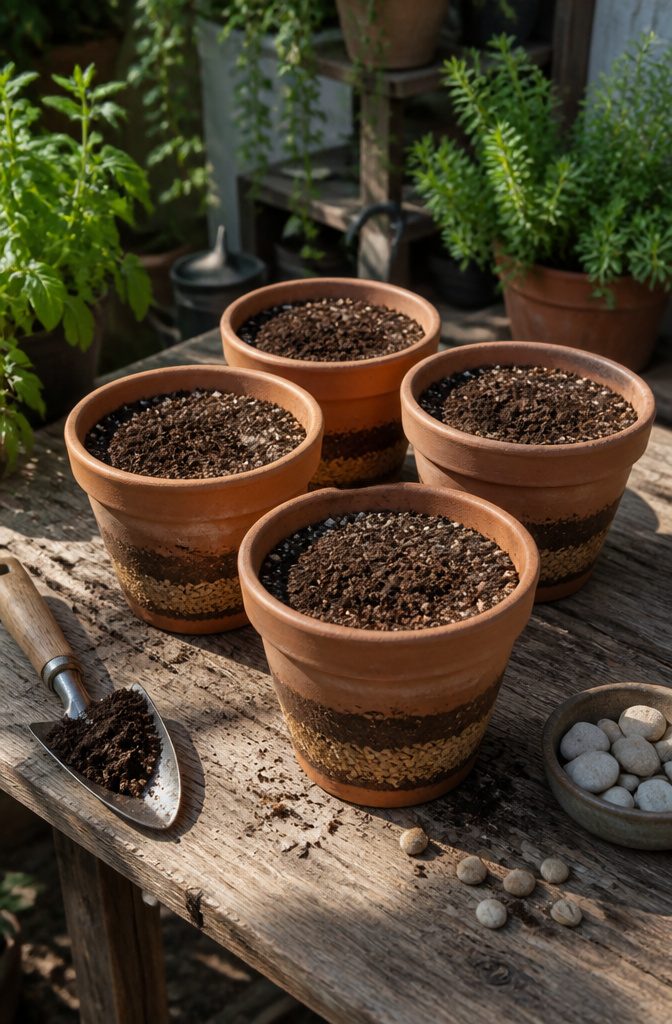
Most herbs come from dry, rocky Mediterranean hillsides, which means their roots expect fast-draining soil and will rot in anything heavy or wet.
For containers and raised beds, a mix of equal parts compost, topsoil, and coarse sand gives the right balance: the compost feeds the plant, the sand creates the airy structure the roots need, and the topsoil holds enough moisture between waterings.
Construction-grade paver sand from the hardware store works here; play sand is too fine and will pack.
The old advice about layering gravel at the bottom of a pot is a myth that refuses to die.
A drainage layer does not improve drainage; it actually raises the water table inside the container and keeps roots wetter. What matters are holes spaced every 3 to 4 inches across the bottom and a quality potting mix throughout.
Before committing seedlings to a container, test the drainage.
Fill it with your mix, water until it runs out the bottom, then wait an hour and dig down a few inches. If the soil there is already soggy, the mix needs more sand or the holes need checking.
Sunlight Requirements
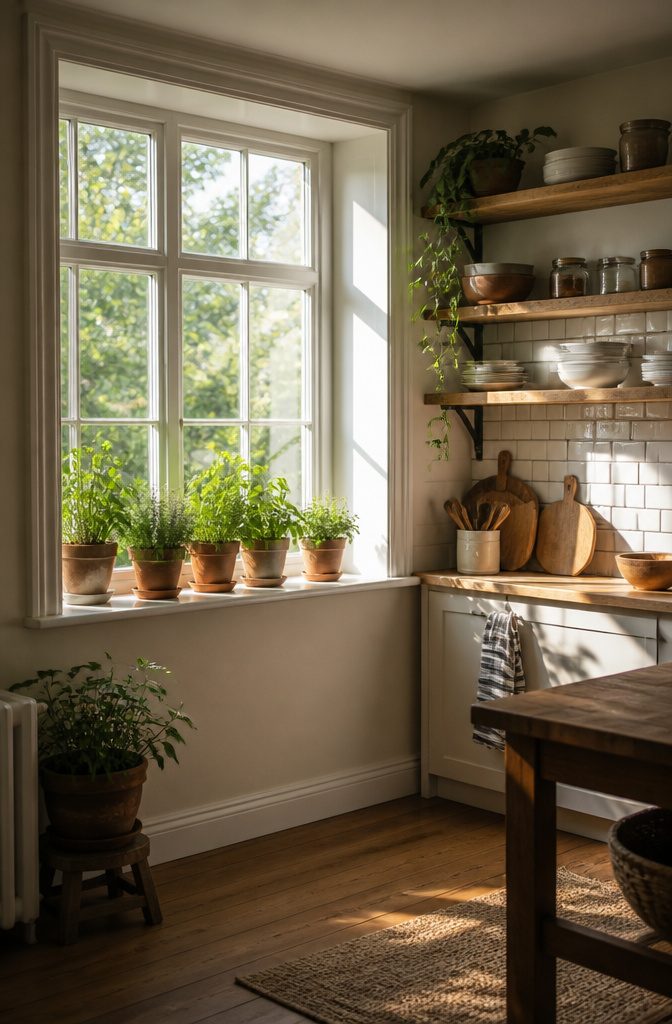
Most herbs ask for 4 to 6 hours of direct sun as a baseline, though the Mediterranean ones, rosemary and thyme among them, push toward the upper end and sulk in anything less.
Parsley and mint sit at the other end of the scale; they will tolerate partial shade and still produce usable leaves, which makes them forgiving choices for a first attempt.
The mistake I see most often is guessing. A spot that looks bright at 9 a.m. can fall into shadow by noon once the sun crosses the roofline or the neighbor’s tree fills out.
I track a site through a full day before I commit a pot to it, noting when direct light actually hits the soil line, not just the general area.
Inside, south-facing windows deliver the strongest intensity, with east and west as workable backups. North-facing light is where I draw the line; most herbs simply stretch and thin rather than leaf out.
If the only window available gives marginal hours, a grow light hung a few inches above the canopy will close the gap, but that is a cost and a cord to manage.
Watering Tips
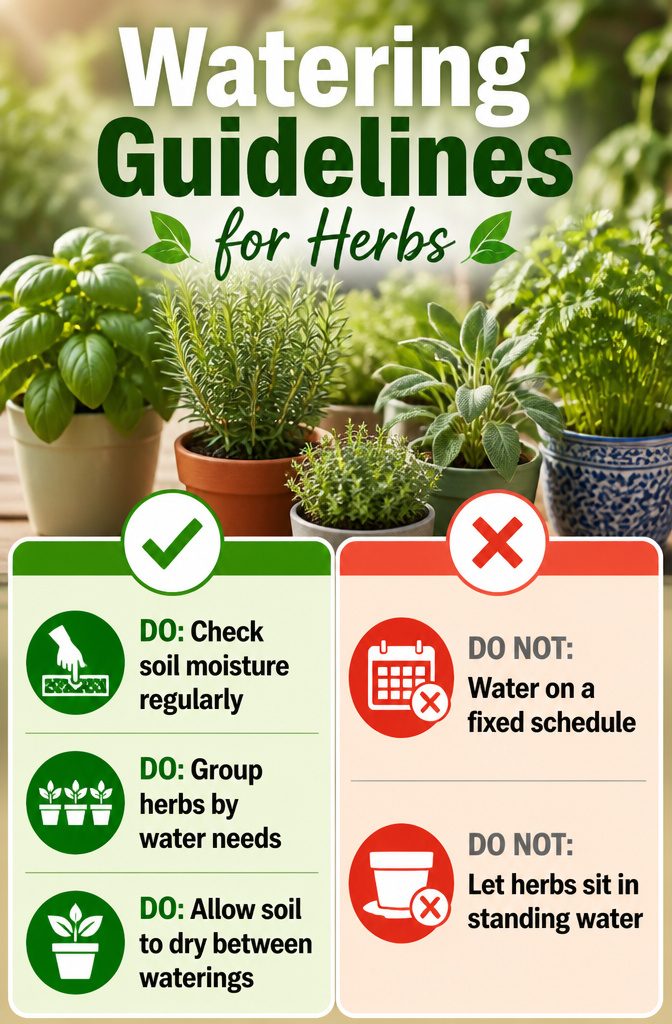
The fastest way to kill a small herb garden is giving every plant the same water on the same day.
Most herbs want soil that dries between drinks, and a fixed schedule ignores that rosemary in a 6-inch terracotta pot on a July balcony dries out in two days while the same rosemary in glazed ceramic on a shaded porch holds moisture for a week.
I check with a finger to the second knuckle. If the soil still feels cool or clings to my skin, I wait.
Dry to the second knuckle is the only signal that actually matters. Woody Mediterranean herbs like rosemary, thyme, sage, and oregano built their flavor in lean, fast-draining conditions; soggy roots rot fast and lush growth tastes flat.
Leafy herbs such as basil, parsley, and cilantro want more consistent moisture, but even they drown in standing water.
Container size shapes this too: smaller pots dry faster, larger ones hold wet longer, so the same herb needs different timing just from moving pot sizes. Grouping by water need matters more than grouping by cuisine.
Seasonal Care
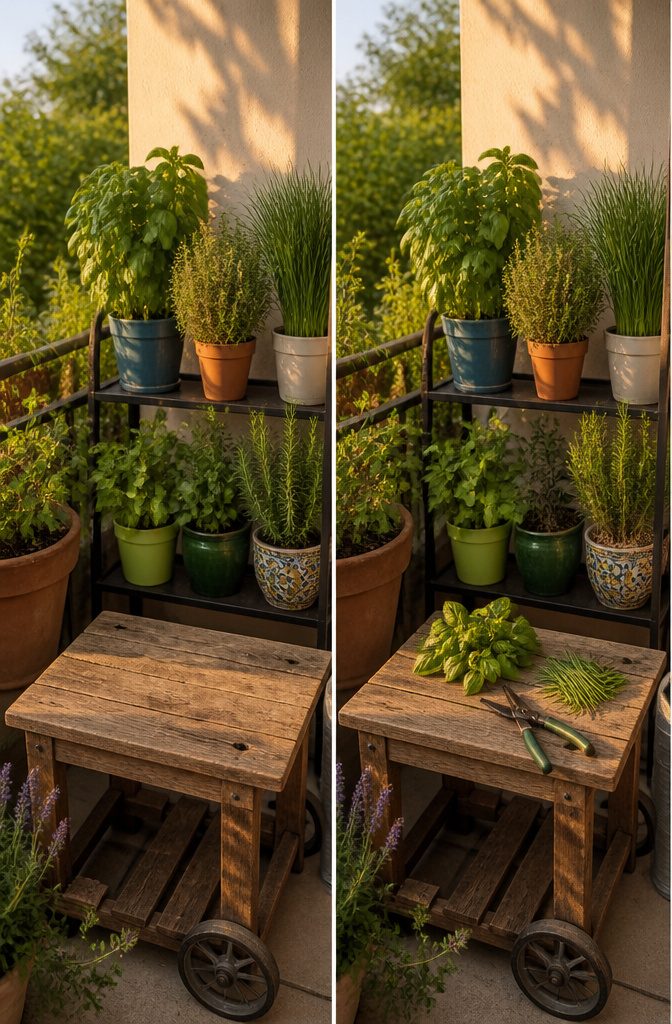
Regular harvesting keeps stems branching instead of stretching.
I pinch basil just above a leaf pair every week or two once the plant is six inches tall, and the difference is immediate: two new shoots replace the one I took, so the plant stays compact enough for a windowsill.
Herbs left to flower almost always turn bitter or woody, so I snip off buds as they appear, even on plants I am not actively cooking from.
A small garden demands more frequent attention than a row in the ground. Soil in a little pot dries faster, roots fill the space quicker, and one leggy plant throws off the whole arrangement.
I refresh mine seasonally, pulling spent annuals like basil in late fall and replacing them with cold-hardy parsley or chives.
For woody perennials such as sage, I wait until early spring and cut back to just above the new growth; the plant comes back bushier and the center does not open up with age.
The work is light, but the timing matters. Skip the spring cutback and sage grows hollow and split by midsummer.
Frequently Asked Questions
What herbs grow best in a small herb garden?
Basil, chives, parsley, thyme, and mint are the most reliable choices.
Basil and parsley want steady moisture and at least 6 hours of sun, chives tolerate partial shade, and thyme stays compact in a 6-inch pot. Mint always needs its own container since it will choke anything planted nearby.
Can I grow herbs in containers instead of a garden bed?
Yes, and pots give you control that small spaces usually lack. Six inches of soil depth handles most herbs, though parsley, cilantro, and dill need 12 inches for their taproots.
The real advantage is mobility: you can move containers to follow the sun and group herbs by water need instead of forcing incompatible plants into the same bed.
How often should I water herbs?
Check the soil with your finger to the second knuckle and water only when it feels dry at that depth. Mediterranean herbs like rosemary and thyme prefer to dry between drinks, while basil and parsley want more consistent moisture.
A fixed schedule ignores that a rosemary in terracotta on a July balcony dries in two days, while the same plant in glazed ceramic on a shaded porch holds moisture for a week.
What is the best way to start a small herb garden?
Begin with a culinary theme like Italian herbs, which does the planning for you.
Basil, oregano, and parsley all want about 6 hours of sun and regular moisture, so one watering routine covers the whole pot. Use containers with drainage holes every 3 to 4 inches and a mix of equal parts compost, topsoil, and coarse sand.
What herbs should never be planted together?
Mint should never share a pot or bed with other herbs, since its roots will invade and choke neighboring plants.
Beyond that, the bigger problem is mixing herbs with opposite water needs: rosemary and thyme prefer dry feet and will rot if planted with thirsty basil or parsley that demands steady moisture.
How to create a mini herb garden?
Start with a single container or a 12-square-foot raised bed, enough space to separate herbs by water need. Use 6-inch depth for shallow-rooted herbs like basil, thyme, and oregano; reserve 12-inch pots for taprooted parsley, cilantro, and dill.
Track your sun for a full day before placing anything, since a spot that looks bright at 9 a.m. can fall into shadow by noon.





