
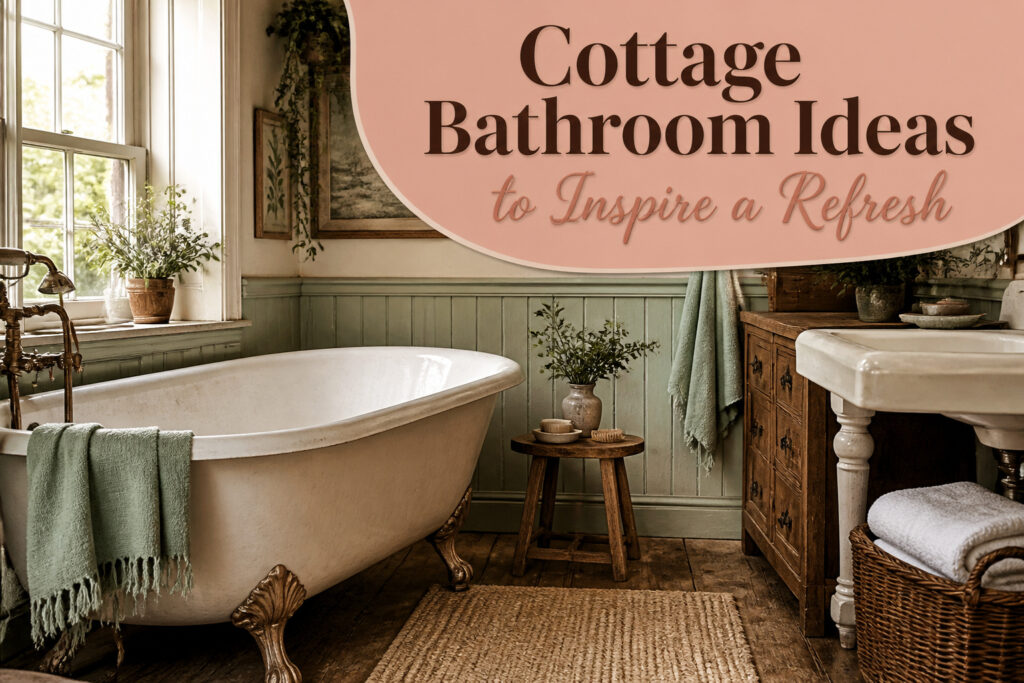
Cottage bathrooms run from a $45 flea-market stool to a copper tub that redirects your whole budget, and the deciding factor is almost always how much winter you plan to spend in the room.
A cast iron roll-top holds heat through a long soak; acrylic saves half the cost but reads ten degrees cooler against your back on a January morning.
I learned the mirror rule the harder way: one genuine antique above a clean white sink carries more character than any four-figure matched set, and the estate-sale route cost me less than a third.
1. Mix Old with New
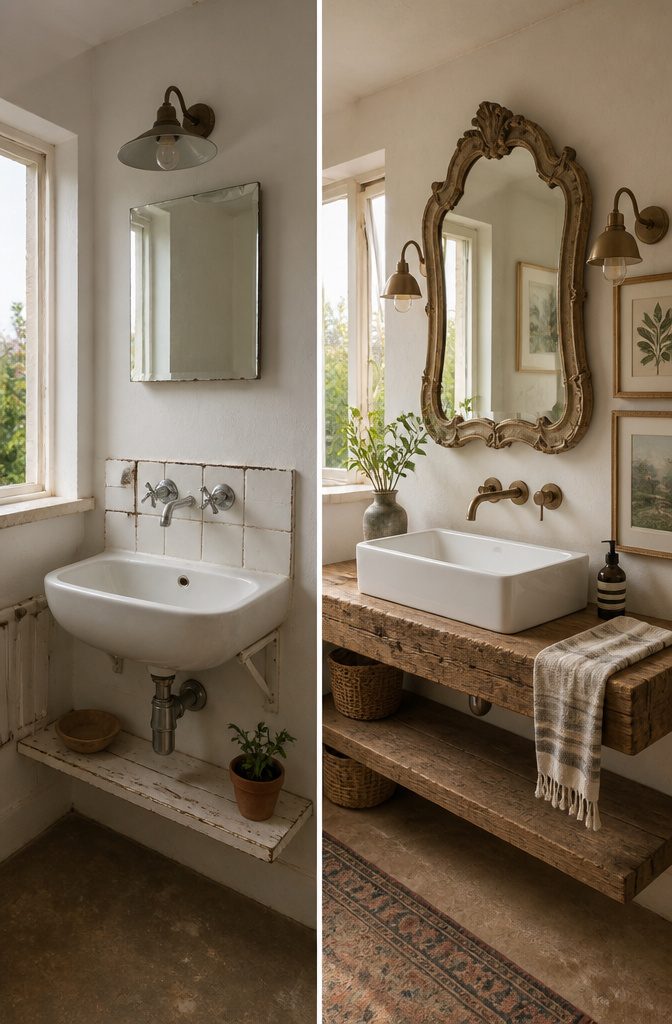
A flea-market mirror above a simple ceramic sink does more for the cottage look than a matched set from any showroom.
I learned this the hard way after pricing out vanity packages and realizing the ones with real character started at four figures. The antique route cost me less than a third of that.
The trick is letting one piece carry the age while everything else stays clean.
A reclaimed wood shelf with a wall-mounted faucet, for instance, reads intentional rather than salvaged because the modern hardware keeps it from feeling like a stage set.
My own bathroom pairs a 1940s medicine cabinet I found at an estate sale with a basic white vessel sink; the contrast is what makes it feel collected over years instead of ordered in one afternoon.
Estate sales and Facebook Marketplace are where the real pieces hide, and the wear on an actual antique reads as authenticity a reproduction never manages.
A small dresser or washstand converted for storage gives you drawers that work and a story worth telling, which is more than most flat-pack lines can offer.
2. Paneling for a Traditional Feel
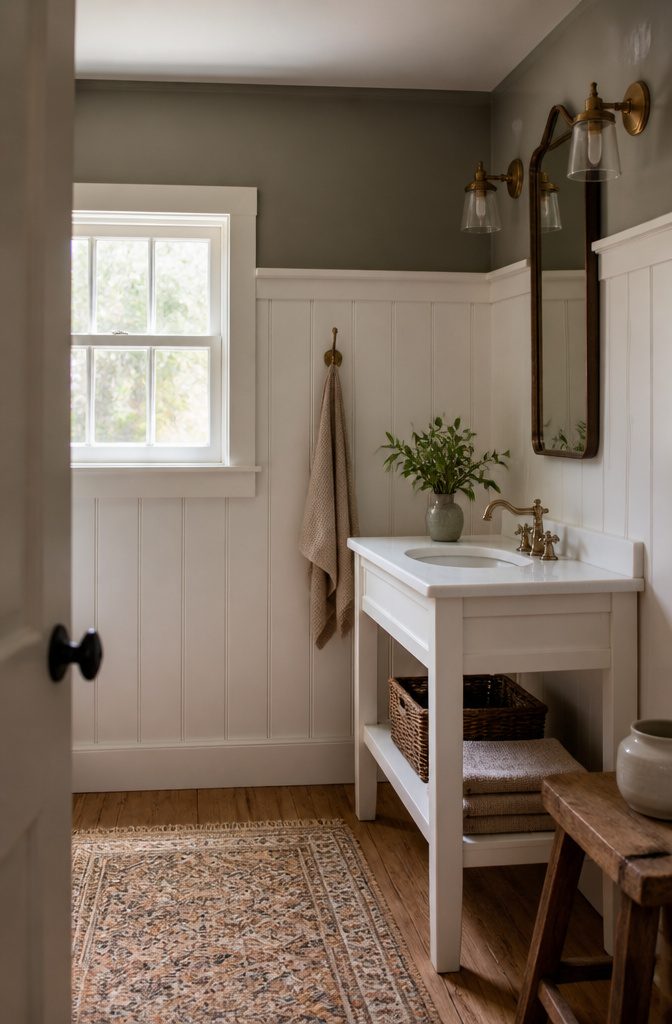
Beadboard or V-groove paneling adds cottage character faster than almost any other wall treatment, and the installation is straightforward enough for a single weekend.
Sheets go up quicker and leave fewer seams to fill, though individual planks give you the real shadow lines and slight imperfections that read as authentic age.
I used pre-primed MDF panels in my own bathroom, and the total material cost ran under $120.
Running paneling to the ceiling makes a small bathroom feel taller, but stopping it at chair rail height with painted drywall above keeps the space from feeling like a period film set.
Satin or eggshell paint finish holds up against steam better than flat, and semi-gloss is worth the slight sheen if your ventilation is weak.
Wipe the surface down with a barely-damp cloth after showers, and the finish lasts years without bubbling at the seams.
3. Showcase Original Features
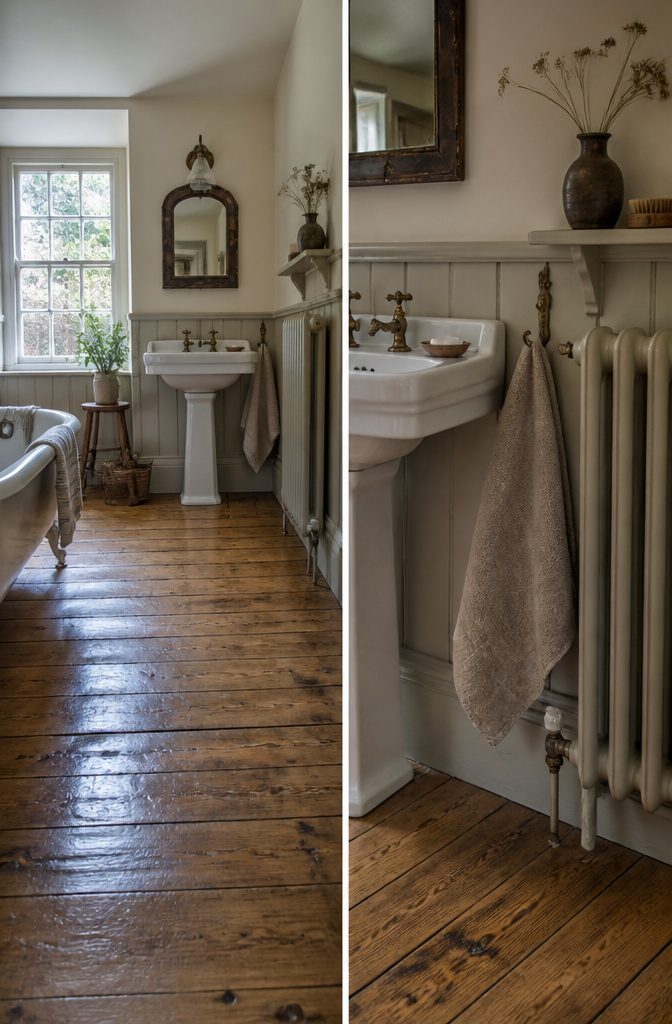
Exposed floorboards in a bathroom can look beautiful, but only if you know what you are getting into. I learned this the hard way when I almost sanded down painted pine only to realize the original grain was worth keeping.
Strip original paint only if the wood underneath is sound and the grain is tight enough to handle the moisture cycle; otherwise, repaint in a wipeable bathroom-grade formula and call it done.
Old windows and original hardware need less intervention.
A cast iron radiator can stay right where it is, painted to match the wall so it does not dominate, or stripped to its natural finish if the enamel is already failing. The patina is the point.
When the feature is damaged but not gone, repair beats replacement every time. Split paneling can be filled and sanded, not torn out for MDF.
Jamie Haller’s rule on this is worth following: real wood carries a different energy than sheet stock, and in a cottage bathroom you will feel the difference every morning.
4. Keep It Serene with Neutrals
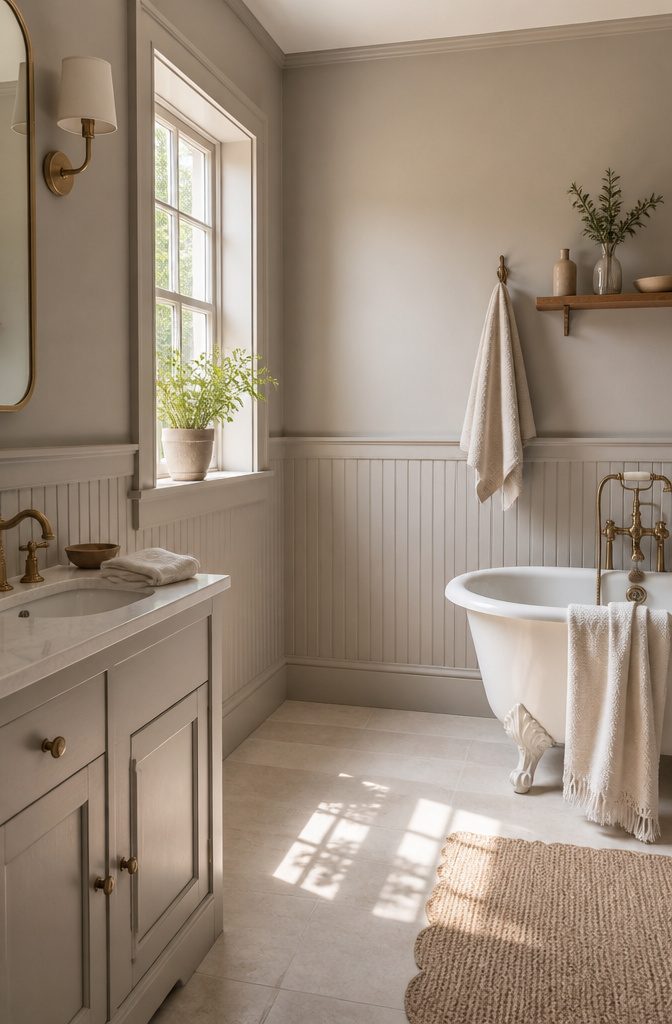
Warm white, soft gray, putty, and greige build a calm base that still feels like a bathroom someone actually lives in.
I learned the flatness problem the hard way in a rental years ago: every surface read as the same muted note, and the room felt like a hospital corridor.
Varying texture and temperature keeps neutrals alive. A matte wall against satin millwork, or a cool gray floor against a warm putty wall, creates movement without introducing color.
Sherwin-Williams Wandering Willow is the closest ready-mixed match I have found to a custom sage green I once color-matched at Home Depot for eight dollars.
That custom batch proved the point: a single quiet color, even in a small dose, anchors the whole palette.
In a cottage bathroom, warm whites on beadboard with a slightly cooler ceiling gray does the same work without the mixing counter.
5. Brighten with Light and Color
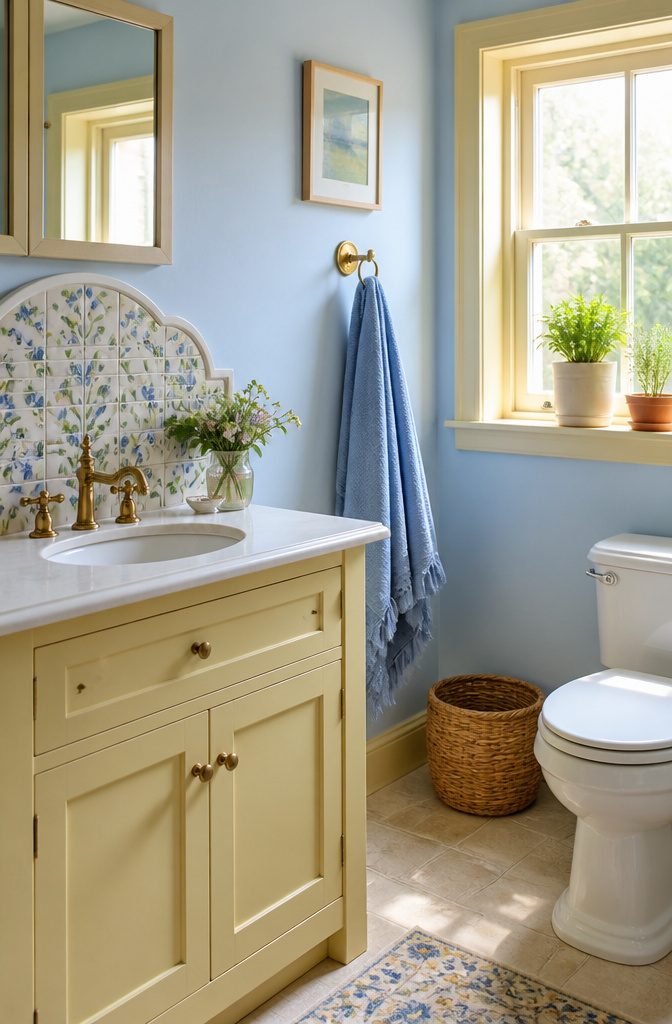
Pale blue, butter yellow, and faded coral read as cottage because they already look sun-bleached, like a door that sat facing south for twenty summers.
Test any candidate by how it shifts from morning glare to evening shadow, not by how it looks on the chip under store fluorescents.
I hold paint samples against the wall at 7 a.m. and again at 7 p.m.; colors that turn muddy or suddenly cool after lunch are the ones that will fight your tile every day.
The same rule applies to textiles. A shower curtain or hand towel in dusty blue or blush pink should look like it faded in place, not like it arrived last week.
Brass hardware with an aged patina helps sell the illusion. If you are renting, peel-and-stick wallpaper in these tones works, but only if the print has enough variation to hide the seams; flat color fields show every bubble.
6. Decorate with Fabrics
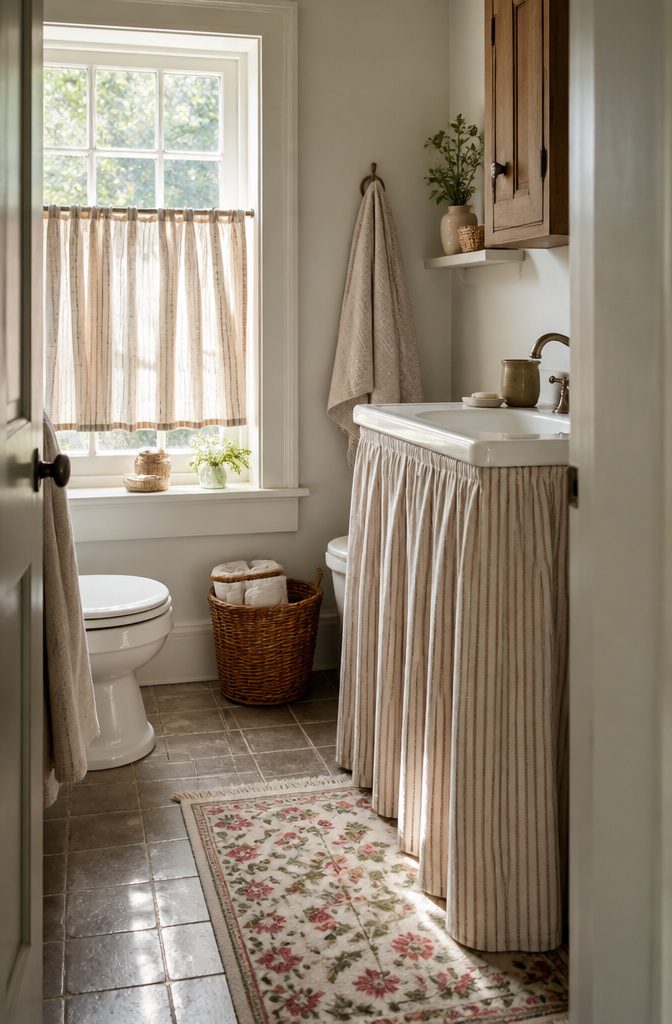
Hard surfaces dominate every bathroom, but a layer of fabric turns the room from clinical to cottage in about an hour.
Roman shades, a skirted sink base, or even a simple curtain hung on a tension rod across open shelving breaks up all that tile and porcelain.
The steam is the problem. A linen-cotton blend holds its shape where pure linen betrays you; I learned that after a shade shrank three inches and left a bare strip at the bottom of the window.
Vintage ticking stripe is another survivor, tight-woven enough to resist mildew and already faded to that washed-forever look cottage style wants.
Yardage does not have to come from a decorator showroom.
Thrift stores near older neighborhoods sometimes stock tablecloths or curtain panels with enough fabric to cut down, and Etsy sellers who deal in vintage textiles often list exact fiber content so you are not guessing.
A skirted sink needs roughly three yards for a standard vanity; buy four if the print has a direction you need to match.
7. Natural Material Furniture
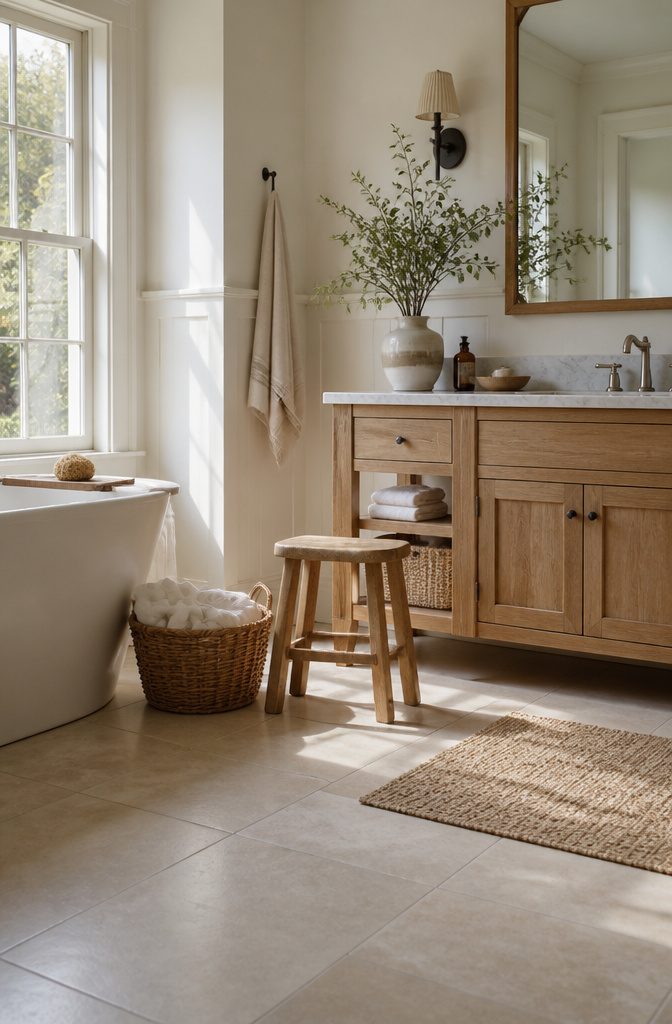
Wood furniture in a bathroom lives a harder life than anywhere else in the house. The humidity cycles every morning, and ordinary finishes eventually give up and let the grain swell.
After a cheap pine stool from a flea market cupped and cracked inside six months, I learned to look at species the way a boatbuilder would.
Teak and white oak survive damp air because their own oils and tight grain structure slow moisture from moving in and out.
Pine does not; it drinks humidity and warps across the grain before you notice the finish dulling. Bamboo and rattan work the same way, though rattan needs more attention at the joints where two materials meet.
The replacement stool cost forty-five dollars, same as the first.
I stripped the factory lacquer, sanded to 220, and brushed on three coats of marine varnish, sanding between each. Marine grade holds flex and UV better than polyurethane, and the satin sheen looks like furniture rather than a boat deck.
Two years in, the seat still reads flat against a level. For anything that sits near the tub or takes direct splash, that finish is the difference between a piece that ages and one that fails.
8. Space-Saving Solutions
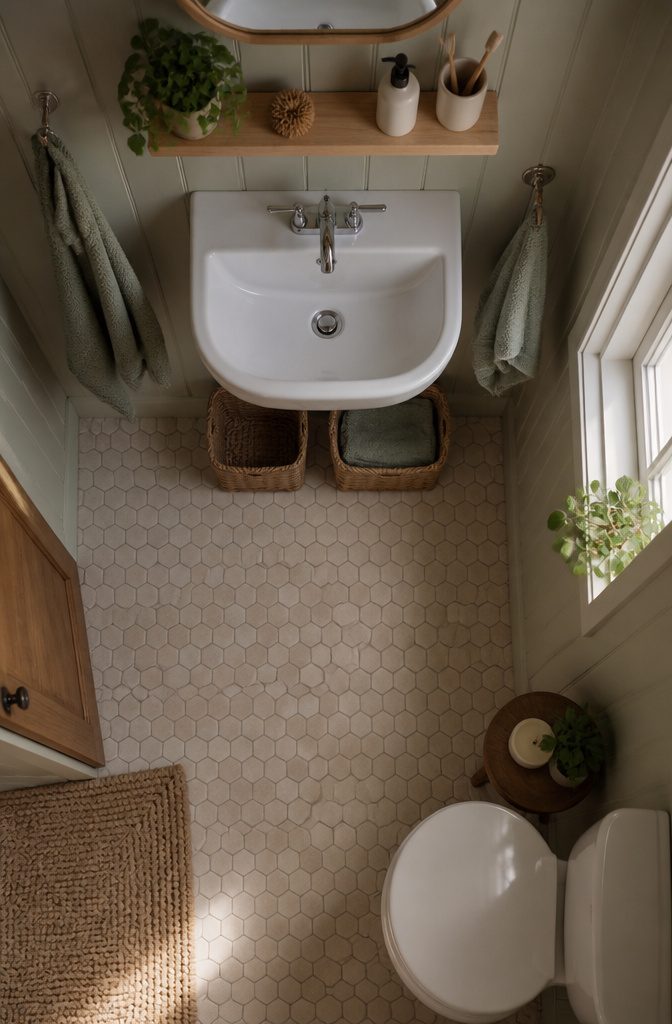
Wall-mounted sinks in a small cottage bathroom free up floor space that a vanity would swallow whole.
The six inches between the sink bowl and the wall are usable if you add a narrow shelf behind a pedestal sink for a toothbrush cup and a spare roll of toilet paper.
That shelf costs you nothing in walkway and gains more storage than the gap suggests.
Corner shelves turn dead angles into daily use. A floating shelf fitted beside a wall-hung sink holds soap without the visual weight of a cabinet, and vertical storage keeps the floor visually open in a room under 40 square feet.
Recessed medicine cabinets do the same job of hiding clutter while sitting flush with the wall, not projecting into the room.
Hooks instead of towel bars let you stack more fabric in the same footprint and work better for damp hand towels that need air.
A full vanity in a space that tight fights you every morning. The pedestal with a slim shelf behind it gives back the inches you need to turn around.
9. Practical Window Shutters
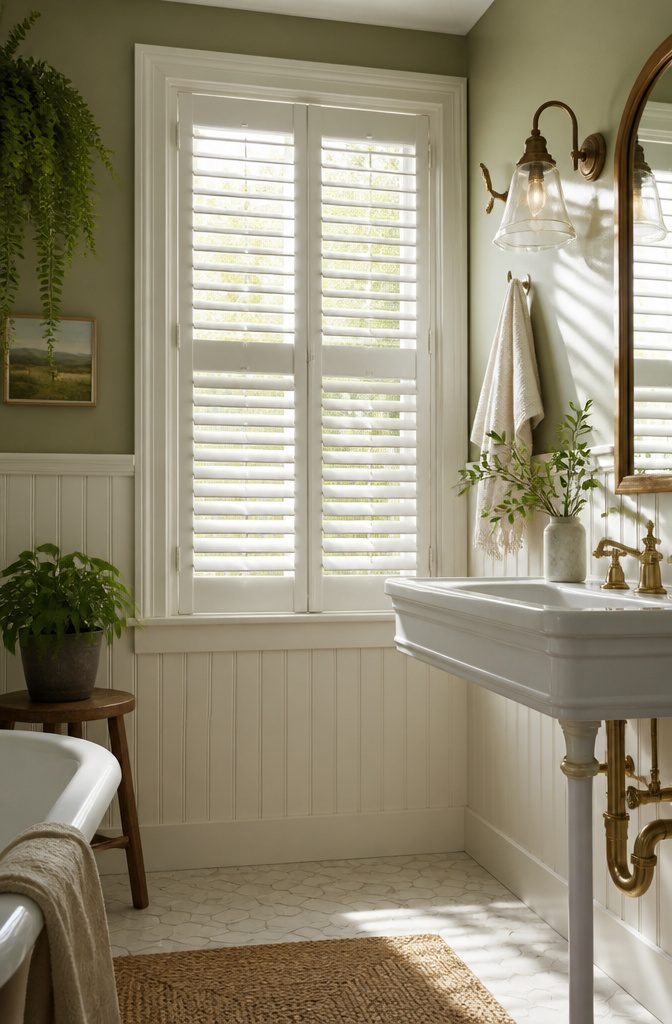
Louvered vinyl shutters handle bathroom steam in a way wood simply cannot. The slats let daylight slip through while the angle blocks sightlines from outside, and a damp cloth wipes away the condensation that would eventually warp a timber frame.
Measuring for an inside mount means checking the depth of your window casing first.
The shutter frame needs to sit flush without protruding into the room, and a casing shallower than two and a half inches will force an outside mount instead.
I learned this the hard way when a set arrived last spring and the frame sat proud of the trim by nearly half an inch.
Rather than send them back, I spent an afternoon planing the casing down to meet the shutter depth, a fix that worked but added hours I had not budgeted for a Saturday project.
Outside mount is simpler to measure and more forgiving, though it does eat a little wall space around the window. For renters, that extra frame width also covers patched holes from previous hardware.
10. Personality with Tiles
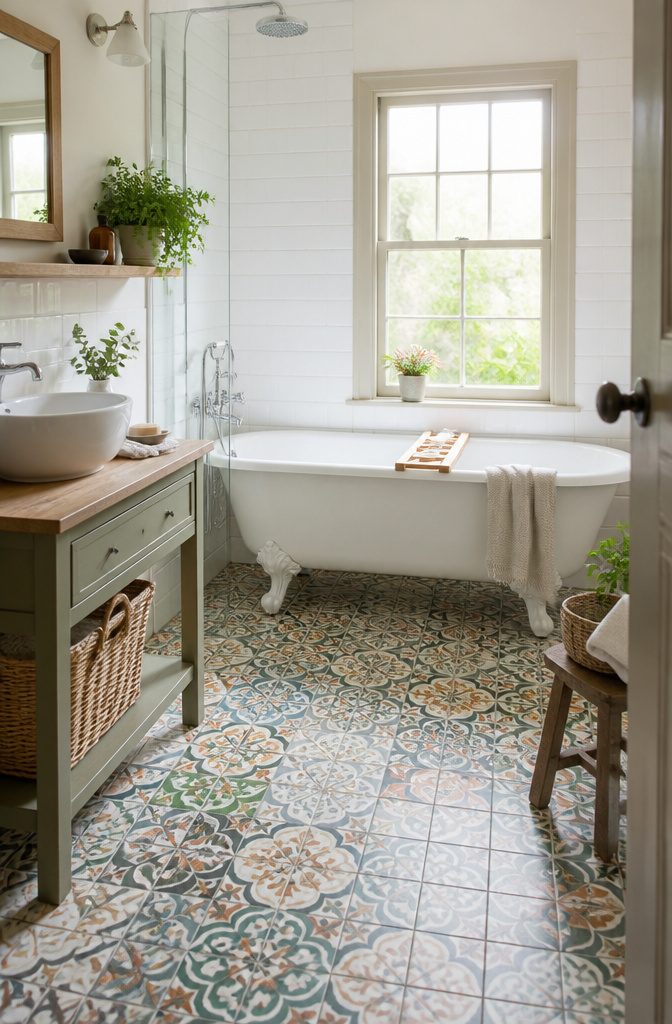
Subway tile around a tub reads classic cottage, but the real personality lives in the floor.
Encaustic-look cement tile gives that chalky, old-world finish without the maintenance headaches of traditional cement, and a small mosaic in a herringbone pattern can add color without swallowing a tight room whole.
Edward Martin carries lines with the worn, uneven edges that sell the look; their checkerboard floor pattern is what convinced me to stop hoarding samples and start cutting.
On my last floor project, I used SimpleFix Alabaster premixed grout, and the color match held up better than the powder I mixed myself the time before. Premixed means one less variable when you’re racing Sunday evening.
A weekend floor job is realistic if you limit the scope. One source tore out existing tile, had the tub reglazed professionally after a DIY kit failed, then laid the new floor.
The lesson there: demo and prep on Saturday, lay and grout on Sunday, but budget a few hours of buffer for the thinset cure before you walk on it.
11. Artwork on the Walls
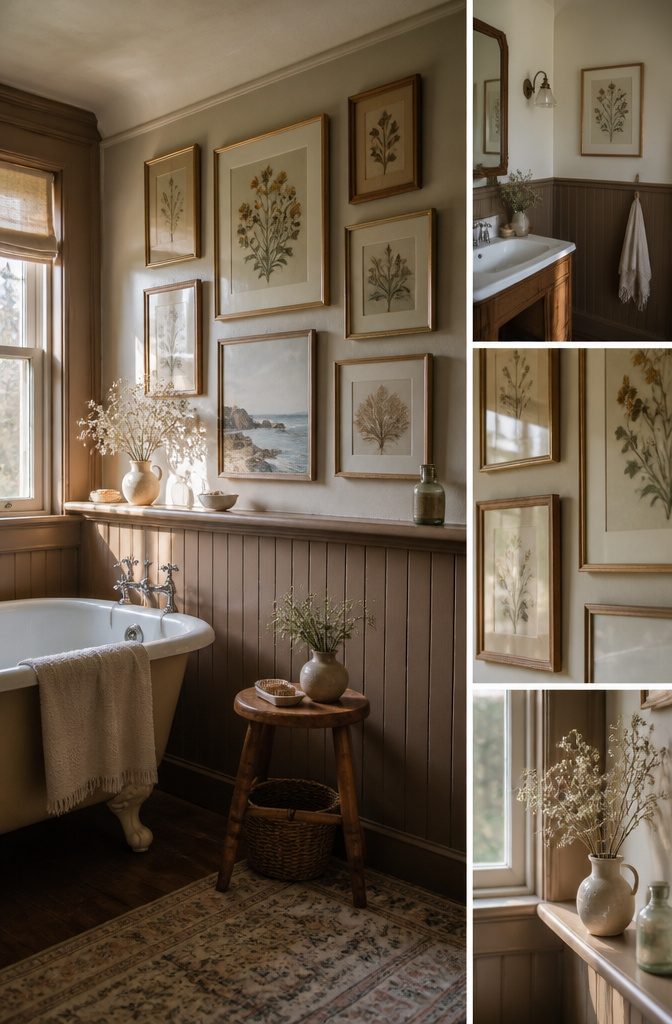
Paper art in a bathroom needs armor against steam, or it will buckle within a season. I learned that after losing a thrifted botanical print to a summer of hot showers.
Now I seal anything I hang behind glass with a bead of silicone run along the inside edge of the frame, pressed flat with a fingertip so water cannot sneak behind the mat.
For pieces without glass, a coat of clear acrylic varnish on both sides of the paper buys a few years, though I would not trust it in a room without an exhaust fan.
Cottage-appropriate art rarely demands gallery prices. Estate sales and church rummage sales in coastal towns yield watercolors of boats and shorebirds for the cost of a coffee, and the frames are often already weathered to the right softness.
I have had better luck there than at the big online print shops, where the same three "cottagecore" images circulate until they feel like hotel art.
What I frame now comes mostly from walking the beach at low tide.
Dried seaweed pressed flat for a week between newspaper and heavy books keeps its color if kept out of direct sun. Sand dollars whiten naturally and need only a gentle brush of glue along the edges to keep them intact.
A pressed fern from the lot behind my building, sealed with the same acrylic varnish, has hung above my toilet for four years without curling. The small effort of collecting and preparing beats buying something made to look found.
12. Roll-Top Bath
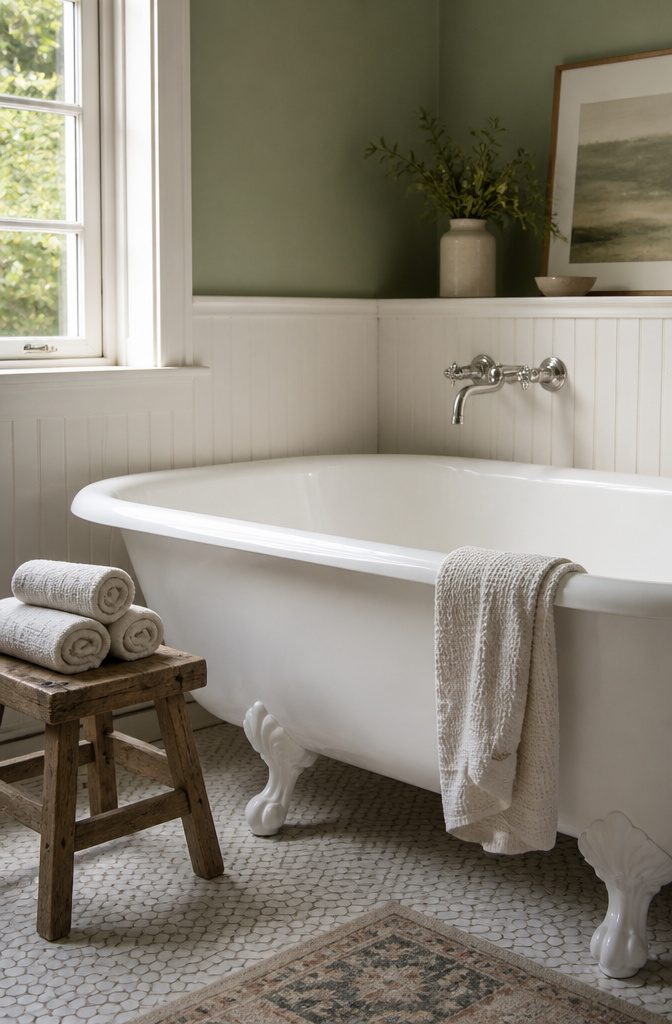
A clawfoot tub reads romantic on Pinterest, but the real question is whether your 5 by 7 foot bathroom can swallow one and still leave room to dry off. The short answer is yes, barely, if you flip the standard layout.
A 54-inch roll-top fits against the short wall with a wall-mounted faucet; you lose the linen closet and gain a 66-inch clear floor strip between tub and vanity, which is the minimum for a workable traffic path.
The feet matter more than most people think.
Lion paws with ball-and-claw detailing lean Victorian; plain rounded feet read 1920s farmhouse; sleek tapered ones are mid-century reproductions. Mixing eras is fair game, but the feet set the tone the rest of the room has to answer for.
I spent months debating cast iron versus acrylic for my own rental redo. Cast iron holds heat like nothing else; water stays hot through a long soak.
Acrylic weighs half as much, costs about half as much, and a single person can muscle it up a staircase. The catch hits on a January morning.
Acrylic flexes slightly under your weight, and the surface reads cooler against your back than iron does. That thermal difference, maybe ten degrees in subjective feel, is what the savings cost you.
For a weekend house or a rental you might leave in two years, acrylic is the defensible choice. For a primary bath you plan to thaw in every winter, the iron earns its keep.
13. Attic Bathroom Conversion
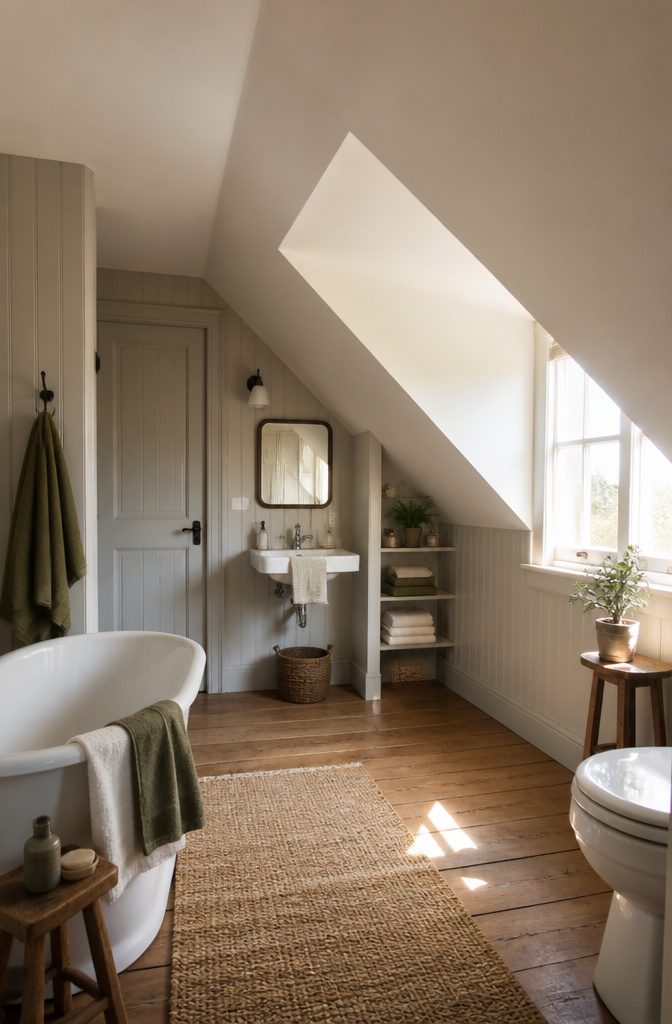
An attic with a dormer already has the light a cottage bathroom needs, but the slope creates hard limits on what fits below it.
Plumbing is the first puzzle: the stack wants a straight vertical path, and in old framing that usually means chasing it down an interior wall or a corner where the roof structure gives you a chase.
I have watched friends lose a weekend trying to route around rafters that turned out to be structural, only to tear back and start where the line should have gone.
Insulation works differently under a roof slope than in a flat ceiling.
The goal is keeping the roof deck warm enough to prevent condensation, which means the insulation sits against the underside of the decking, not hung below it as a ceiling plane.
A vent channel between insulation and roof sheathing lets air move; skip this and you will get mold that no amount of bleach fixes.
The shower needs a 36-inch knee wall minimum to keep spray off sloped drywall. Anything shorter and you are relying on a curtain pulled tight, which fails the first time someone elbows it reaching for soap.
That 36 inches is finished height, so if you are framing from bare studs, measure carefully before the backer board goes up.
14. Patterned Tile Floors
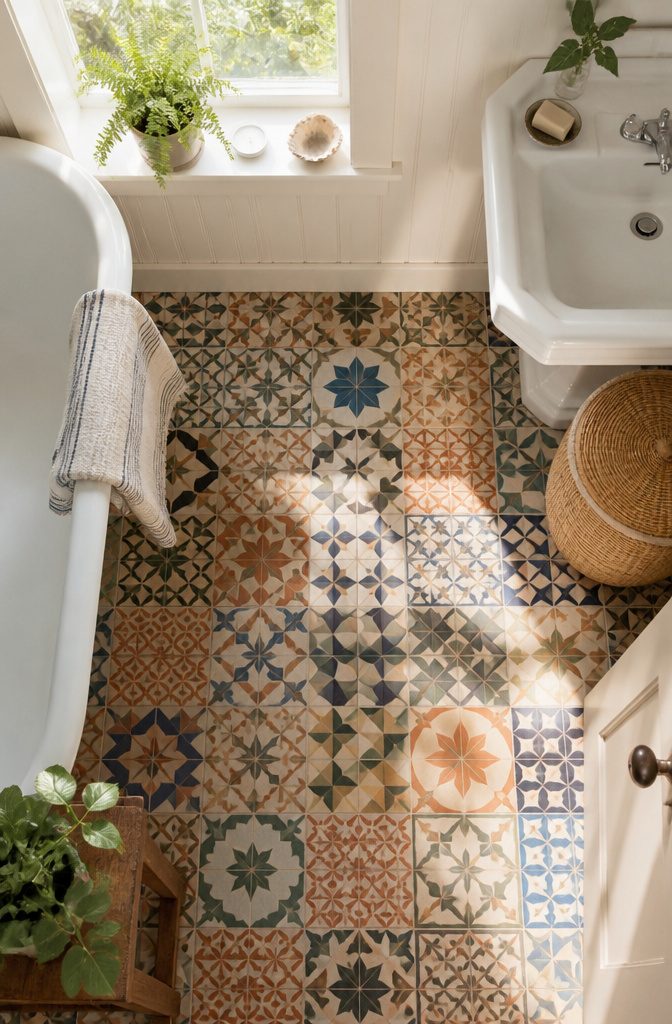
Patterned tile floors give a cottage bathroom its footing in a way paint never manages. Encaustic, geometric, or floral designs underfoot anchor the room without demanding attention from every wall.
In a small bathroom, the scale of the pattern matters more than the pattern itself.
A print that repeats every four inches reads as texture from the doorway; one that repeats every twelve becomes a single loud statement in a tight space.
Most cottage floors that work keep the repeat under six inches so the eye reads movement, not a billboard.
The real trick is letting the floor carry the visual weight while everything above stays quiet.
White subway tile, a simple curtain, bare wood: these are what let a busy floor breathe. Two competing patterns, wall and floor, turn the room into a fight for attention.
I laid 12 by 12 inch cement-look LVT in my own bath last spring, clicking it over the existing vinyl in six hours of a Saturday morning.
The pattern was a soft geometric in slate and cream, busy enough to hide water spots, quiet enough not to shout.
The walls stayed flat white. By Sunday evening the room felt finished, and the total outlay sat comfortably under two hundred dollars.
15. Dark Colors for Intimacy
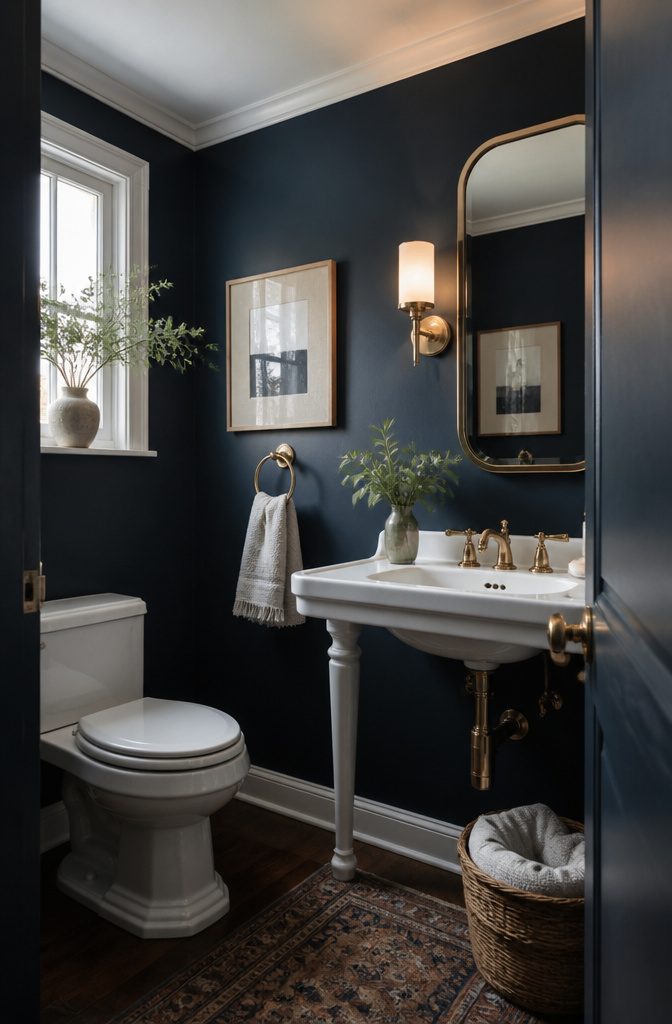
A powder room is the one place where a dark wall color can actually expand the feeling of the space rather than close it in.
Deep green, navy, or charcoal push the walls back visually, so the room reads as a contained, intentional place instead of a tiled box.
The finish matters more than the shade. Eggshell or satin reflects enough light to keep a small bathroom from feeling like a cave, especially if the ceiling stays white and the fixtures are pale porcelain.
That contrast is what lets the dark color work; without it, the tone flattens into gloom.
I painted my own powder room Farrow & Ball Railings, a near-black navy, after seeing how rich it looked in a friend’s cottage renovation.
The first two coats went on streaky and thin. The third coat finally gave the depth I was after, and the lesson cost me an extra Saturday I had not planned for.
If you’re painting a dark color over anything lighter than a mid-tone gray, budget for three coats or a tinted primer.
"Dark colors work particularly well for a small cottage bathroom with little light as this will make the room feel more intimate and relaxing and draw the eye away from the size."
The intimacy is the point: a dark powder room feels less like a pass-through and more like a room someone chose deliberately.
16. Cottage Wallpaper
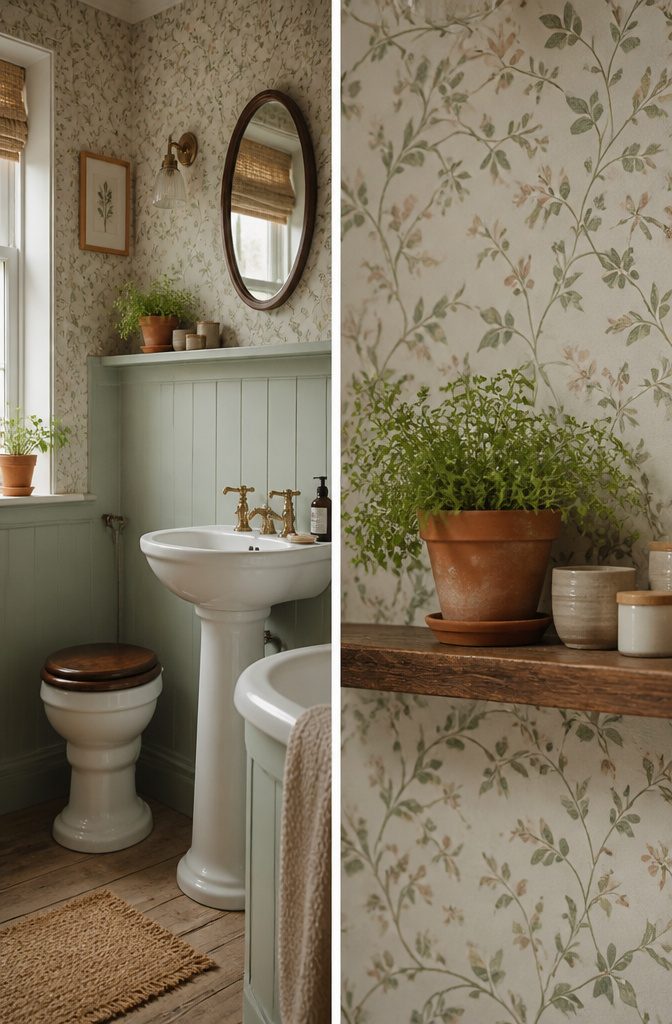
Wallpaper turns a small bathroom into the one room guests remember.
Botanical prints, narrow stripes, and anything small-scale all read cottage without shouting for attention. Samberg’s Anton Sage Green, a Swedish design built around a quiet nature pattern, is the kind of paper that still looks right ten years in.
Peel-and-stick versions matter for renters, though the seams need joint compound and tape underneath first.
I learned that the hard way: I hung paper over untaped drywall seams, and within a week the edges lifted and bubbled where the seam tape should have been.
The paper itself was fine; the wall underneath was lying about being smooth. Two hours of prep would have saved the do-over.
Traditional paste papers like Samberg’s own kit go up with more forgiveness than you expect, since wet glue lets you shift the sheet before it sets.
Either way, a bathroom’s tight footprint keeps the roll count low and the risk manageable.
17. Window Treatments for Privacy
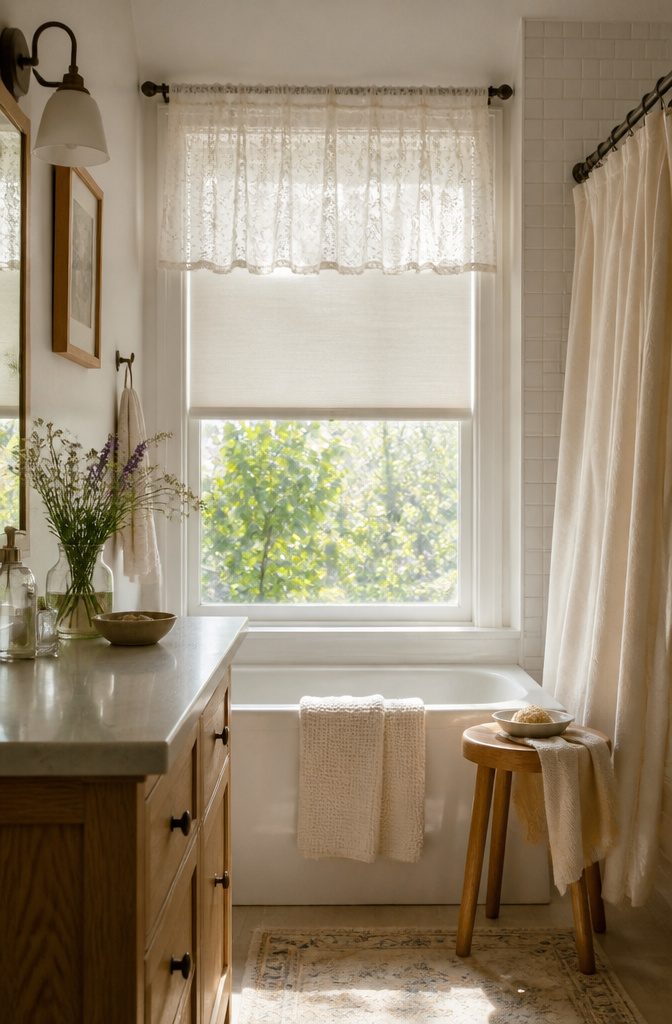
Sheer curtains in a bathroom look romantic until you realize they glow like a lantern after sunset.
A lace panel with a plain liner behind it, or a half-shade hung at sill height, keeps sightlines blocked while the sun is up without turning the room into a cave.
The layered approach is what actually solves both problems: a sheer or lace layer for daylight, and a roman shade or flat panel that drops over it once the lights go on.
One heavy drape does neither job well. It blocks sun when you want it, and at night it still gaps at the edges or stacks too narrow to cover the glass.
Cafe shutters work the same way in principle, letting you tilt the louvers for light while the bottom half stays fixed, though in a small cottage bath the hardware can eat more wall than you have.
What convinced me, reading through the plans that made it to real rooms, was the curtain hung above a pony wall: fabric from ceiling to wall height, softening the tile line without pretending to be a full window treatment.
That is the move for a window that faces a fence or the neighbor’s deck, which is most cottage bathrooms built before setback rules mattered.
Layer sheer plus a flat shade, not one thick curtain, and you get privacy that adapts instead of guessing.
18. Copper Bath
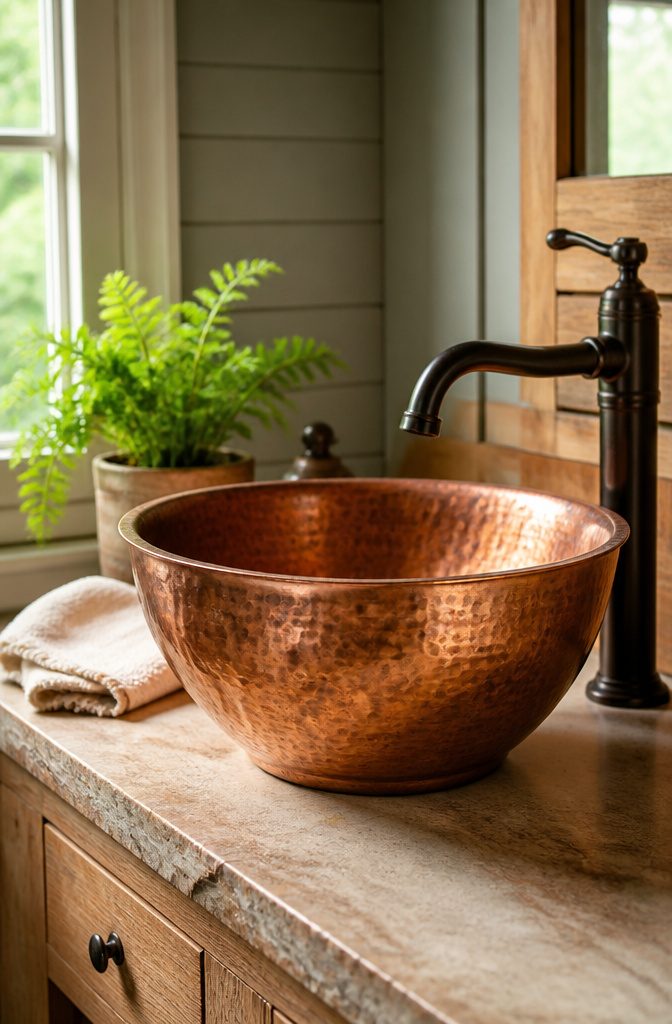
A copper basin warms up a bathroom the way enamel never manages to, and it only gets better as the surface shifts.
The first time I saw a full copper tub in a cottage renovation, I priced it out and closed the tab.
The jump from a standard enameled steel tub to copper was enough to redirect my whole plan toward a copper vessel sink instead.
That sink has lived with hard water for three years now. The spotting started inside a month, pale green blooming at the waterline where the copper meets the mineral load every morning.
Most people scrub at it like it’s corrosion; I leave it. The verdigris is surface oxidation, not decay, and in a cottage context it reads as age you would have paid to fake.
Wiping it fully clean every week would keep the bright penny color, but the patina is why you bought copper.
Wood and stone nearby help the metal settle in. Oak vanity legs and a slate countertop gave my basin something to visually lean against; alone on painted drywall it would have looked like a retail display.
The basin itself is thin-gauge hammered copper, lighter than it looks, which mattered when I was hanging it on a wall-mounted frame without help.
If you are choosing between tub and sink, the sink wins on a real budget and you still get the living finish that changes year to year.
19. Soothing Color Schemes
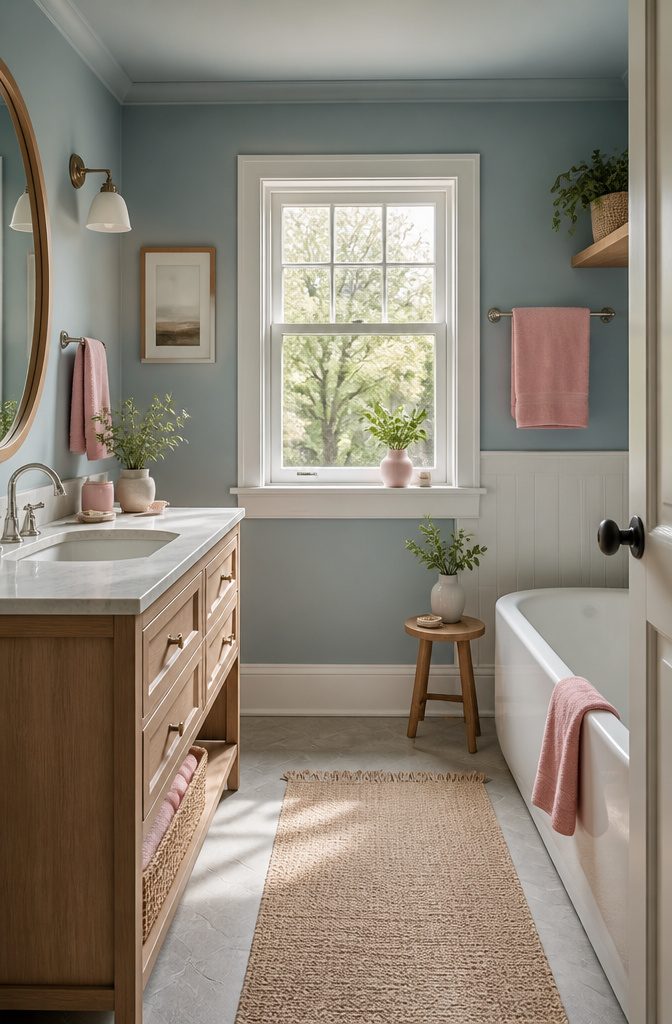
Dusty blue, buttery cream, warm white, sage green, and blush pink are the five colors I keep coming back to for cottage bathrooms.
Paint one of them as your base, another as cabinets or wainscoting, and the smallest touch, maybe a hand towel or a vase, as the accent.
That is the 60-30-10 rule stripped to its bones: sixty dominant, thirty secondary, ten accent. It saves you from the flatness of a single color without letting the room turn busy.
I stopped trusting paint chips after a cream I loved at ten a.m. turned sickly yellow by evening. Now I buy sample pots for every project and brush two-foot squares on opposite walls.
Morning light and overhead bulbs read color differently, and a bathroom sees both. The two dollars per sample beats repainting a room I already finished once.
Color Schemes That Calm
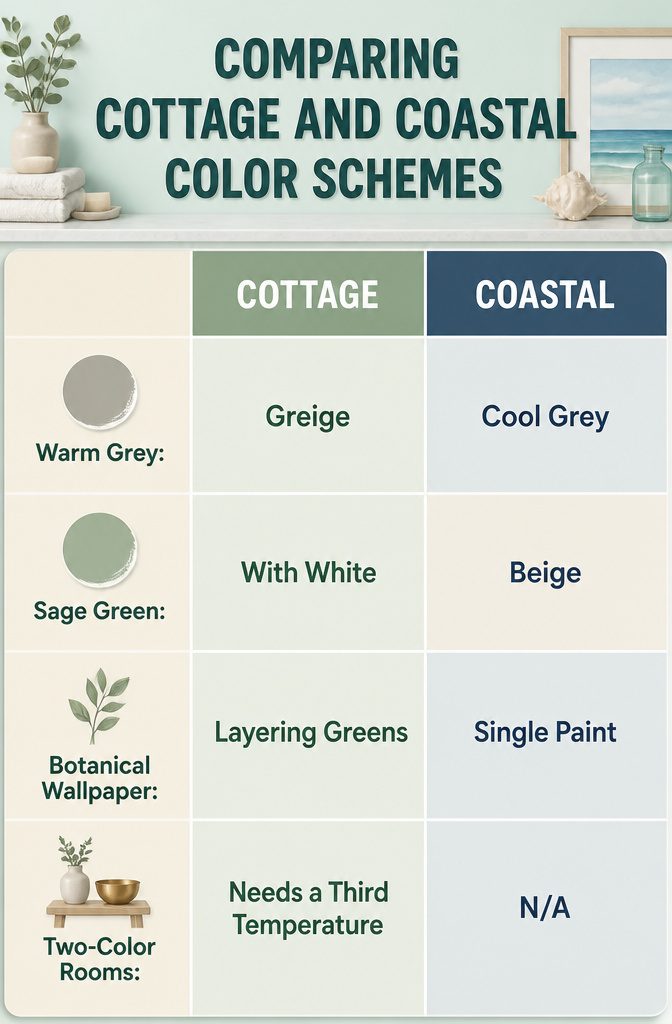
Warm grey reads cottage only if you stay on the greige side of the spectrum; cool grey drifts coastal fast, and pairing it with white wainscoting plus navy stripes pushes it all the way there.
The farmhouse version swaps in creamier whites and throws in aged brass or black iron hardware for contrast.
Sage green with white walls and natural wood stays firmly in cottage territory, though the same green against too much beige turns rental-generic fast.
Two-color rooms need a third temperature: wood counts, and so does unlacquered brass. Without that break, even the prettiest pairing goes flat.
Botanical wallpaper does the work for you, layering greens and creams so the room never depended on a single paint decision.
In a small bathroom, the pattern hits harder than it would in a larger space, and the cost lands about the same as a single accent wall.
If you are painting instead, test the grey or green against your trim in morning light; the warm-cool shift changes more than you would guess from the chip.
Frequently Asked Questions
What colors are used in a cottage bathroom?
Soft, muted, warm tones work best: dusty blue, butter yellow, faded coral, warm white, putty, greige, and sage green.
The trick is letting them look sun-bleached, like they faded in place over years. Test any color by how it shifts from morning glare to evening shadow before committing.
Can I get a cottage bathroom look in a rental?
Yes. Peel-and-stick wallpaper in dusty or muted tones works if the print has enough variation to hide seams.
A ruffled or lace shower curtain, swappable hardware, and fabric layers like a skirted sink base or roman shade all come with you when you leave.
Just prep the wall properly first; untaped drywall seams will bubble the paper within a week.
What is the difference between French cottage and farmhouse style?
Cottage style leans more romantic and detailed, with collected pieces, patina, and soft layers of fabric and age.
Farmhouse is more minimal and utilitarian, built around cleaner lines and function-first choices. A cottage bathroom might pair a 1940s medicine cabinet with a modern vessel sink; farmhouse would more likely match the periods.
How do you make a timeless bathroom?
Combine high-quality, simple fixtures with a neutral palette, then let texture and temperature create movement instead of chasing trends.
Warm white beadboard against a slightly cooler ceiling gray, or matte walls against satin millwork, keeps the room alive without dating it. One well-chosen antique or natural material carries more staying power than a showroom set ever will.