

The eight ideas below range from weekend paint jobs to full furniture swaps, and the one that fits your room depends on whether you actually fold your bed up or leave it down.
A Murphy bed only earns its keep if you use it; most people sleep better with a centered bed, 22 inches of walking space, and a snake plant in the corner that needs water once a month.
1. Natural Tones for Calm
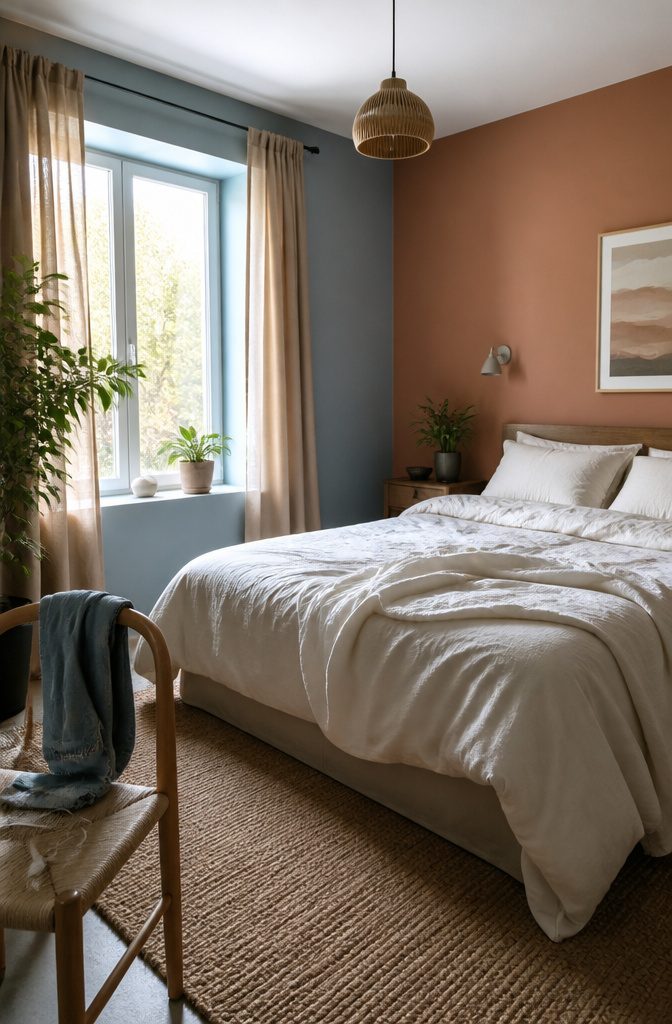
Mustard yellow, forest green, terracotta, and pale blue read loud on a swatch card, but on bedroom walls they do the opposite of shouting.
These tones borrow from dirt, bark, and late-sky light, so the eye reads them as already familiar.
That familiarity is what lets a color work as a psychological tool first, aesthetic choice second; the room settles you rather than presenting itself for appraisal.
I learned this distinction the hard way after painting a rental bedroom a saturated teal that photographed beautifully and felt like a gymnasium at 6 a.m.
The earthy palette operates lower on the saturation scale, which matters more than the hue itself.
Even a strong terracotta, when muted toward clay rather than traffic cone, recedes enough to let morning disorganization or unfolded laundry sit in the background instead of competing for attention.
The functional payoff shows up in how little these colors fight changing light.
A pale blue that reads gray before dawn stays legible at noon without flipping to nursery-cute; a mustard with brown undertone warms artificial evening light instead of turning sickly.
Forest green and terracotta layered together create depth without the busyness of high-contrast schemes, so the room holds together when you add the real textures of use: rumpled linen, a charging cable, yesterday’s jeans.
If your bedroom gets aggressive sun, test the swatch in that light. Bright southern exposure can wash paler earth tones toward off-white, stripping the calm effect you chose them for.

[Queen Murphy Bed] Bed & Storage Cabinet, maximize your space effortlessly with our Murphy bed's dual functionality. Use it as storage cabinets when folded, or unfold it into a comfortable bed when needed, , ensuring clutter-free spaces

2-in-1 Murphy Bed: Fold it into a cabinet when not in use, then easily convert it into a comfortable bed for overnight guests. Ideal for small apartments, guest rooms, home offices, and multifunctional spaces. Gold ring handles add a warm farmhouse-inspired accent to the rustic finish.
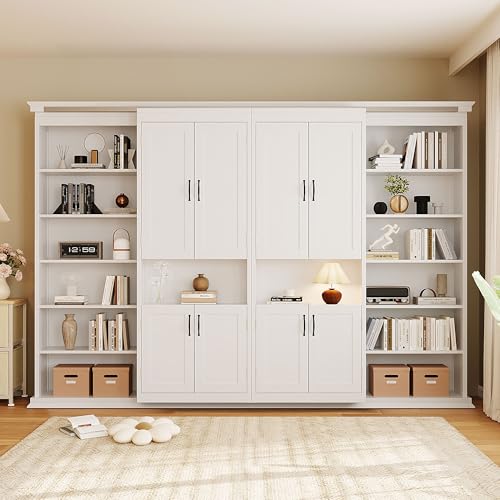
Dual Sliding Storage Cabinets for Flexible Organization:Two front storage units glide smoothly left or right on premium rails, giving you effortless access and customizable storage. Perfect for books, décor, toys, or daily essentials—without blocking the bed operation.
2. Multifunctional Furniture
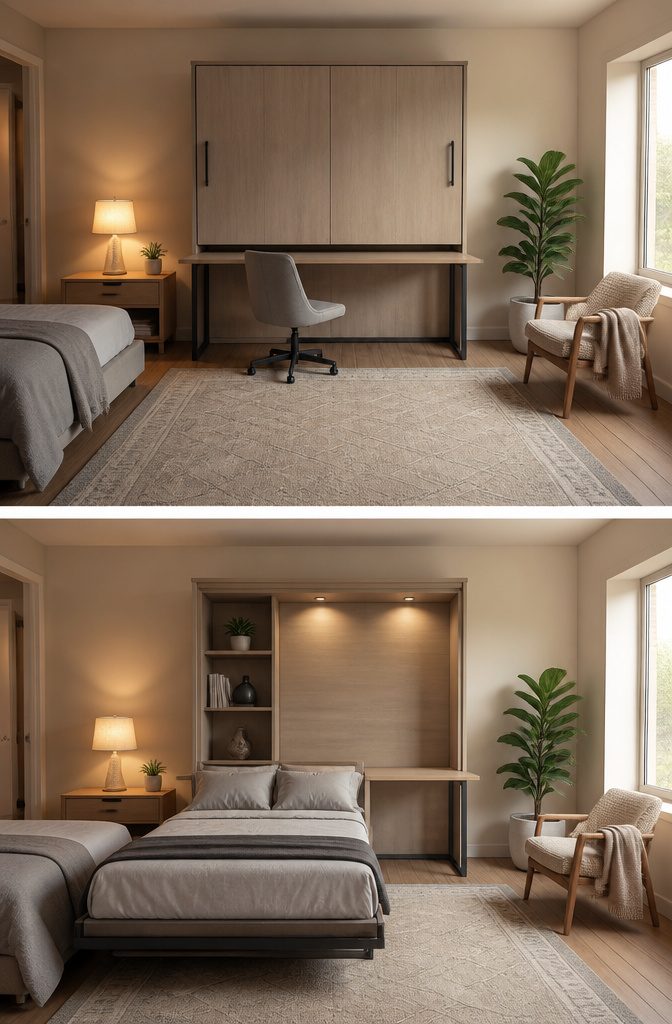
A Murphy bed only earns its keep if you actually fold it up.
I looked at the Penelope Dining Wall Bed by Clei for months before admitting I would leave it down nine nights out of ten and lose the desk underneath.
That is the test: does the secondary function survive your real habits, or does one mode become a storage fantasy?
Storage ottomans and lift-up beds like West Elm’s Myla Pop-Up Storage Bed pass more easily because the extra work is lifting a lid, not reconfiguring a room.
The Myla gives you a place to sleep and a cavity for spare bedding without demanding a floor-plan change at 11 p.m.
"Fewer, high-quality, multifunctional pieces make the space work harder and feel less crowded."
For a renter, this means one solid piece usually beats two cheap ones.
Measure your open floor space with the bed in both positions before you buy. If the folded footprint still blocks a door swing or closet, the square footage it "saves" is theoretical.

Large Capacity: This under bed storage bag measures 39.4"(100cm) x 19.7"(50cm) x 7.1"(18cm) and has a capacity of 95L which can easily hold 20 sweaters, 4 thick blankets and 14 sheets. Ideal for under-bed storage, closet or shelves.
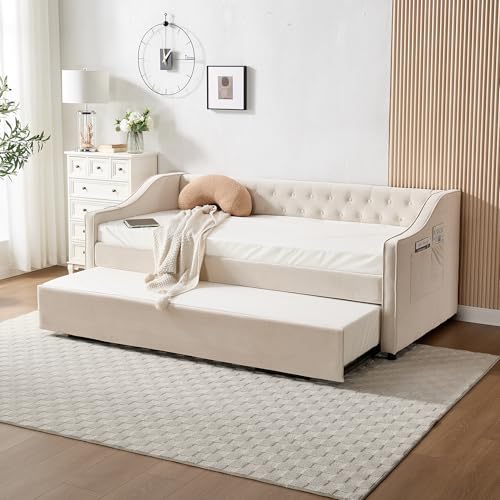
Luxurious Button-Tufted Daybed: Elevate your guest room, bedroom, or apartment with this stylish velvet daybed. Featuring deep button-tufting for sophisticated comfort, it effortlessly transforms from a chic sofa by day to a cozy twin bed by night, maximizing your living space.

Fashion & Comfortable Design: Enhance your bedroom with our 52.1" high wingback headboard, beautifully upholstered in soft linen. Its neutral tone effortlessly complements any style, from modern to classic
3. Vertical Storage
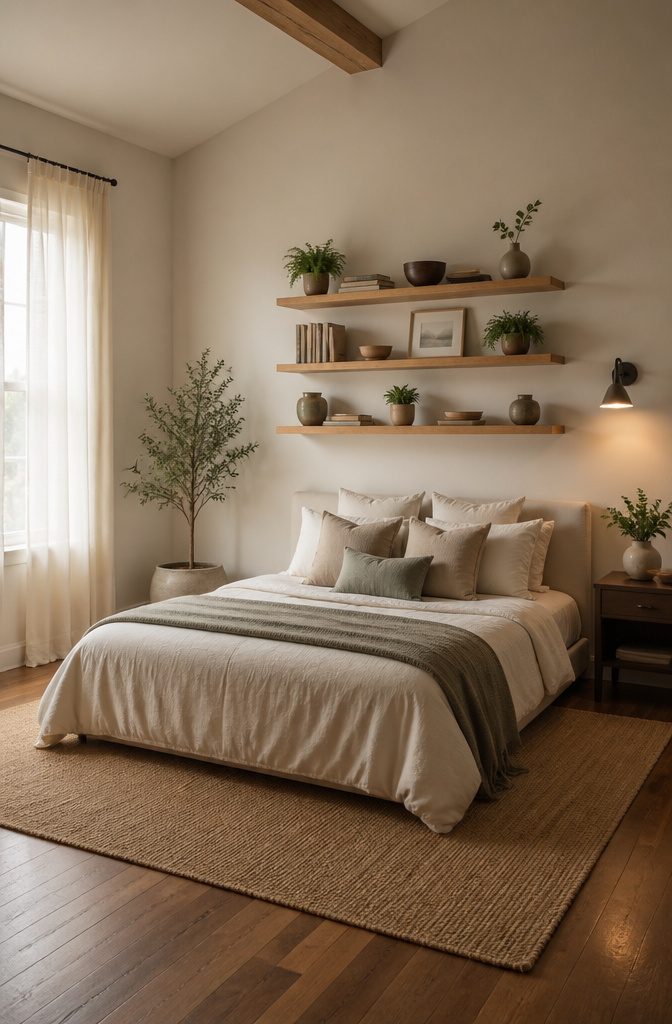
Wall-mounted shelves keep storage off the floor without the visual weight of a bookcase.
I learned this the hard way in my first rental: three floating shelves above the bed looked sleek at first, but I loaded them with everything I owned and the wall felt like it was closing in.
The line between curated and cluttered is about twelve inches of empty wall between groupings. Give each shelf breathing room, and treat the wall as a composition rather than a filing system.
Slim floating units work best for books, small decorative items, and mementos you want visible.
Keep what you reach for daily at waist height or below; anything higher becomes storage you forget you have. In a nursery or kid’s room, this rule matters even more.
For renters, the usual damage deposit fear kicks in. Picture ledges with a shallow lip give you the same vertical real estate but sit on two small brackets you can patch with a dab of spackle later.
I’ve also seen people mount a single long shelf above the door frame for out-of-season items in bins; it uses dead space and keeps the eye level calm.
Wall sconces paired with shelf lighting add ambient layers without sacrificing nightstand space. A single overhead fixture alone flattens a small room; the combination of upward and task light keeps the walls from feeling oppressive after dark.

ABSTRACT TEXTURED WALL ART: Modern abstract framed canvas wall art set of 3, 12x16 inches each. Features thick impasto brushstrokes with geometric blocks in neutral earth tones. Gallery-wrapped on sturdy wooden frames, ready to hang. Perfect minimalist statement piece for contemporary interiors.

【Vintage Floral Book Wall Art】Bring warmth and literary charm into your home with this elegant stacked book design. Perfect as book wall art and stylish book wall decor, this artwork blends vintage books with soft botanical elements for a cozy and timeless aesthetic.

Framed Wall Art: This 57 x 28.5 inch large wall art features a brown neutral abstract design with layered flowing lines and a wide horizontal layout Finished with a black wood frame with a 1.38-inch frame thickness, it adds depth, structure, and a clean finished edge around the artwork while giving the piece a refined gallery-style presentation
4. Zoned Layouts
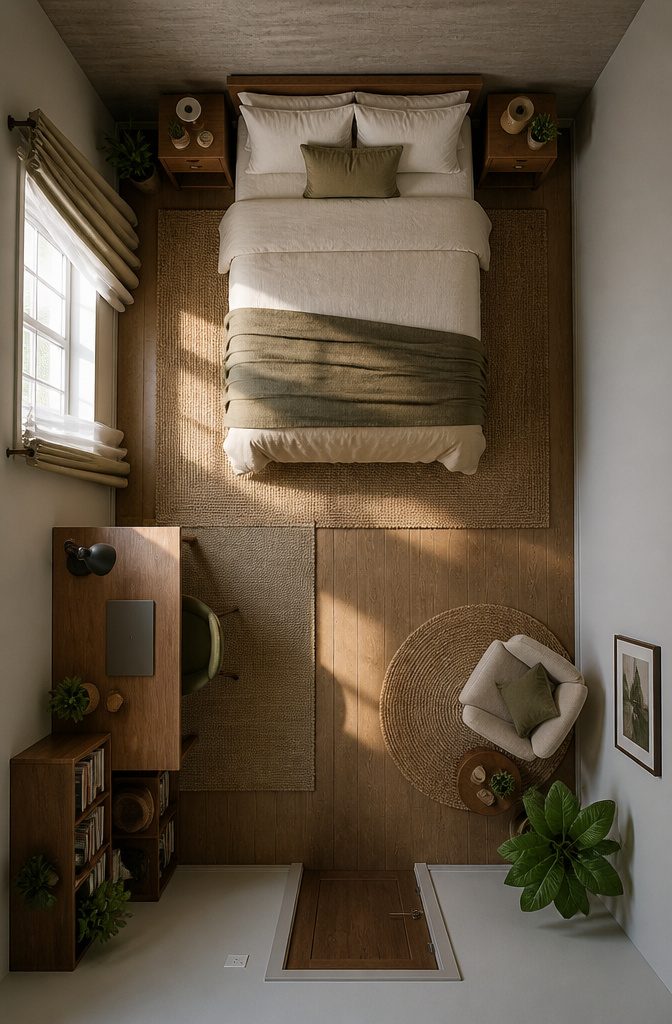
The bedroom I sleep in now is long and narrow, and for months I treated it like one box for everything.
The bed sat wherever the wall was longest, the desk angled into the leftover corner, and the whole space felt like a hallway with a mattress in it.
What changed was splitting it into three actual zones instead of one crowded room.
Center the bed on the wall opposite the door, not shoved to a corner. This gives the room its axis, the same way a hotel room does: walk in, see the bed, feel the space open around it.
In a long room, pushing the bed to one side instead lets you split the remainder into a sitting area and a workspace, each with its own rug or wall color so your eye reads them as separate rooms.
The sources all agree on the bed placement but skip the tape measure entirely. One mentions 22 inches of walking space on three sides of the bed; another says 60–70 centimeters around key pieces, which converts to roughly the same range.
No one gives the distance from desk to bed or where to cut the rug, so you’ll mark that out with painter’s tape and walk it yourself.
I kept the desk out of my sightline from the pillow.
The chair’s back faces the bed so work stays work and sleep stays sleep. That boundary, invisible but real, is what makes the zone idea actually function.

BOHO TASSEL GARLAND DECOR — Handmade terracotta tassel garland adds cozy earthy texture to bedrooms, bathrooms and classrooms. Neutral warm tones complement any boho, western or fall aesthetic.

Elegant Boho Wall Art Design: This beautiful set of 3 botanical floral canvas prints features an abstract blend of burnt orange, terracotta, and jungle tones, capturing the essence of nature and tropical plants. The artwork combines boho decor aesthetics with mid-century modern influences, making it a vibrant and eye-catching addition to any room

Vintage Gallery Wall Art : This neutral-toned, frameless vintage wall art piece infuses home decor with nostalgic charm and elegant style, creating a warm and inviting atmosphere that perfectly complements any interior space. Enjoy the DIY fun of framing it with your favorite picture frame.
5. Layered Textures and Color
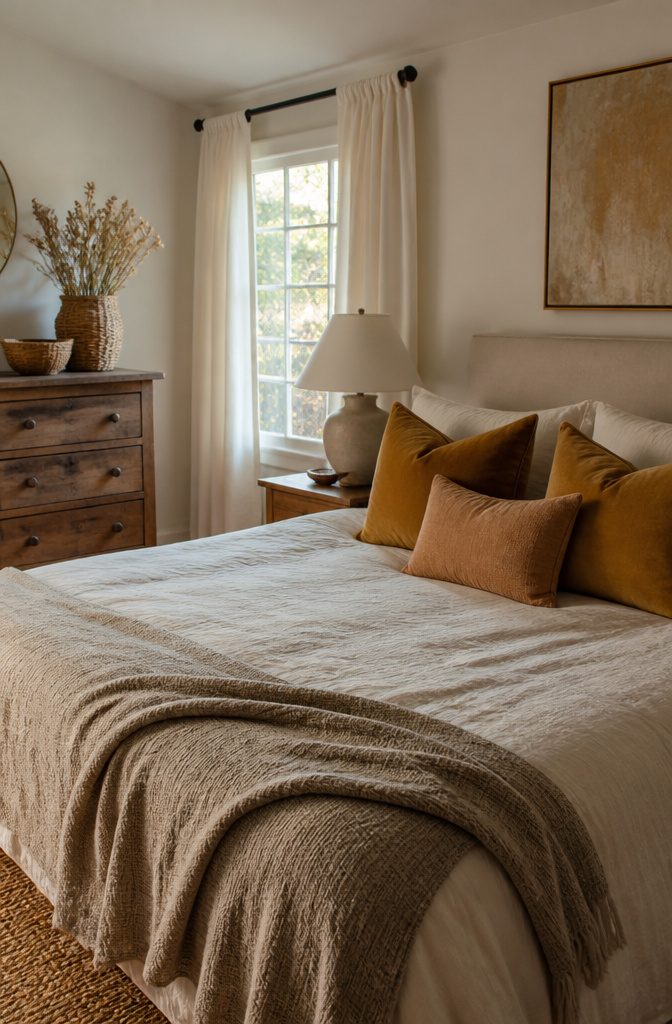
A bedroom built only around storage and empty surfaces can feel like a showroom, not a room you sleep in. The fix is layering materials within a tight color range so the space stays calm but alive.
I started paying attention to this after noticing how a single warm white wall can read as flat once the lights dim.
Layering finishes within the same color family stops that deadness. Think woven grass cloth or a subtle wall treatment against velvet pillows and linen sheers, all in varying shades of honey or stone.
The eye reads the difference in texture even when the tone barely shifts, so the room gains depth without the clutter of competing colors.
For renters, this is practical. Paint and textiles are easier to change than built-ins, and a restrained palette means your next set of sheets still matches.
The 60–30–10 rule keeps it grounded: roughly sixty percent dominant color, thirty secondary, ten accent. In my own reading, the designers who pull this off skip the accent more often than you’d expect and let the materials carry the interest.
Warmth in a bedroom should come from what you touch and see up close, not from adding more objects. A tonal approach with real texture does exactly that.

SLEEK, STYLISH ROOM DÉCOR : The Live Snake Plant (Sansevieria) is a versatile, beginner-friendly houseplant that adds texture to any space. Its architectural leaves deliver a classic look for tabletops, desks, and windowsills in any home or office

✅Unframed Wall Art Poster Print - ALPINE INK CO. wall art posters are unframed and printed in standard sizes from 8x10 to 24x32 inches. This allows you to your wall decor with a frame that matches your home, kitchen, or office style.

INSTANT ROOM DÉCOR UPGRADE: The architectural upright leaves of this live Snake Plant provide a modern, sleek look that defines minimalist decor. An excellent, stylish choice for a floor accent in your home or offlice
6. Three Kinds of Light
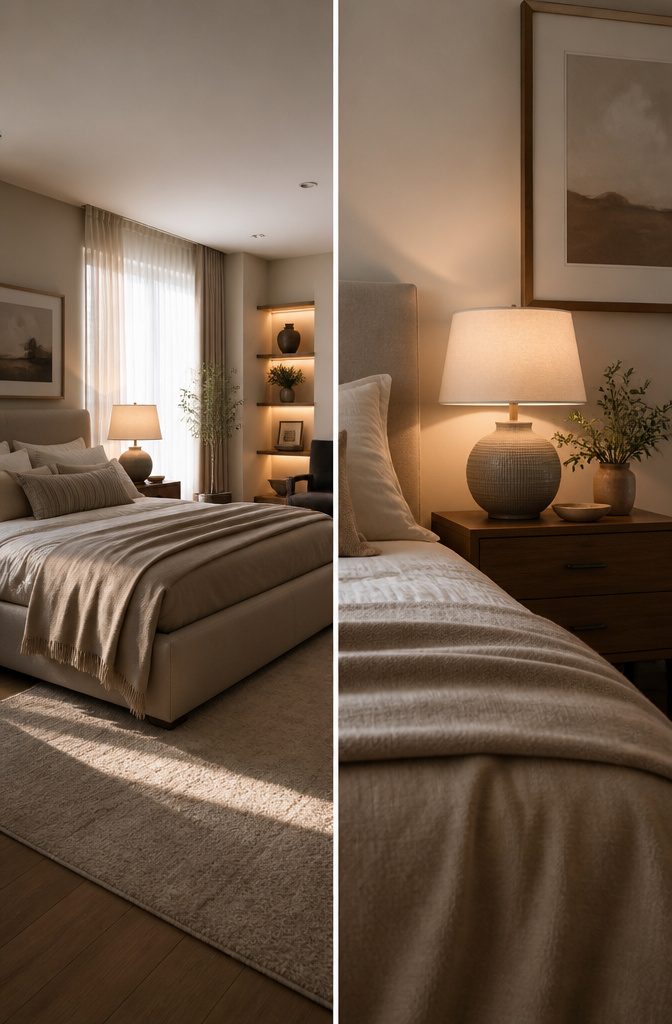
Bedrooms need three kinds of light working together, not one ceiling fixture trying to do everything. Natural light during the day, warm LED lamps at night is the pairing that actually supports sleep rather than fighting it.
Ambient light sets the base. An overhead fixture works if it hangs high enough and fits the room’s scale.
Wall sconces are the better pick in tight spaces or for anyone who wants to skip ceiling wiring drama. They free up surface area while still giving that soft, room-filling glow.
Task light is what keeps you from squinting at your book or your phone charger.
Bedside lamps belong exactly where the name says: beside the bed, close enough to reach without sitting up fully. A dresser lamp matters too, for folding laundry or sorting tomorrow’s clothes after dark.
Accent light is the thin margin that makes a room feel finished. Salt lamps, fairy lights, and dim LED strips add that layer of calm without asking for much money or outlet space.
The real choice is in control.
Programmable blackout shades can sync with sunrise and sunset, letting morning light in and sealing it out at bedtime so melatonin can do its job. Without that timing, even the right fixtures become decoration instead of function.

[Murphy Bed with Desk] The Queen Size Murphy Bed boasts a unique design that effortlessly transitions from bed mode to desk mode, making it an ideal addition for small spaces like studios, study rooms, or home offices. You can have a dedicated office space by day and a comfortable guest bedroom by night.
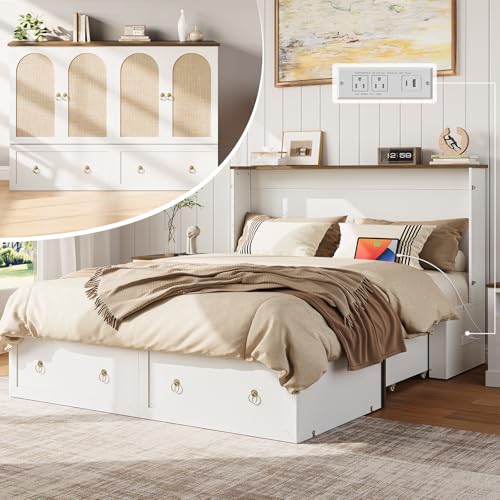
【2-in-1 Murphy Bed Queen】Retracts into a compact cabinet measuring 62.6"W x 23.9"D x 43.3"H to save space. Unfolds into a bedframe measuring 81.9"L x 62.6"W x 43.3"H to host overnight guests instantly, ideal for small homes. Mattress not included

【Dual Functionality】Bed & Storage Cabinet, maximize your space effortlessly with our Murphy bed's dual functionality. Use it as storage cabinets when folded, or unfold it into a comfortable bed when needed, ensuring clutter-free spaces
7. Declutter Systems
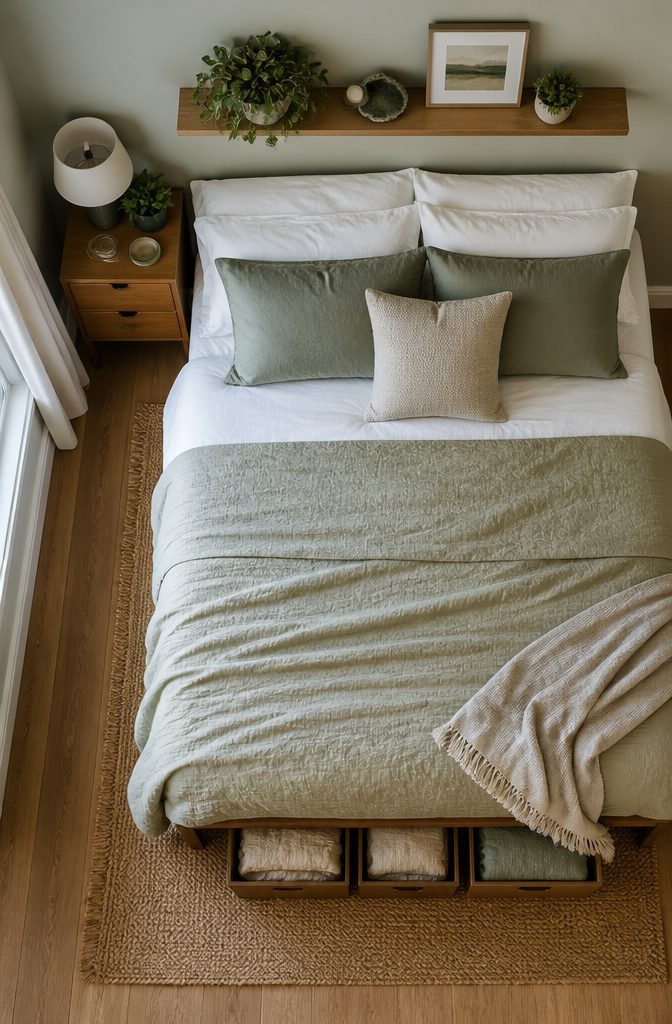
A declutter system only works if it survives the Tuesday night when you drop clean laundry on the chair and keep going. I learned that the hard way after three weekends of perfect closet installs collapsed by Thursday.
The split that matters is permanent removal versus accessible storage. Anything that leaves the room for good needs a harder filter than you think.
My rule now: if I have not touched it in two bedroom seasons, it goes to the donation bin that same afternoon, not to a maybe box that becomes a new junk drawer.
What stays needs a home you will actually use.
Nightstands with drawers beat open shelves for the stuff you reach for half-asleep. A nightstand within 2–4 inches of your mattress top keeps your phone charger and lamp at the right height without the visual noise of everything sitting out.
For the weekend timeline, skip the full closet rebuild. One Saturday gets you sorted if you limit the project: pull everything out, run the two-season test, then add one drawer organizer or underbed bin per category that failed.
The bed itself is your biggest storage opportunity. A storage bed or ottoman holds the bulky items, spare bedding, or off-season clothes that used to live in the laundry pile.
Vertical space helps, but keep frequently used items low. Floating shelves or a full-height bookshelf work for books and mementos you want to see, not the daily clutter you need to hide.

Note: This daybed does not include mattresses, it consists only of the bed frame.

Space-Saving Storage: With its lifting up storage feature, this bed frame provides ample space to store extra bedding, clothing, shoes, and other items, especially helpful for smaller bedrooms or apartments where storage space is limited

Materials: Crafted from premium, heavy-duty Oxford fabric, this storage duffle bag features reinforced webbing handles (extra thick and wide) and a heavy-duty two-way zipper. Strengthened by precision stitching, it's built to last for both travel and storage.
8. Plants That Survive Bedrooms
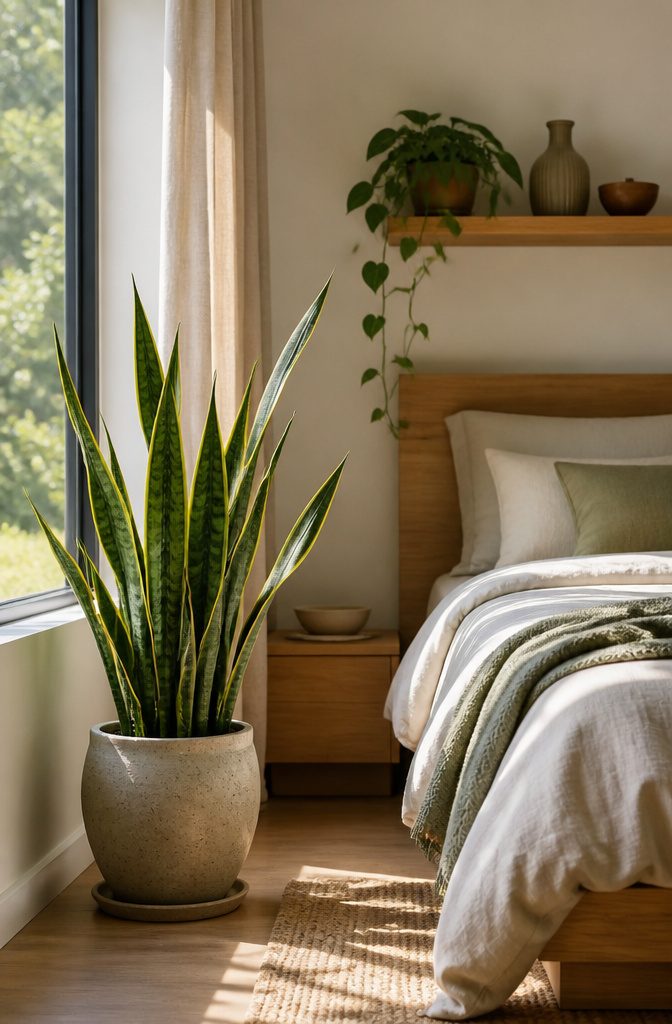
A rubber plant, devil’s ivy, or snake plant will handle a bedroom’s low light and your weekend-warrior schedule without turning brown out of spite.
The sources back this up: these three tolerate the corner opposite your window, the shelf above the headboard, or that narrow strip between the dresser and wall where nothing else survives.
Placement matters more than variety.
A plant on the nightstand catches water rings and crowds your phone charger; hanging devil’s ivy from a ceiling hook or setting the rubber plant on the floor in the corner keeps surfaces clear for actual function.
Floor plants work in the dead space where walking paths don’t reach. Small succulents on the bedside table look cute in photos, but they need more light than most bedrooms offer and more attention than you’ll remember to give.
Snake plant, in particular, survives the kind of neglect that comes from a project-heavy life where Tuesday’s plant care gets buried under Wednesday’s shelf install.
It does not ask for misting schedules or fertilizer calendars. Water when the soil is dry, which in a bedroom’s low humidity means roughly every two to three weeks, and it will outlast your lease.
One snake plant in the corner opposite your bed adds the green without the guilt.

Track Your Travels Across the USA – This earth tone USA map with pins doubles as stylish wall décor and an interactive travel tracker. Mark states you’ve visited and plan future road trips while creating a visual story of your journey.

Boho Wildflower Wall Art: This 3-piece AUUAUU wall art set features delicate watercolor wildflower and botanical designs, with soft earthy tones and organic brushstrokes. It creates a warm, serene focal point for boho and modern home decor, instantly elevating any blank wall with timeless natural charm.

Neutral Landscape Wall Art:This framed artwork features a quiet open landscape with soft rolling fields, a distant horizon, and a muted sky, creating a peaceful and reflective atmosphere. The understated composition and gentle painterly texture bring a calm vintage character to the piece, making it a beautiful wall accent for spaces that call for warmth, balance, and visual ease.
Bed Placement and Walking Space
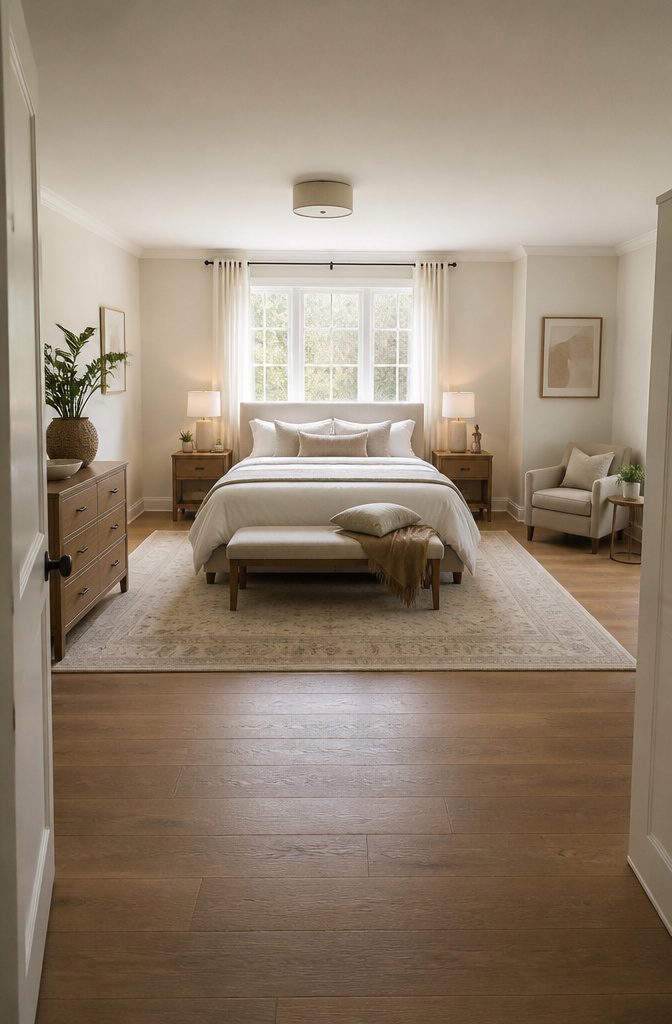
A queen bed needs 22 inches of walking space on both sides and the foot to keep the room from feeling cramped. Less than that, and you’re shimmying around furniture every morning.
The wall opposite the door usually wins for bed placement. Walking in and seeing the bed centered there sets the focal point immediately, the way hotel rooms handle it.
In a long bedroom, though, pushing the bed to one side splits the leftover space into two usable zones, maybe dressing and sitting, rather than one awkward corridor.
Windows complicate this. Sources vary on whether the bed should face one directly.
Two ways to play it: position the bed so you see the window from it without being right under it, or treat an exposed brick wall or other architectural feature as the anchor and let the door sightline fall where it may.
For clearances beyond the bed, 60–70 cm around key pieces keeps circulation honest.
In a tight room, a platform bed with storage replaces the dresser, and floating shelves plus wall-mounted lamps take over from nightstands. The floor space you save matters more than the furniture you lose.

Multiple Sizes & Framed Options:This women reading book canvas wall art is available in 5 common sizes: 8×10, 12×16, 16×24, 20×30, 24×36 inch. Pre-framed artwork is well protected with shockproof packaging during transportation. 4 different frame styles are provided for your home decoration needs. Each framed print comes with hanging accessories, allowing easy installation right after unpacking.

Bohemian Plant Wall Art:Bohemian Floral Wall Decor Art Dimensions Are 12x16 Inch30x40 cmx3 Pcs pls notice that the painting is not framed now you need to framed it by your self

Machine Washable & Stain-Resistant: Effortlessly clean this rug in your washing machine on a gentle cycle; made from high-quality faux wool fibers that resist stains, spills, and shedding, making it ideal for busy households with kids and pets.
Feng Shui I Actually Use
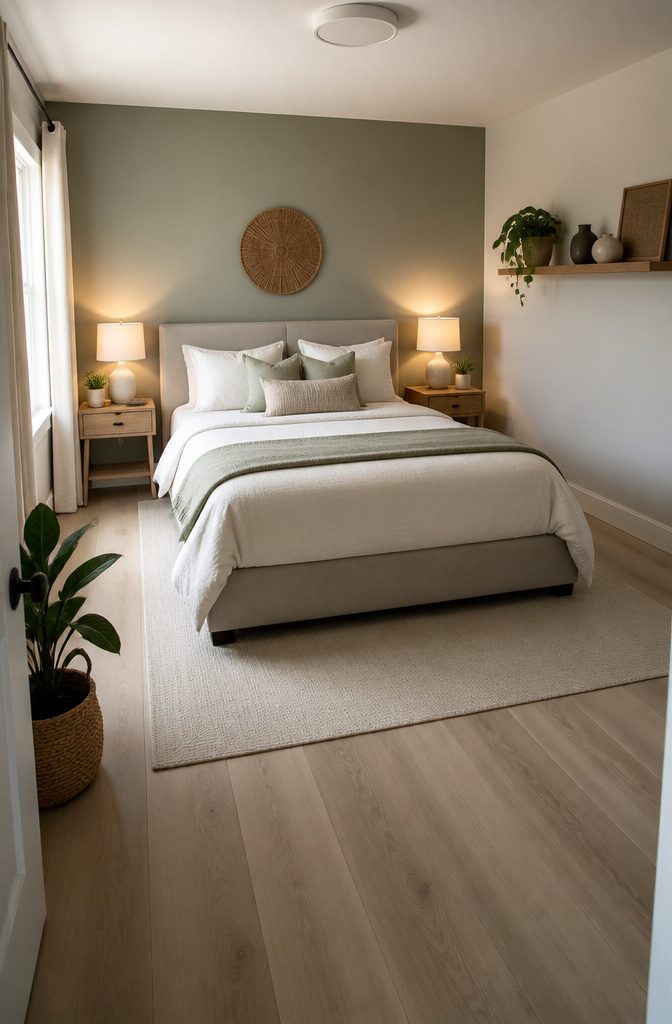
The bed placement advice that actually changed how I sleep came from stripping feng shui down to what fits a rented rectangle.
Against the wall opposite the door, centered, with matching nightstands on either side if the room allows it: this is the symmetry that matters, not the compass.
Leave at least 24 inches of walking space around the bed; anything less and you are climbing over furniture at midnight.
I have lived with the bed shoved in a corner to save space, and the corner wins nothing back in sleep quality.
The centered placement against a solid wall, visible from the entrance but not dead-on facing the door, is the arrangement hotel architects keep using because the brain settles faster.
Window symmetry is a gift, not a requirement. If two windows frame a wall evenly, the bed between them with nightstands under each sill gives you built-in balance without buying matching lamps.
If your room is long and narrow, the bed offset to one side can split the remainder into a dressing zone, but the sleep side still needs that centered, anchored feel.
What I discarded: the directional rules, the element colors, the mirror placement prohibitions.
None of them survived a test against my actual morning. What stayed was the spatial logic of not being startled by the door, of not blocking my own path, of waking up to a room that holds still around me.
✅Unframed Wall Art Poster Print - ALPINE INK CO. wall art posters are unframed and printed in standard sizes from 8x10 to 24x32 inches. This allows you to your wall decor with a frame that matches your home, kitchen, or office style.
✅Unframed Wall Art Poster Print - ALPINE INK CO. wall art posters are unframed and printed in standard sizes from 8x10 to 24x32 inches. This allows you to your wall decor with a frame that matches your home, kitchen, or office style.
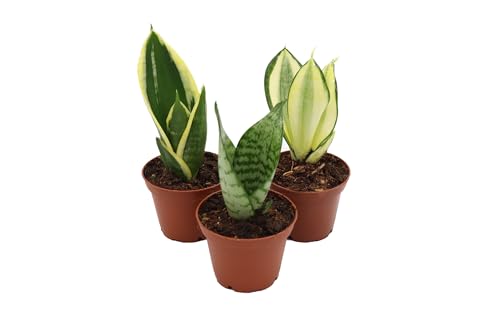
Light: Snake plants are quite adaptable to different light conditions. They can thrive in low to bright indirect light. They will do best in bright, indirect light but can also tolerate low light.
Small Bedroom Product Picks
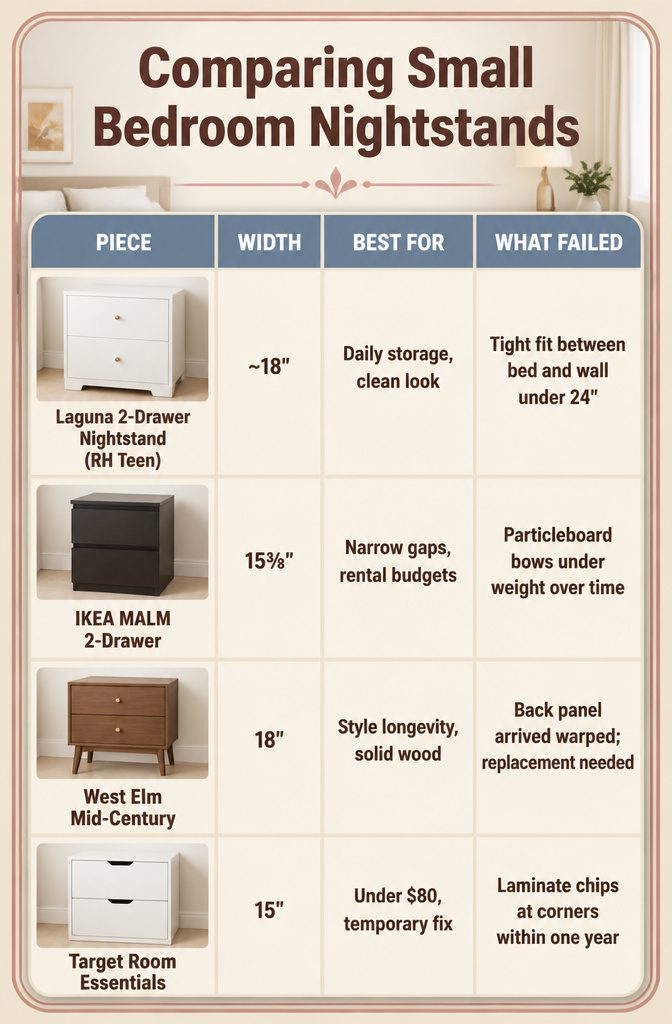
A nightstand either earns its floor space or becomes a drawer where the remotes go to die.
Most small bedrooms need something between twelve and sixteen inches wide, and depth matters more than width because the bed frame determines your walkway.
The ** Laguna 2-Drawer Nightstand from RH Teen** has held up better than expected through two years of daily use.
The drawers slide on metal hardware, not plastic, and the white lacquer finish has survived multiple coffee rings without staining. At around eighteen inches wide it pushes the limit for truly tight spaces, so measure your clearance first.
| Piece | Width | Best For | What Failed |
|---|---|---|---|
| Laguna 2-Drawer Nightstand (RH Teen) | ~18" | Daily storage, clean look | Tight fit between bed and wall under 24" |
| IKEA MALM 2-Drawer | 15⅜" | Narrow gaps, rental budgets | Particleboard bows under weight over time |
| West Elm Mid-Century | 18" | Style longevity, solid wood | Back panel arrived warped; replacement needed |
| Target Room Essentials | 15" | Under $80, temporary fix | Laminate chips at corners within one year |
Skip anything with a glass top. It shows dust by noon and cracks when you set a lamp base down slightly off-center.
Budget and Timeline Reality
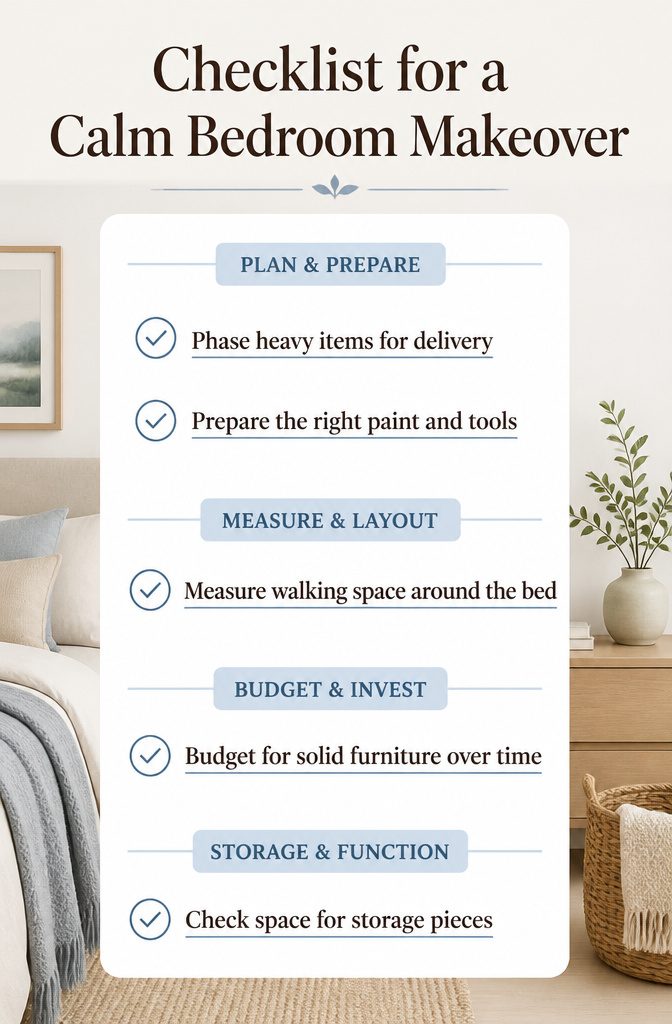
A calm bedroom doesn’t arrive all at once, and trying to force every idea into one weekend is the fastest way to a half-finished mess.
Phase the heavy items: the bed frame, storage pieces, lighting. These need delivery windows and another pair of hands, and swapping them in stages lets you sleep in the room the whole time.
Paint, hardware swaps, and shelf installs are your Saturday projects. Two coats of a muted mid-tone on Saturday, dry overnight, hardware and shelving Sunday afternoon.
The budget sting comes from treating furniture as disposable. A solid pine dresser with swapped pulls outlasts three particleboard replacements, and the cost difference narrows fast over five years.
I learned that after replacing a pressed-wood nightstand that swelled from winter humidity. The walking space around your bed matters more than the exact bed dimensions; measure your stride with arms full of laundry, not just the tape measure.
What I Got Wrong
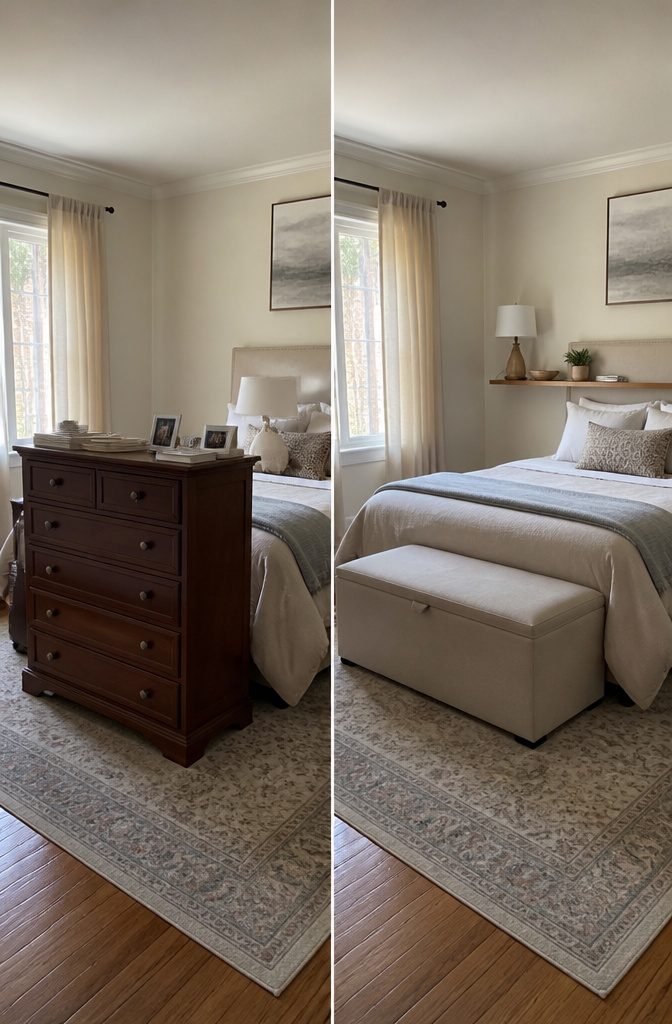
The first dresser I bought for my bedroom was a wide six-drawer piece I placed opposite the bed because every layout diagram I saw suggested that symmetry.
It swallowed the walking space. Getting from the door to the closet meant edging past the corners, and the room felt smaller, not balanced.
Leave at least 60–70 cm of clear circulation around any large piece, and in a compact bedroom that rule eats your furniture list fast.
I swapped it for a storage ottoman at the foot of the bed and a slim wall-mounted shelf above it.
The ottoman holds linens; the shelf takes a lamp and a phone charger. The floor space returned, and the room actually calms down when you can walk straight through.
The dresser moved to the living room, where the wider footprint works. For small bedrooms, dual-purpose pieces win only if they fit the circulation first; storage that blocks your path turns into clutter you walk around every morning.
Frequently Asked Questions
How can I make the most of my small bedroom?
Choose each piece deliberately so it serves the calm mood you want, not just a function.
Earthy, muted tones settle the eye rather than demand attention, and fewer high-quality multifunctional pieces beat a crowded room of single-purpose items. A storage bed or ottoman handles bulky items while keeping floor space open for walking.
What’s the best approach to furniture in a small bedroom?
Focus on fewer pieces that work harder. One solid multifunctional item, like a lift-up storage bed or a desk that doubles as a nightstand, usually beats two cheap single-purpose ones.
Measure your open floor space with the bed in every position it offers before buying, and make sure the secondary function fits your actual habits, not your ideal ones.
How do I plan a layout for a small bedroom?
Center the bed on the wall opposite the door to give the room its axis, then build zones around it.
Keep 22 inches of walking space on both sides and the foot of a queen bed, or 60–70 cm around any key piece, so you are not shimmying through your own room.
In a long, narrow space, offsetting the bed to one side lets you split the remainder into distinct sitting and dressing areas with their own rugs or color breaks.