
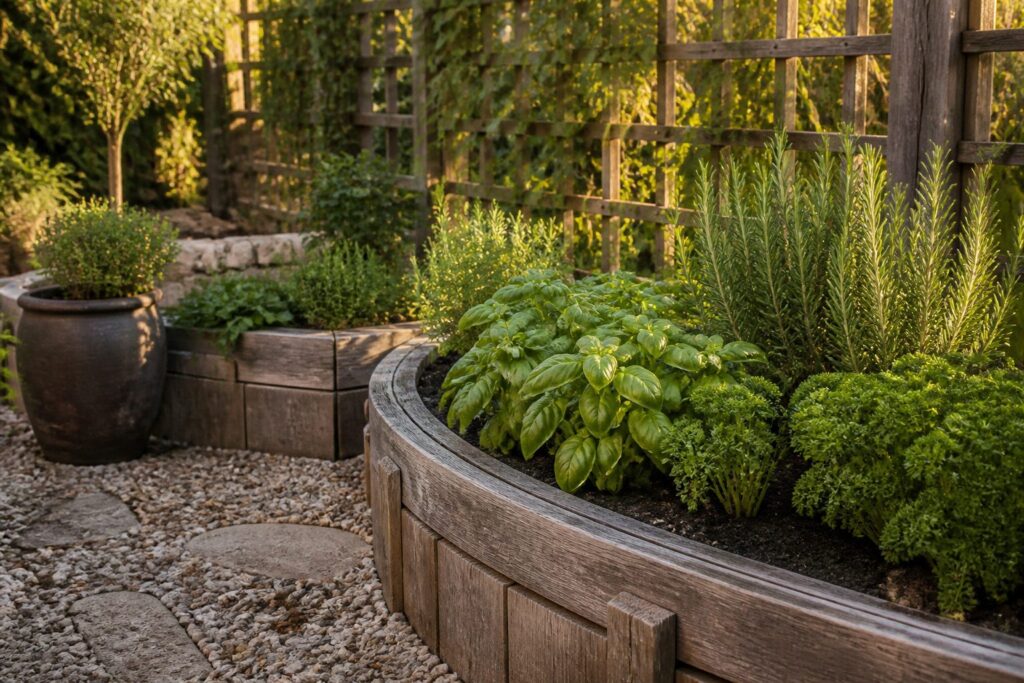
Growing herbs outdoors is the practice of cultivating culinary plants in open garden beds or containers rather than inside. It only works if you match each herb to the right light, soil, and water profile.
Rosemary and basil want six hours of direct sun and lean, gritty soil amended with compost and horticultural grit, while parsley and cilantro need richer, consistently moist ground.
Place the bed near your kitchen door, and you will actually cut from it.
Choose a Sunny Spot Near the Kitchen
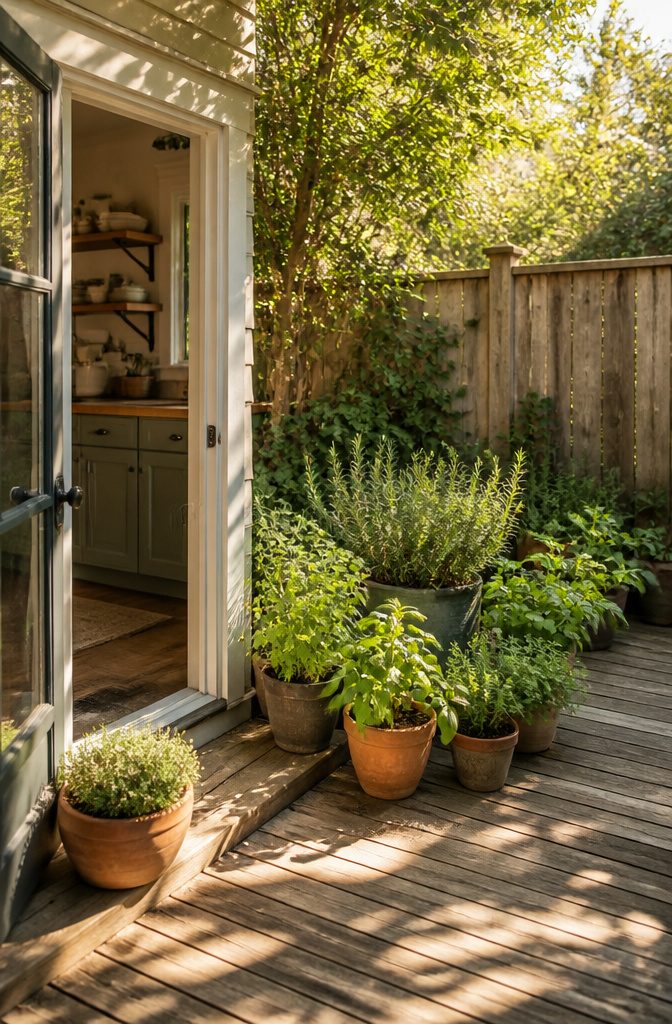
Most herbs want at least six hours of direct sunlight daily to produce the leaves you’re actually growing them for. Rosemary, oregano, and basil sit at the hungriest end of that range and will stay sparse and leggy without it.
Before you commit a bed or container to the spot, watch how the light moves across it through a full morning and afternoon.
A corner that looks bright at 10 a.m. can fall into shadow by 2 p.m. when a fence or the house itself blocks the low-angle sun.
Placing the garden close to your kitchen door is not just a nice idea. It is the difference between herbs that get used and herbs that get forgotten.
When thyme for a weeknight sauce means a thirty-second walk instead of a muddy trek to the back corner of the yard, you will cut from it regularly.
That same proximity also makes it easier to notice when plants need water or when something has started to bolt.
A sheltered spot still matters, especially if your area gets wind that can dry pots out fast, but sun and access are the two factors that should drive the decision.
Fix the Soil with Compost
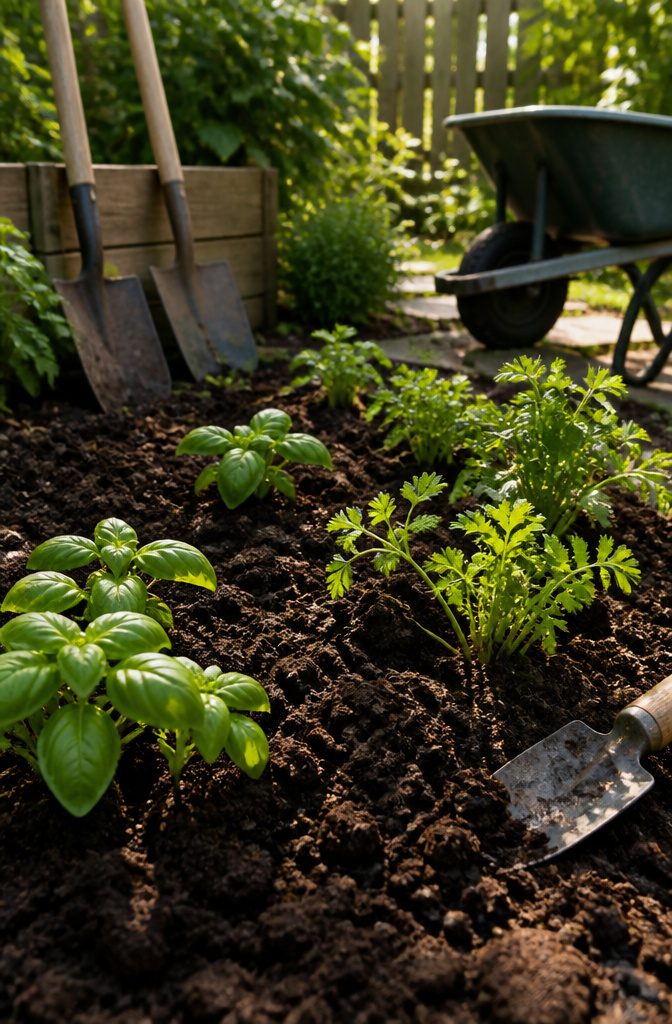
Heavy clay soil is the fastest way to kill an outdoor herb garden. Water sits around the roots instead of moving through, and Mediterranean herbs like rosemary, thyme, and oregano turn yellow and rot before you figure out why.
The fix is mechanical, not chemical: dig in plenty of compost and horticultural grit to break up that dense structure and open drainage channels.
Annual herbs such as basil, parsley, and coriander want more organic matter than their Mediterranean cousins, but the same principle holds.
Compost improves the soil’s texture without pushing fertility into the range that actually hurts flavor. Many herbs produce their strongest taste when grown steadily rather than forced into fast, soft growth with rich conditions.
That is why I skip the fertilizer here and lean on compost alone. It gives annual herbs enough moisture retention while keeping the ground lean enough for perennials.
If your site is truly compacted, work the compost and grit in deeply rather than top-dressing; surface layering will not break the pan that traps water at root depth.
Group Herbs by What They Need
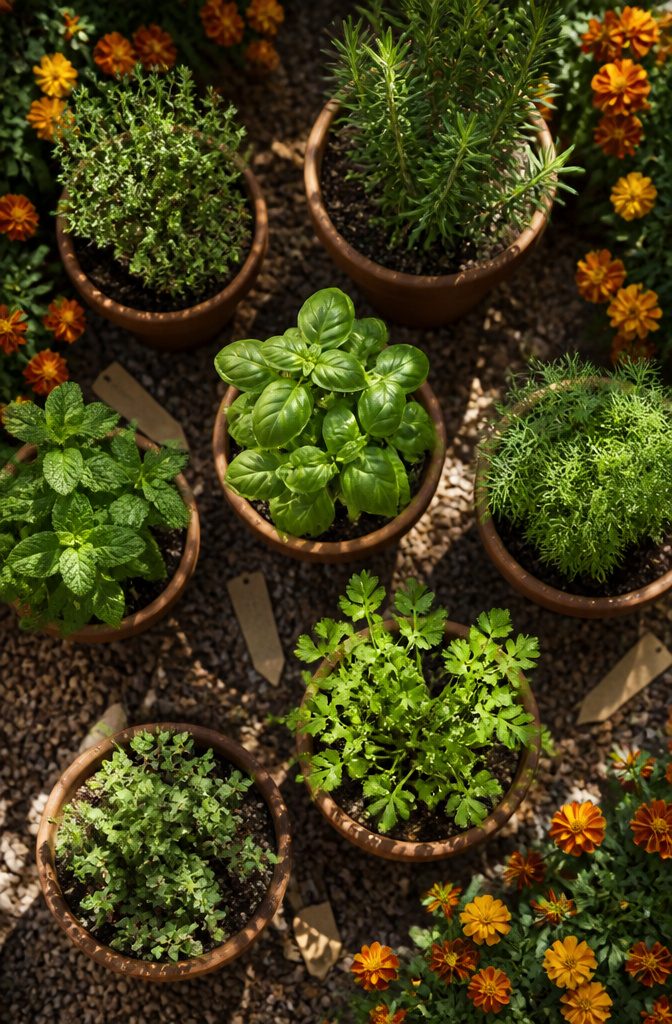
Most culinary herbs need at least six hours of direct sun each day, but sun alone does not decide where a plant goes. Match the full profile of needs, soil moisture above all.
Mediterranean perennials like rosemary, thyme, oregano, sage, lavender, and marjoram want lean, well-drained soil that dries between waterings. They belong together, whether in a raised bed or clustered at the edges of a container.
Annual and biennial herbs like basil, parsley, cilantro, and dill prefer richer, more consistently moist soil; crowd these toward the center of a pot where evaporation slows, or give them their own bed with more organic matter.
Chervil, chives, mint, and lemon balm tolerate partial shade, though mint and lemon balm spread aggressively and need their own contained space, pot or dedicated plot, or they will overrun neighbors.
Fennel is the outlier: it inhibits most other herbs and should only pair with dill. Basil and rue, and both away from sage, also make poor bedfellows according to common practice.
If your garden has clay soil, Mediterranean herbs will struggle unless you loosen the bed with horticultural grit and organic matter.
That upfront effort matters more than any single plant choice: grouped wrong, a moisture-loving basil planted beside a drought-tolerant rosemary means one of them suffers no matter how carefully you water.
Plant at the Right Depth and Spacing
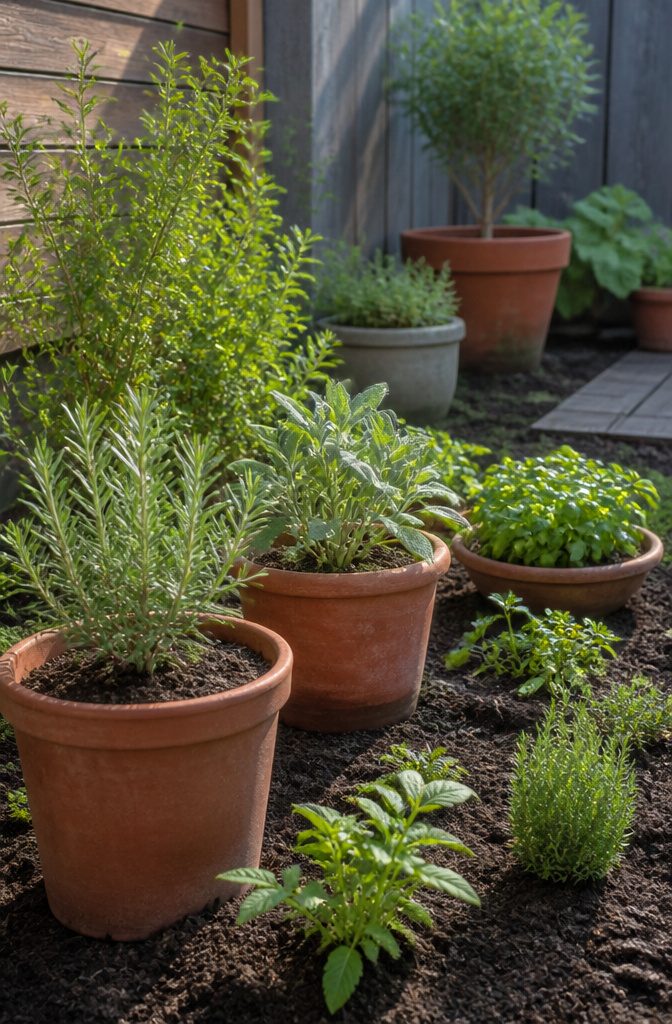
A young herb in a nursery pot always looks smaller than it will grow, so the arrangement on the ground before digging matters more than the arrangement in your cart.
I lay every pot in its planned spot and check the spacing label for each variety, because six hours of sunlight means nothing if the mature canopy blocks it.
Plant each herb at the same depth it sat in its nursery pot; too deep rots the stem, too shallow dries the root ball.
Loosen roots that have circled the pot, set the root ball in the hole, backfill, and water hard enough to settle the soil without leaving air gaps.
Mint and other aggressive spreaders need a physical barrier or their own container even at planting time; the space you save by squeezing them in costs triple the work later.
Rosemary, sage, and lavender all grow wider than their tags suggest, so the gap that looks generous in April looks right by August.
Water New Plants More, Established Ones Less
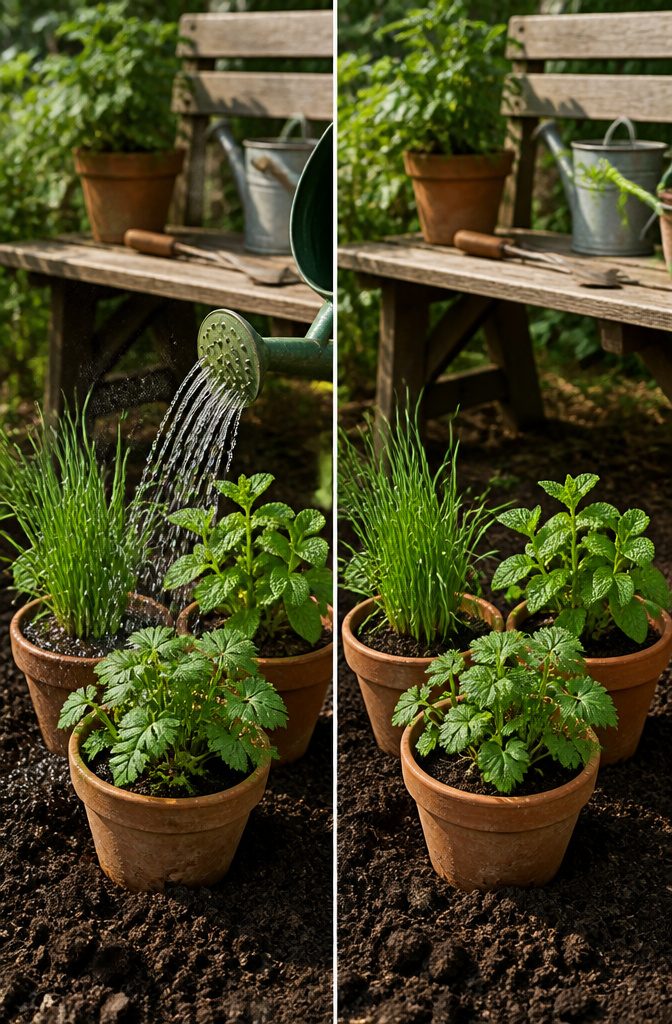
Newly planted herbs need consistent moisture while their roots settle in, which usually means checking the top inch of soil and watering whenever it starts to feel dry.
I water slowly at soil level in the morning, letting moisture reach the root zone without wetting the foliage over and over. Constantly soggy soil causes trouble even now, so I skip rigid schedules and read the soil instead.
Once herbs are established, the schedule splits. Soft-stemmed types like basil, parsley, cilantro, chives and mint appreciate steadier moisture, roughly an inch of water per week from rain or me.
Woody-stemmed Mediterranean herbs such as rosemary, thyme, sage, oregano and lavender prefer to dry out more between drinks, and in normal weather I often leave them to rainfall entirely.
Container plantings dry out faster, especially in hot or windy spells, so I check them daily and water to a six-inch depth when I do, making sure drainage holes are clear since Mediterranean types rot in sogginess while mint tolerates excess better than most.
Fertilize Lightly or Not at All
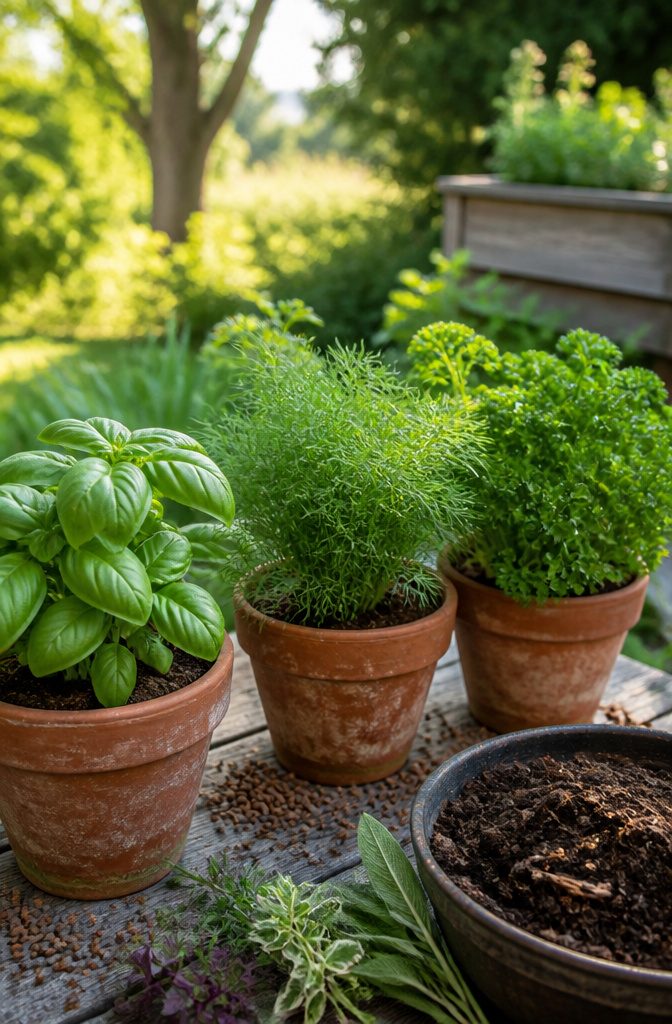
Herbs grown in soil already amended with compost rarely need extra feeding.
That lean soil you prepared, the one that drains well without being packed full of nutrients, is closer to what Mediterranean herbs evolved in than the rich beds meant for tomatoes.
Too much nitrogen produces soft, fast growth with weaker flavor and fewer of the aromatic oils you planted them for.
Watch the plants instead of fertilizing on schedule.
Pale leaves or stalled growth in a container that has been watered for months signals real hunger. When that happens, a balanced organic fertilizer at half-strength is enough.
Container-grown herbs need this more often because regular watering washes nutrients through the potting mix, but even there I start light and increase only if the plant asks for it.
Basil, dill, and parsley are the exceptions in my outdoor planting: they appreciate feeding about every three weeks. For everything else, restraint wins.
Harvest Before Plants Bolt
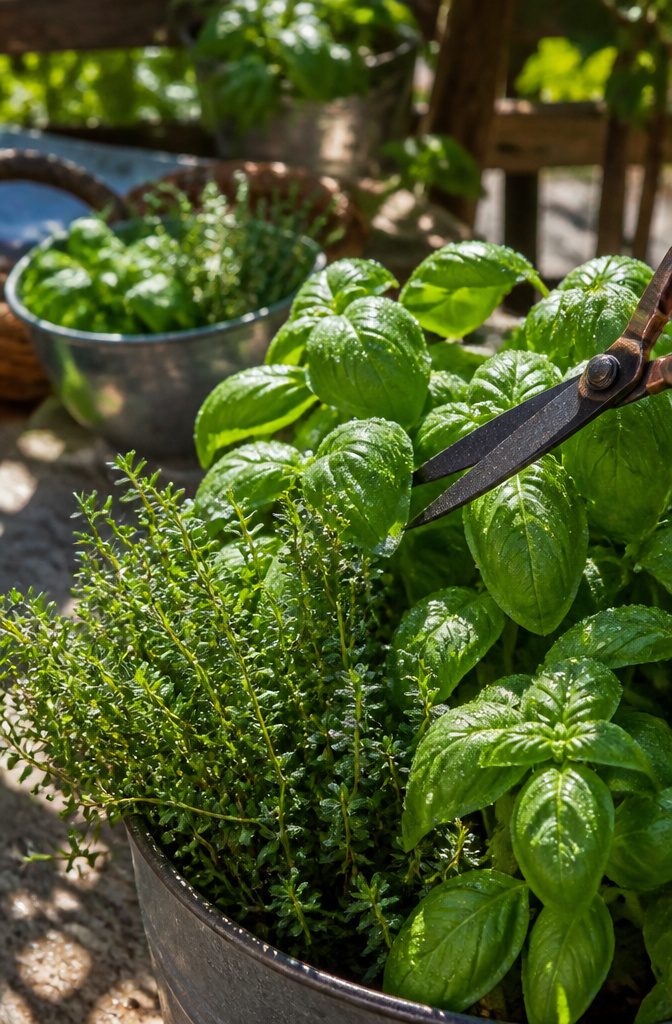
Regular harvesting keeps annual herbs producing leaves instead of racing to flower and set seed.
Snip stems just above a pair of healthy leaves, and never take more than one-third of the plant at once. That cut tells the stem to branch, giving you bushier growth and a longer harvest window.
Morning is the practical time to pick, after dew dries but before afternoon heat pushes essential oils back into the stem.
Basil in particular needs flower buds pinched off the moment they appear; once it bolts, leaf flavor turns sharp and the plant’s energy shifts entirely to seed.
For herbs you’ve picked heavily, a light feeding helps them recover. A liquid seaweed feed or comfrey tea works well, and a shot of high-potash tomato feed in midsummer toughens Mediterranean herbs against dry spells.
Skip the fertilizer if the plant already looks stressed from heat or transplanting; let it settle, then resume cutting once new growth shows.
Winterize or Bring Indoors
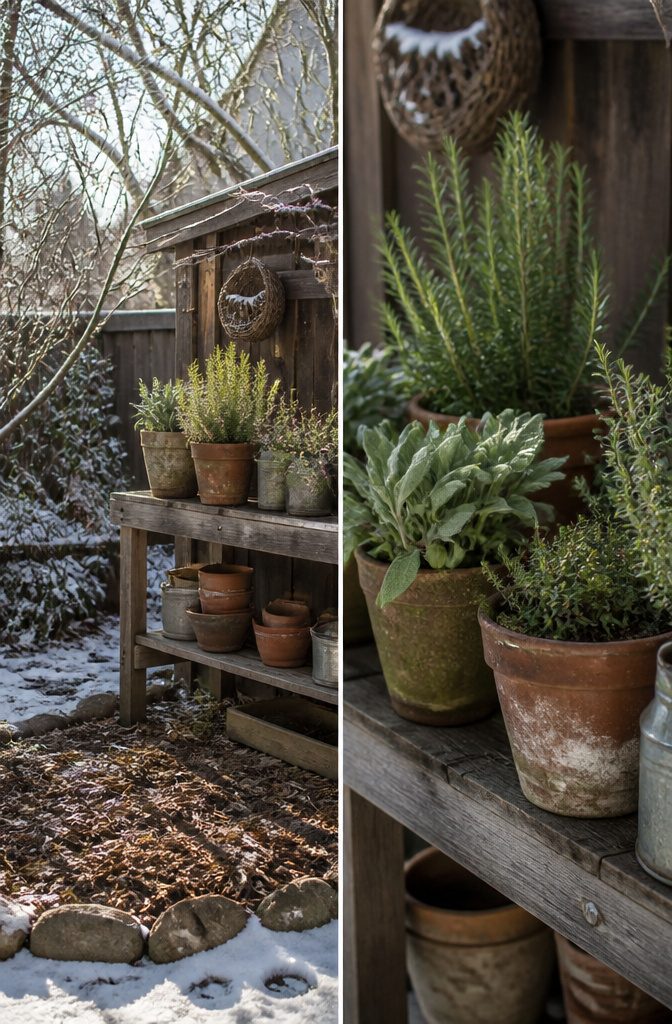
Tender herbs need a decision before the first hard freeze. Basil suffers damage well before freezing temperatures arrive, so I move it indoors early along with rosemary, thyme, sage, and lavender from the mint family.
Annuals like cilantro or dill stay outside; their taproots resent disturbance and replanting seed costs less than the effort of transition.
For herbs staying outdoors, drainage matters more than cover. Hardy perennials suited to the local zone handle winter fine if the soil drains properly.
I skip late-season fertilizer and mulch lightly only after the ground turns cold, not before. Warm mulch invites rodents and rot.
Indoor herbs drop productivity. Leaves grow smaller and sparser than they did outside, but the plants survive.
Come spring, they move back out to recover. Container herbs dry faster indoors; the same hot weather rule applies in reverse.
Check soil more often near heating vents, and keep drainage holes open. Mediterranean types rot fast in soggy pots, though mint tolerates excess moisture better than the rest.
Annual Herbs That Need Replacing
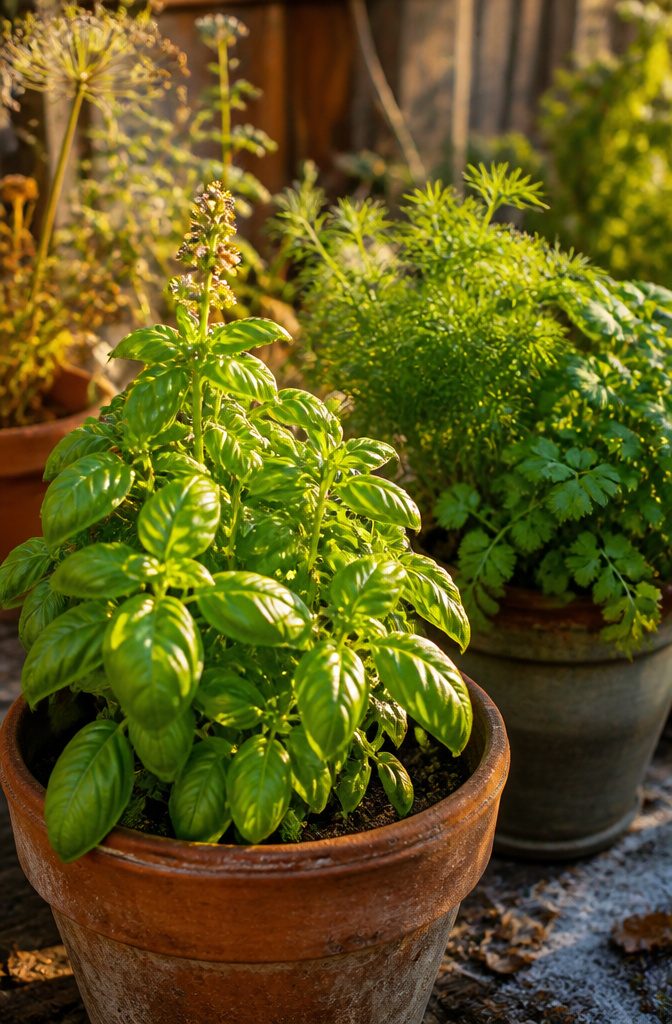
Some herbs finish their whole life in a single season and die with the first hard frost. Basil is the one most gardeners learn this on, because it is the annual herb people plant first and mourn last.
Basil wants full sun and soil that drains well. It is also especially sensitive to cold, and can suffer damage well before freezing temperatures arrive.
That tenderness means most of us grow it as an annual, replanting by seed or seedling each spring rather than trying to keep it through winter.
Other annual herbs that follow the same pattern include dill, cilantro, borage, and German chamomile.
Most members of the Apiaceae family, the group that holds dill and cilantro, complete their entire life cycle in one season. Parsley is the exception worth remembering: it is a biennial, surviving two years before it sets seed.
Perennial Herbs That Come Back
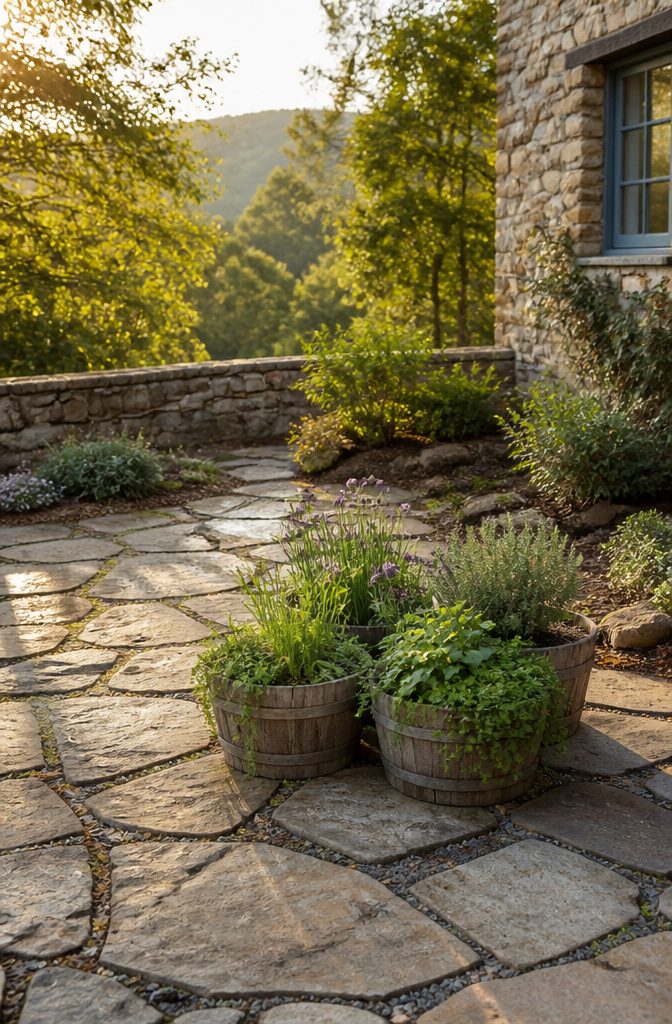
Thyme, oregano, chives, and rosemary share the one trait that matters most for a low-effort outdoor herb garden: they come back on their own.
Perennial herbs save you from replanting every spring, and these four are hardy enough to survive typical winters across most U.S. growing zones.
Thyme and oregano both hail from the Mediterranean, so they like sun, poor soil, and dry spells.
Thyme handles drought better than almost anything else in the herb bed; oregano wants its soil to dry out between waterings. Letting them sit in damp ground rots the roots faster than cold ever will.
Chives are the cold-tolerance outlier in this group.
They push through early spring chill and send up purple blossoms as a reliable return each year. They also take more consistent moisture than the Mediterranean pair, so I would not plant them in the same container.
Rosemary is the one caveat. It behaves as a true perennial only in warmer zones; elsewhere it needs winter protection or replacement.
The practical move is keeping it in a pot that moves indoors before frost. That same container habit works for any renter with a patio and a sunny window.
Herbs That Need Containment
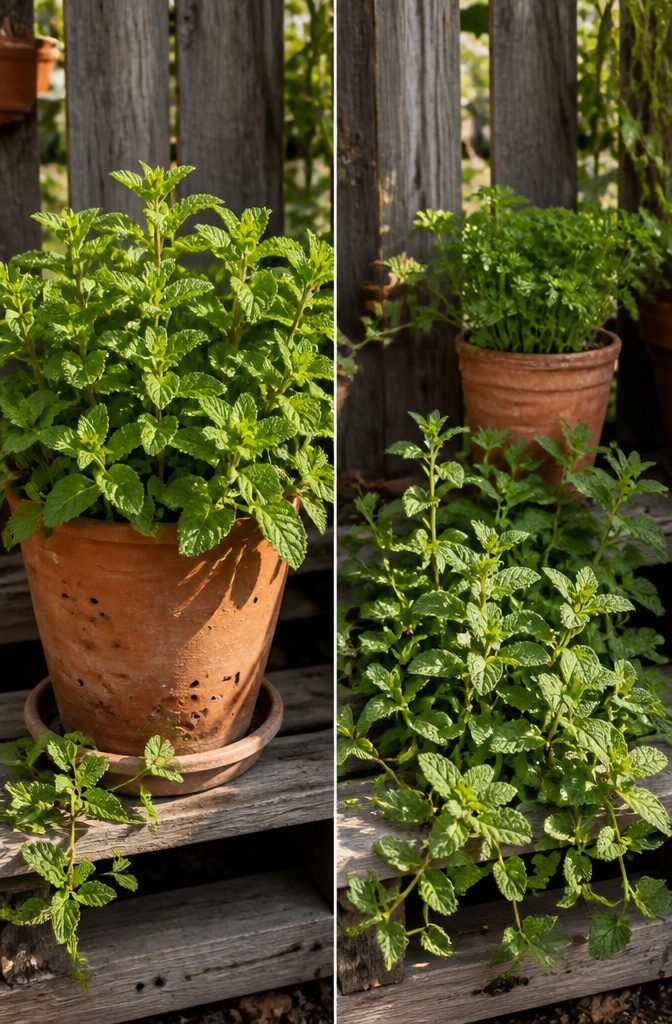
Mint is the herb that will teach you containment the hard way if you let it.
The same runners that fill a bed in a single season make it the plant to keep in a pot no matter what, preferably one with a saucer underneath to catch the escaping roots.
I learned to check the drainage holes every spring; a single overlooked runner can thread through and colonize the ground below.
Parsley is less dramatic but just as particular. It is a biennial, which means leaf production the first year and a flower stalk the second, so you are effectively replanting for continuous harvest.
It tolerates partial shade and wants soil that stays moist, not the dry, sharp drainage that suits rosemary or thyme.
That difference in water needs is exactly why I keep parsley in its own container even when other herbs share a bed, so I can soak it without drowning the Mediterranean plants beside it.
Both herbs reward the extra handling. The pot keeps mint from becoming a garden invader, and it lets you give parsley the wetter, shadier corner it prefers without negotiating with sun-loving neighbors.
Sun, Water, and Lifespan at a Glance
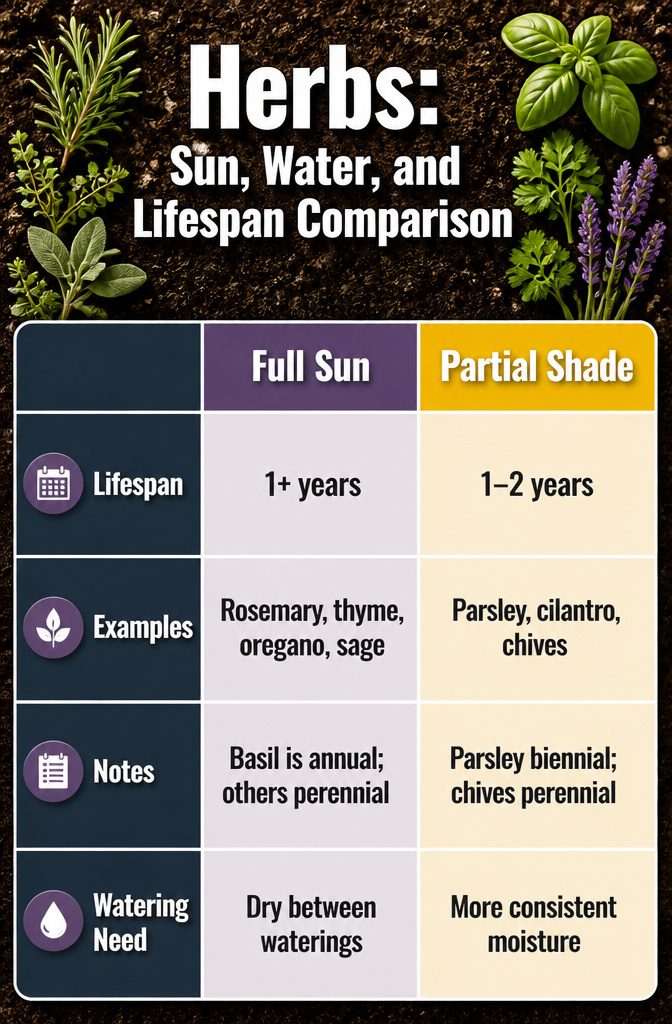
Most culinary herbs want at least six hours of direct sun daily, but the ones that don’t still need thoughtful placement.
Rosemary, thyme, oregano, sage, lavender, and basil all develop stronger flavor in full sun, while parsley, cilantro, chives, mint, and lemon balm handle partial shade, especially where afternoon heat is intense.
Watering splits along the same lines. Mediterranean herbs like rosemary and lavender prefer to dry between waterings; basil, parsley, cilantro, chives, and mint want more consistent moisture.
New plantings need steady moisture until roots establish, then the soil’s top inch can guide you rather than any fixed schedule.
Lifespan determines whether you’re planting once or planning for turnover:
| Herb Type | Lifespan | Examples | Notes |
|---|---|---|---|
| Full Sun | 1+ years | Rosemary, thyme, oregano, sage, lavender, basil | Basil is annual; others perennial |
| Partial Shade | 1–2 years | Parsley, cilantro, chives, mint, lemon balm | Parsley biennial; chives, mint perennial |
| Drought-Tolerant | Perennial mostly | Rosemary, thyme, sage, oregano, lavender | Struggle in wet climates |
| Moisture-Loving | Annual/biennial mostly | Basil, parsley, cilantro, chives, mint | Chives and mint perennial but need water |
Annuals like basil and cilantro complete their cycle in one season.
Biennials such as parsley and Florence fennel last two years, often self-sowing to appear perennial. True perennials including chives, oregano, and thyme return yearly if conditions suit them, though Mediterranean types may fail in wet winters regardless of hardiness zone.
Which Herbs to Keep Apart
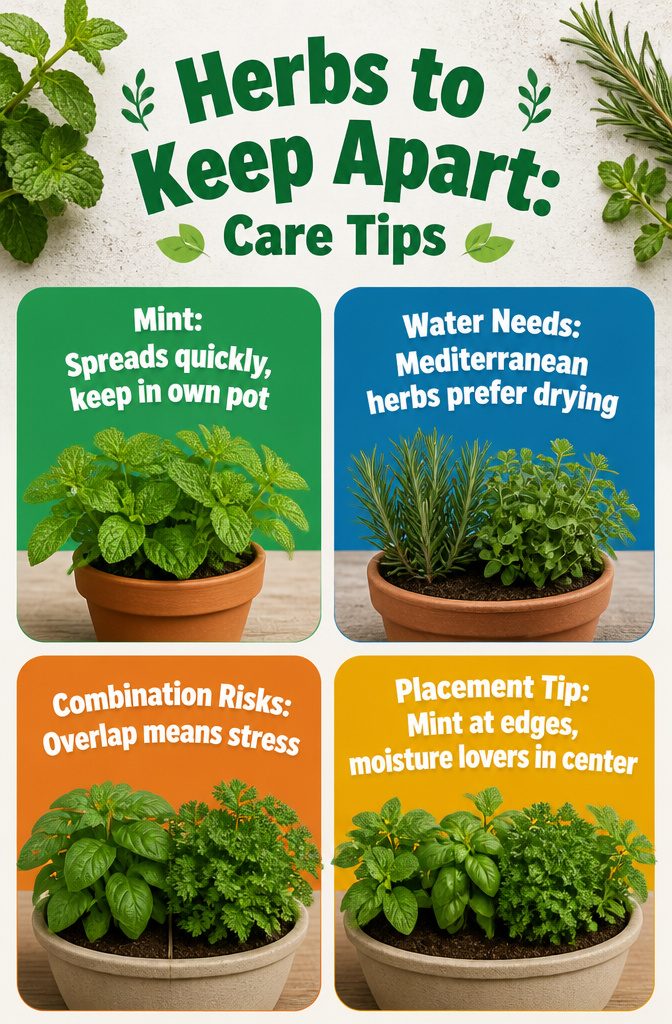
Mint sends underground runners at roughly four inches a month and will smother anything in its path if you let it.
Keep mint in its own pot, even if that pot sits among other herbs. I have seen it climb out of raised beds and into neighboring soil faster than most gardeners notice.
Anise hyssop and lemon balm spread the same way, just slower. Water preferences matter too.
Mediterranean herbs like rosemary and oregano want soil that dries between waterings, while basil and parsley stay thirsty. Pairing those two groups in the same container means one side is always stressed.
If you are working with a single planter, edge placement helps. Soil at the rim dries first, so mint-family plants go there while moisture-lovers sit toward the middle where water lingers longer.
Frequently Asked Questions
How much sunlight do herbs need?
Most culinary herbs need at least 6 hours of direct sunlight daily.
Rosemary, oregano, and basil sit at the hungriest end of that range and will stay sparse and leggy without full exposure. Parsley, cilantro, chives, mint, and lemon balm can tolerate partial shade, especially where afternoon heat is intense.
What are the best herbs for outdoor gardening?
Basil, thyme, rosemary, parsley, oregano, and chives are reliable choices for growing herbs outdoors.
Mediterranean perennials like rosemary, thyme, and oregano come back yearly, while annuals such as basil and cilantro complete their cycle in one season and need replanting each spring.
How often should I water my herbs?
Newly planted herbs need consistent moisture while roots establish; check the top inch of soil and water when it starts to feel dry.
Established herbs split by type: basil, parsley, cilantro, chives, and mint appreciate about an inch of water per week, while rosemary, thyme, sage, oregano, and lavender prefer to dry out between waterings and often survive on rainfall alone.
Can I grow herbs in containers?
Yes, many herbs thrive in containers, and pots are essential for aggressive spreaders like mint that would otherwise overrun a bed.
Containers let you group herbs by water needs and move tender perennials like rosemary indoors before frost. Use quality potting mix, keep drainage holes clear, and check daily since container soil dries faster than ground plantings.
What should I do with my herbs in winter?
Move tender herbs like basil indoors before the first hard freeze, and bring potted rosemary, thyme, sage, and lavender to a sunny window if your zone is too cold for them to survive outside.
For hardy perennials staying outdoors, skip late-season fertilizer and mulch lightly only after the ground turns cold, not before; warm mulch invites rodents and rot.
What herbs can grow outside all year long?
Thyme, oregano, and chives are hardy perennials that return on their own across most U.S. growing zones. Rosemary behaves as a true perennial only in warmer zones; elsewhere it needs winter protection or replacement.
Parsley is a biennial that lasts two years, while true annuals like basil and cilantro complete their life cycle in a single season and die with frost.
Do herbs regrow when you cut them?
Yes, regular harvesting encourages annual herbs to keep producing leaves instead of bolting to flower.
Snip stems just above a pair of healthy leaves and never remove more than one-third of the plant at once; that cut signals the stem to branch, giving bushier growth and a longer harvest window.
Morning picking, after dew dries but before afternoon heat, captures the highest concentration of essential oils.





